YouTuber builds working USB graphics card for 20 cents
Bitluni turned a 13-cent CH570 microcontroller into a monochrome USB graphics card using PWM video tricks and SRAM caching on a CRT TV.
AIXVZ
AI agents that sell for you. AIXVZ builds sales agents and automates routine business processes — from first contact to deal.
Learn more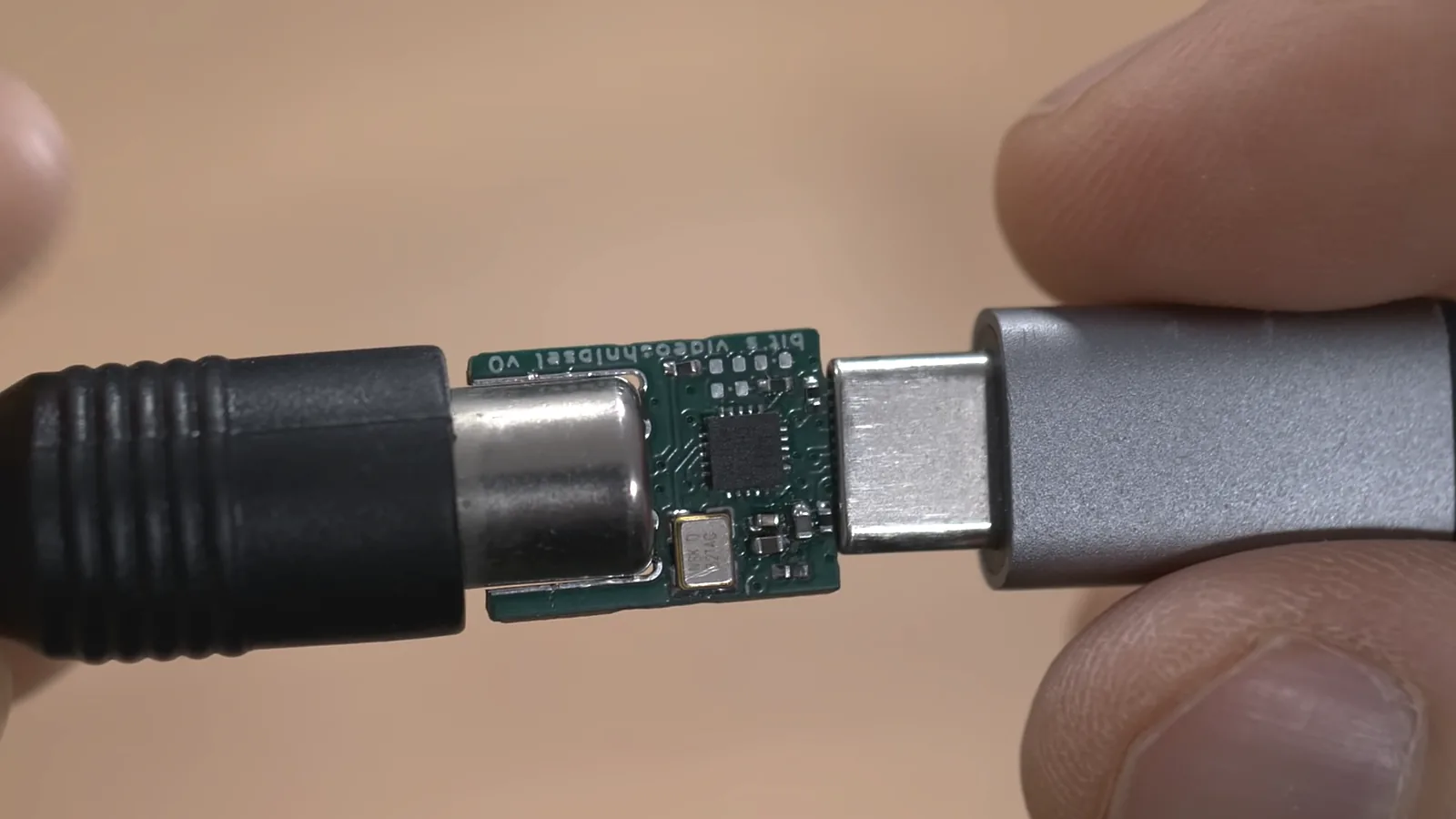
YouTuber Bitluni built a working monochrome graphics card from a single CH570 microcontroller, with about 20 cents worth of parts on a custom board. The chip itself cost 13 cents, and the project outputs text and simple animation to a CRT television over composite video. The build matters because it shows how far ultra-cheap silicon can be pushed with careful low-level programming.
How PWM video and cache delivered 24x speedup
The project centers on the CH570, the successor to the CH32V003 RISC-V microcontroller Bitluni had used in an earlier VGA experiment. He chose it for doubled RAM capacity plus integrated USB connectivity and Bluetooth. Since the CH570 has no digital-to-analog converter, he used a pulse-width modulator flipping rapidly on and off to approximate voltage levels, settling for 16 shades of gray rather than the 50 others might target. The same switching principle is used in modern Class D audio amplifiers for hi-fi, PA systems and instruments.
Memory remained the main constraint, so Bitluni first rendered text at half the possible vertical resolution. Output was extremely slow until he moved the active code into the CH570 SRAM cache, after which picture generation ran 24 times faster and supported a 34 by 37 character display. Further optimization produced a short low-resolution animation of Rick Astley dancing that was clearly recognizable. He then designed a simple PCB with room for the CH570, a USB-C connector and supporting parts, with boards costing 15 dollars for ten. The tiny board used an improvised RCA barrel connector formed from grooves.
Why ultra-cheap chips matter for makers
For hobbyists and hardware learners, the project is a practical lesson in tradeoffs between cost, memory and processing time. The USB connection was configured as a serial bus through USB CDC, letting the TV display what Bitluni typed. That step required several optimization passes because handling USB consumed CPU time slices needed for the video signal. As a side effect, a jumper wire on the development kit acted as an impromptu VHF antenna and almost locked the TV signal without a cable.
The result does not point to a consumer product or a replacement for conventional graphics hardware. It is a single-maker demonstration in monochrome composite video at low resolution, dependent on hand-tuned code and timing. It also does not show the CH570 running general computing or high-color graphics, and most users would still need standard microcontrollers, displays and interfaces for practical work.
// Read next
AI labs near cryptography breakthrough as expert panel prepares statement
A 21-expert cryptography panel lists a forthcoming statement as researchers point to an AI breakthrough in theoretical …
Musk: Google Wants to Rent More Computing Capacity From SpaceX
Elon Musk says Google is interested in renting additional computing power from SpaceX, a signal of how tight AI infrast…
RTX 5090 Cable Melt Triggers Air Quality Alarm in PC Owner Room
A Reddit user says a melting 12+4-pin cable on a Gigabyte RTX 5090 filled the room with particles and damaged the GPU p…
Amateurs use OpenAI tools to find possible exoplanets in NASA data
Two amateurs used OpenAI Codex and GPT-6.2 Astra to scan NASA Kepler and TESS data, surfacing signals that still need m…