Personal AI agents compared on memory, security and price
OpenClaw, Hermes, Gemini Spark, OpenAI dots and Meta Muse split into self-hosted and cloud camps, with very different trade-offs for memory, safety and cost.
AIXVZ
AI agents that sell for you. AIXVZ builds sales agents and automates routine business processes — from first contact to deal.
Learn more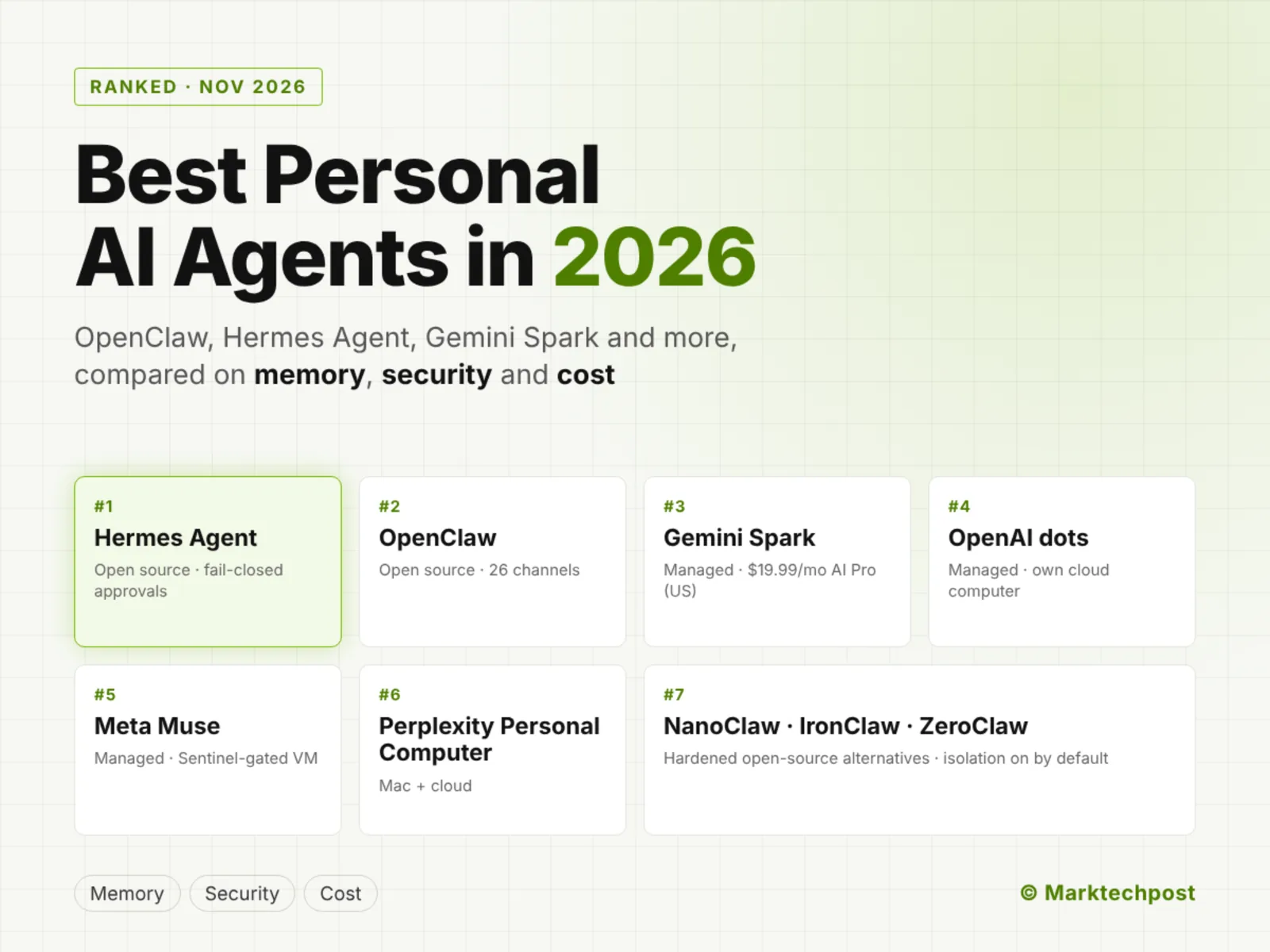
Personal AI agents that keep memory and work inside apps have moved from a weekend project to products from Google, OpenAI, Meta and Perplexity. The comparison by MarkTechPost ranks Hermes Agent, OpenClaw, Gemini Spark, OpenAI dots and Meta Muse on memory, security and cost, with prices current as of November 21, 2026. For readers it matters because an agent with inbox access and credentials can save time or create lasting risk.
Hermes, OpenClaw, Spark, dots and Muse ranked
Hermes Agent from Nous Research is open source and runs through a terminal UI, desktop app, local web dashboard and messaging gateways, with about 25 supported platforms as of October 2026 including Telegram, Slack, WhatsApp, Signal, Teams and email, plus native iMessage from June 2026. It stores persistent MEMORY. md and USER. md files, session history in SQLite with full-text search and summarization, and can turn completed tasks into reusable skills. OpenClaw, started in November 2025 as Clawdbot, reached version 2026.9.5 with a Gateway process, Control UI and 26 channels as of v2026.6, supporting models from OpenAI, Anthropic, Google, DeepSeek, xAI, Kimi, Ollama and OpenRouter.
Google unveiled Spark at I/O on May 19, 2026, running on Gemini 3.5 Flash with dedicated virtual machines in Google Cloud and native access to Gmail, Calendar, Drive, Docs, Sheets, Slides, YouTube and Maps. OpenAI launched dots at DevDay on September 29, 2026, each running on GPT-6 Astra with its own cloud computer and browser and plugins to more than 4,000 apps, reachable in ChatGPT, Slack, Teams or voice. Meta launched Muse on September 8, 2026 on its Muse Spark model, reachable through iOS, Android, muse. ai and WhatsApp, with a Mac app from September 19. The field divides into self-hosted agents on user hardware and managed agents on vendor cloud virtual machines.
What persistent agents mean for work and money
The practical split is control against convenience. Hermes and OpenClaw are free software where spending comes from model tokens plus hosting, with Nous Portal optional tiers at Free, 20, 100 and 200 dollars per month and managed OpenClaw hosts surveyed from about 12 to roughly 49 dollars per month. Spark is now included in the 20-dollar US AI Pro plan after launching on the 99.99-dollar AI Ultra plan, while a first OpenAI dot is included but reports differ on whether entry requires Pro 200 or Business Premium. Workers already centered on Google Workspace or ChatGPT get the smoothest setup, while developers comfortable with terminal setup get deeper memory control and model choice with self-hosted tools.
The ranking reflects fit for an individual user, not raw capability, and several limits remain. OpenClaw defaults to full host access, had CVE-2026-25253 for remote code execution, and audits found hundreds of malicious ClawHub skills, now scanned with VirusTotal. Hermes defaults to fail-closed approvals with denial after 300 seconds, but its documents state the denylist does not contain a compromised agent without OS-level isolation. Spark and dots restrict local access and add approval checks, yet Google tells users to supervise closely and availability excludes several regions including the EEA, Switzerland and the UK.
// Read next
AI labs near cryptography breakthrough as expert panel prepares statement
A 21-expert cryptography panel lists a forthcoming statement as researchers point to an AI breakthrough in theoretical …
Musk: Google Wants to Rent More Computing Capacity From SpaceX
Elon Musk says Google is interested in renting additional computing power from SpaceX, a signal of how tight AI infrast…
RTX 5090 Cable Melt Triggers Air Quality Alarm in PC Owner Room
A Reddit user says a melting 12+4-pin cable on a Gigabyte RTX 5090 filled the room with particles and damaged the GPU p…
YouTuber builds working USB graphics card for 20 cents
Bitluni turned a 13-cent CH570 microcontroller into a monochrome USB graphics card using PWM video tricks and SRAM cach…