Amateurs use OpenAI tools to find possible exoplanets in NASA data
Two amateurs used OpenAI Codex and GPT-6.2 Astra to scan NASA Kepler and TESS data, surfacing signals that still need months of follow-up checks.
AIXVZ
AI agents that sell for you. AIXVZ builds sales agents and automates routine business processes — from first contact to deal.
Learn more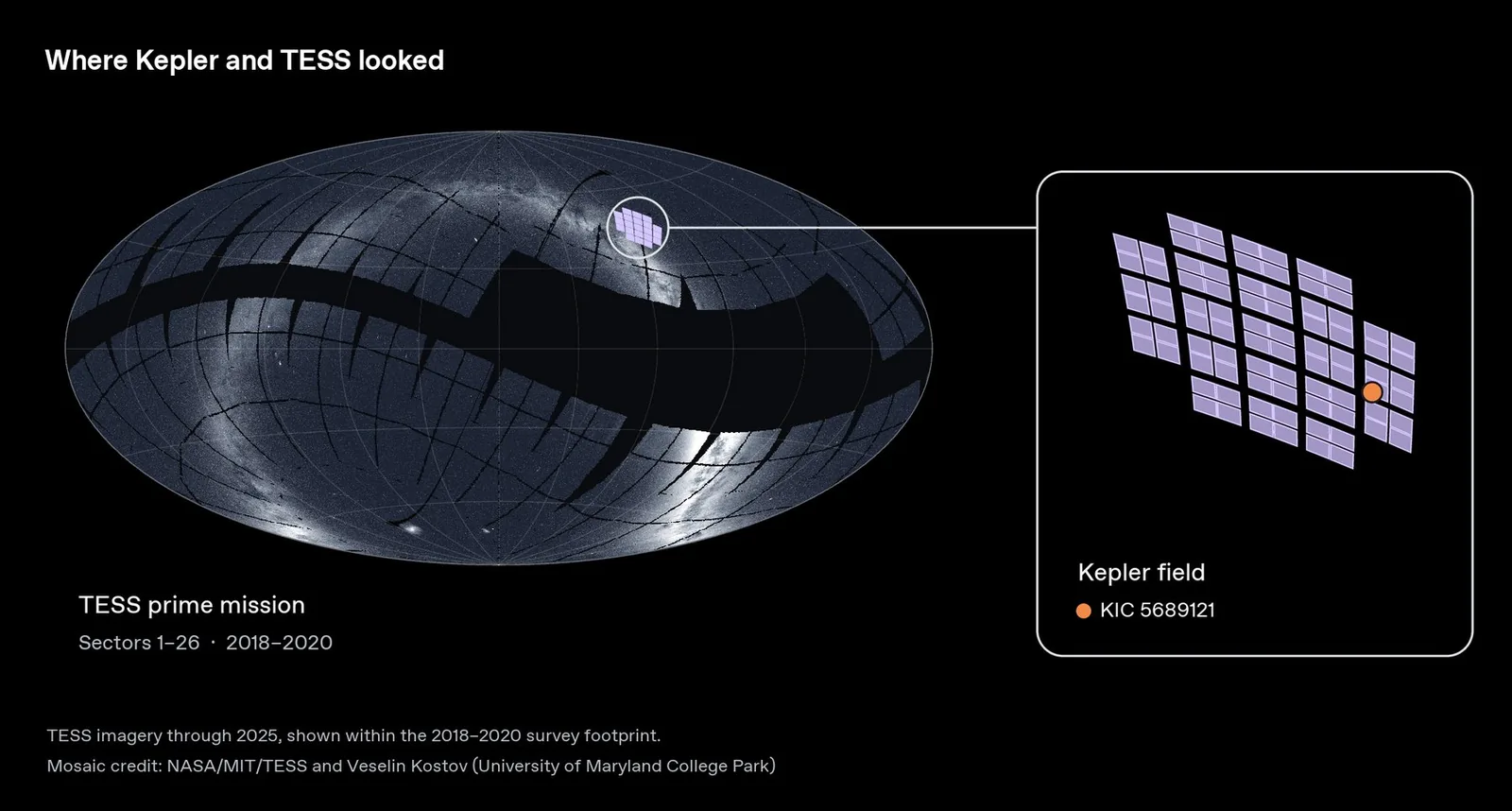
Two amateur astronomers used OpenAI software to search old NASA telescope data for exoplanets and surfaced signals that professional pipelines had missed. One search covered about 100,000 stars and produced two standout candidates, while a second search filtered 49 candidates from data on 19 million stars. The finds are unconfirmed, but a SETI Institute researcher independently found two of the signals.
Codex pipeline and Astra search flagged candidates
Kevin Bond, an OpenAI engineer and amateur astrophotographer, and Ethan Byrd, founder of the email startup Primitive, worked independently using OpenAI tools and public data from NASA telescopes. Both looked for transits, the small repeated dips in a star light curve that occur when a planet passes in front of its star as seen from Earth. Bond asked Codex to compare published search methods, combine them into one program, and test whether code changes improved detection. One AI agent scanned light curves from about 100,000 stars observed by the Kepler mission, which ran from 2009 to 2018, while a second agent reviewed flagged candidates in more detail.
The program reported more than 200 signals, including 10 from previously confirmed planets. Two stars stood out. KIC 5689121 in the constellation Lyra is cooler than the sun and about half its size, with light dips every 13.8 days that would fit a planet about 2.4 times Earth diameter. KIC 6691030 shows a dip every 4.8 days that would fit a planet smaller than Neptune. Vishal Gajjar, who oversees international SETI programs at the SETI Institute, found both signals in a separate search and said the pipeline turned up candidates conventional searches may have missed. Byrd had GPT-6.2 Astra design two searches, one broad and one focused on the habitable zone where a planet with the right atmosphere could hold liquid water. Using data from NASA TESS satellite, launched in 2018, and other public archives, the first run produced 49 candidates, with one sent to TESS researchers for closer review.
Signals need months of checks before confirmation
For readers watching AI and science work, the practical change is access to research-grade analysis without a lab or observatory. Public Kepler and TESS archives plus AI coding help let skilled amateurs build detection pipelines, review literature, write software, and run initial checks. Byrd plans to submit two more candidates, and his search is still underway. OpenAI launched GPT-6.2 Astra in mid-November as a model for scientists, and it recently produced a machine-verifiable proof of a math theorem without human intervention. AI-assisted discovery is already established: in 2017 researchers trained a neural network on 15,000 vetted Kepler signals and found an eighth planet around Kepler-90, and more than 6,400 exoplanets have been confirmed so far.
A dip in starlight does not prove a planet exists. Eclipsing binary stars can produce similar signals, and temperature swings aboard a telescope can affect instruments and make a star look dimmer. Astronomers vet candidates statistically or use follow-up methods such as radial velocity, which measures how a planet gravity tugs its star. Gajjar called the initial checks encouraging, but said follow-up observations will have to show what is behind the signals, a process OpenAI says can take months or years. The SETI Institute and Breakthrough Listen also use AI to operate the Allen Telescope Array and analyze radio signals.
// Read next
AI labs near cryptography breakthrough as expert panel prepares statement
A 21-expert cryptography panel lists a forthcoming statement as researchers point to an AI breakthrough in theoretical …
Musk: Google Wants to Rent More Computing Capacity From SpaceX
Elon Musk says Google is interested in renting additional computing power from SpaceX, a signal of how tight AI infrast…
RTX 5090 Cable Melt Triggers Air Quality Alarm in PC Owner Room
A Reddit user says a melting 12+4-pin cable on a Gigabyte RTX 5090 filled the room with particles and damaged the GPU p…
YouTuber builds working USB graphics card for 20 cents
Bitluni turned a 13-cent CH570 microcontroller into a monochrome USB graphics card using PWM video tricks and SRAM cach…