X-VPN claims 200% speed gain with 25 Gbps servers and Talaria protocol
X-VPN says its Talaria protocol and 25 Gbps servers tripled speeds in internal tests, with an independent audit and open-source release attached.
AIXVZ
AI agents that sell for you. AIXVZ builds sales agents and automates routine business processes — from first contact to deal.
Learn more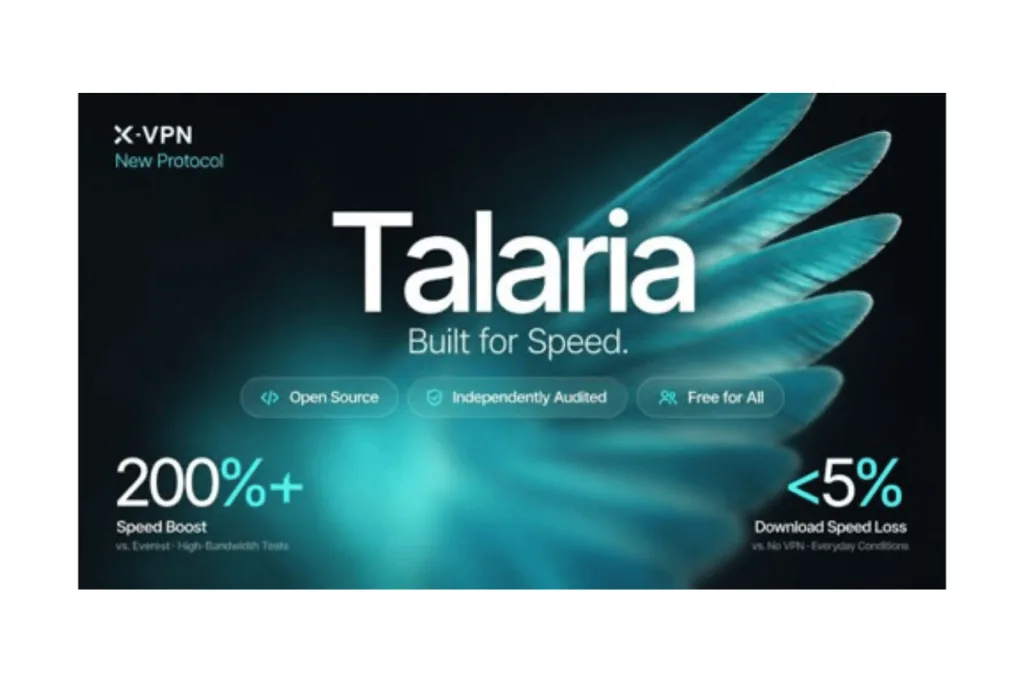
X-VPN has rolled out a network-wide speed upgrade centered on its new in-house Talaria protocol. In internal 10 Gbps tests, Talaria delivered over 200% aggregate improvement in download and upload speeds compared with the company's previous best-performing protocols. The change matters for remote workers and travelers because VPN overhead often slows video calls, file transfers and cloud work.
Talaria tests, 25 Gbps servers and AI routing
X-VPN said it introduced servers with 25 Gbps port capacity in the United States and Canada, alongside 10 Gbps infrastructure in Germany, Spain, the Netherlands, the UK, Italy and Singapore. More than 90% of its VPN traffic in the US and Europe can now be served by 10 Gbps or 25 Gbps infrastructure. New bare-metal configurations feature 64 CPU cores and 128-256 GB of memory to handle simultaneous connections and large volumes of traffic.
Internal speed tests covered Windows, macOS, Android and iOS, with connections originating in Singapore and reaching servers in Singapore, the UK and the US. In one 10 Gbps Windows test to a Singapore server, median download speed rose from 1,536 Mbps with the previous protocol to 5,706 Mbps with Talaria. In separate 1 Gbps tests, Talaria kept download speed loss below 2% versus connections without a VPN on Windows and macOS. The company's SmartEntry Adaptive Mesh and PrivacyRoute Fabric system prioritizes promising entry nodes in time-limited batches and stops remaining attempts once one authenticates.
What faster VPN paths mean for work and privacy
For people who keep a VPN on during the workday, the practical effect would be less slowdown during large downloads, backups and high-resolution streaming. X-VPN attributes the gains not only to bandwidth but to reduced data copying and repeated processing. Windows uses an upgraded kernel data driver, macOS uses more balanced multicore scheduling, while Android and iOS use larger data batches on supported paths. On servers, prefetching, batched writes and flow-level forwarding are used to process packets in groups rather than one by one. Talaria gives each application connection its own transport channel so multiple streams can be processed independently across CPU cores.
These figures reflect X-VPN internal testing under defined configurations, and actual performance may vary by device, network environment and server. Talaria includes TLS 1.3, hybrid post-quantum key exchange, authenticated encryption and replay protection. Singapore-based Vantage Point Security conducted a white-box review and penetration test, found no security vulnerabilities, and verified fixes for four observations. The protocol code is publicly available on GitHub under AGPL v3. Talaria is available to free and premium users on Windows, macOS, Android and iOS, with optimizations varying by platform.
// Read next
AI labs near cryptography breakthrough as expert panel prepares statement
A 21-expert cryptography panel lists a forthcoming statement as researchers point to an AI breakthrough in theoretical …
Musk: Google Wants to Rent More Computing Capacity From SpaceX
Elon Musk says Google is interested in renting additional computing power from SpaceX, a signal of how tight AI infrast…
RTX 5090 Cable Melt Triggers Air Quality Alarm in PC Owner Room
A Reddit user says a melting 12+4-pin cable on a Gigabyte RTX 5090 filled the room with particles and damaged the GPU p…
YouTuber builds working USB graphics card for 20 cents
Bitluni turned a 13-cent CH570 microcontroller into a monochrome USB graphics card using PWM video tricks and SRAM cach…