Willo builds wireless power zones that charge moving robots
Finnish startup Willo demonstrated room-scale wireless charging at Slush and now targets robotics makers with pilot deployments planned in 18 to 24 months.
AIXVZ
AI agents that sell for you. AIXVZ builds sales agents and automates routine business processes — from first contact to deal.
Learn more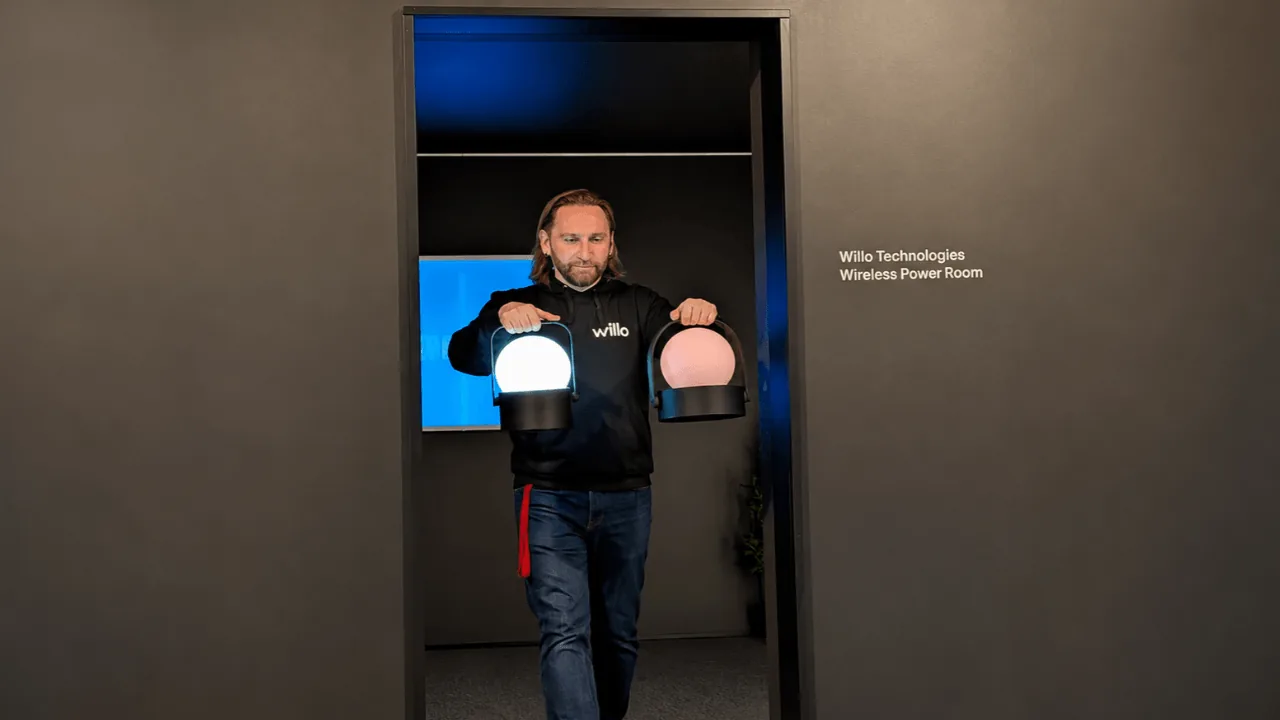
Finnish startup Willo Technologies demonstrated a system that powers drones, robotic trucks and lamps inside an enclosed space without cables, pads or alignment. The Aalto University spinout, which raised 2.9 million euros earlier this year, calls it a three-dimensional power zone where multiple devices can charge while moving or rotating. For workers and households, it points to rooms where machines top up simply by being inside.
PowerBubble and wireless room shown at Slush
At Slush in Helsinki, co-founder and chief executive Harri Santamala and co-founder and chief technology officer Nam Ha-Van showed two implementations built on the same concepts. A PowerBubble generated a strong power field for drones and robotic trucks without cables or pads, while a wireless room created a uniform zone where lamps operated wirelessly. Both allow devices to draw power from any position and orientation, without a direct line of sight or precise placement within millimetres.
The system operates at 6.78 MHz inside the industrial, scientific and medical band, which the company says simplifies certification. Its hub-based technology is at Technology Readiness Level 5, meaning validation in a relevant environment. The work builds on more than a decade of research by a seven-person team combining postdoctoral researchers and hardware veterans with experience at Oura, Nokia and Microsoft. In September 2026 Willo signed a 12-month joint research agreement with Chiba University and Professor Hiroo Sekiya to study stable operation as devices move and power needs fluctuate.
What room-scale charging means for work
The near-term use is robotics and automation rather than phones and laptops. Willo says it is targeting robotics equipment makers and hardware manufacturers as a technology partner, with pilot deployments next and commercial rollout in 18 to 24 months if customer specifications fit current capabilities. In warehouses and factories where robots return to the same area repeatedly, even a confined power field could keep fleets running without docks, connectors and cable wear. The technology debuted publicly at CES 2026 and won CNET Best of CES, but consumer electronics will require support from large device makers.
The system is still early and its range is expected to increase only over time. Stable delivery when devices enter, leave or draw different power, and when people and obstacles are present, remains the core engineering challenge now studied with Chiba University. Commercial timing depends on individual manufacturers, and consumer adoption faces a chicken-and-egg problem of getting device makers on board. The account describes company claims and demonstrations, not independent test results or certified products.
// Read next
AI labs near cryptography breakthrough as expert panel prepares statement
A 21-expert cryptography panel lists a forthcoming statement as researchers point to an AI breakthrough in theoretical …
Musk: Google Wants to Rent More Computing Capacity From SpaceX
Elon Musk says Google is interested in renting additional computing power from SpaceX, a signal of how tight AI infrast…
RTX 5090 Cable Melt Triggers Air Quality Alarm in PC Owner Room
A Reddit user says a melting 12+4-pin cable on a Gigabyte RTX 5090 filled the room with particles and damaged the GPU p…
YouTuber builds working USB graphics card for 20 cents
Bitluni turned a 13-cent CH570 microcontroller into a monochrome USB graphics card using PWM video tricks and SRAM cach…