US courts authorize action on $1.2B in Binance theft as return stays
US authorities won court authority over $1.2 billion linked to the October Binance theft, but forfeiture and repayment to victims remain unresolved.
AIXVZ
AI agents that sell for you. AIXVZ builds sales agents and automates routine business processes — from first contact to deal.
Learn more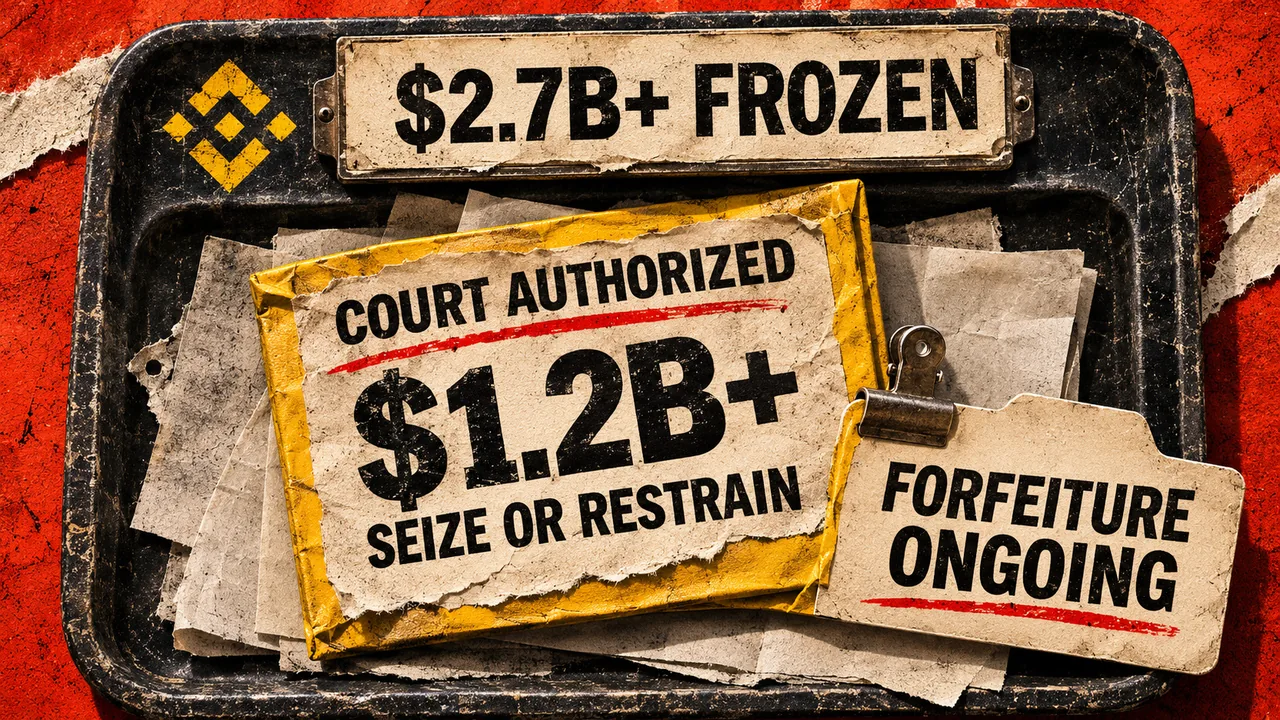
US authorities have received court authorization to seize or restrain more than $1.2 billion linked to funds stolen from Binance, moving the recovery effort forward without yet returning money. The Department of Justice disclosed the authorization on Nov. 12, while saying tracing, freezing, seizure and forfeiture work was still ongoing. For holders and exchange users, the distinction matters because frozen funds are not the same as recovered funds.
Court authority covers part of frozen assets
The $1.2 billion figure identifies the portion for which the Department of Justice reports seizure or restraint authority. That pool sits inside more than $2.7 billion frozen through combined US government and private-sector efforts, according to the department. The larger number measures the combined freezing effort, while the smaller number defines the scope of court-backed action. The announcement did not break down how much falls into seizure versus restraint, and did not announce completed forfeiture or a timetable for returning the money.
The case concerns a theft of more than $6 billion on or about Oct. 29, which the Department of Justice attributes to North Korean military actors known as TraderTraitor. Its account said the attackers continued laundering the assets through cryptocurrency bridges, mixers and exchanges. Binance addressed the incident in a Nov. 3 incident report, promising to absorb the financial impact of the stolen funds and saying it had set aside more than 100% of what it would need to cover the loss. The Nov. 12 announcement leaves unanswered how much is ultimately forfeited, who receives the assets, and when any return occurs.
Why frozen crypto is not yet returned money
For a normal crypto user, the practical point is that court authorization is an intermediate legal step. Before remission can occur, the government must identify, seize, and forfeit assets, and the release describes forfeiture efforts as ongoing. The eventual recipients and distribution route remain unspecified. That means customers should not treat frozen totals as funds already secured for repayment, even where an exchange has separately promised to cover losses from its own resources.
The story does not prove that victims will be repaid in full, in crypto or in cash, or on any particular schedule. It also does not establish that the entire $2.7 billion frozen amount is under court control, only the portion above $1.2 billion described as authorized for seizure or restraint. The update applies to this Binance theft case and the identified laundering activity, not to other exchange incidents or frozen funds more generally.
// Read next
FT: Russian VC revealed as multibillion-dollar Tether co-owner
Vitaly Bezrodnykh, founder of Fulgur Ventures, holds a previously undisclosed multibillion-dollar stake in Tether, per …
Binance wins conditional approval for Bhutan regional hub
Binance received in-principle approval from Bhutan’s Gelephu Central Bank to build an Asia hub, weeks after a $6.3 bill…
Bitcoin and gold are 2026's worst-performing major assets
Bitcoin is down 32% in 2026 and gold 16%, placing both at the bottom of the year's major-asset rankings — a pairing mar…
Kalshi fights states over prediction market taxes and gambling rules
New York, New Jersey and Kentucky are testing whether federal oversight shields Kalshi from state gambling laws as Bern…