TSMC unveils AI Design Kit to speed up chip development on A14
TSMC introduced its AI Design Kit in Munich to help AI agents automate chip layout for advanced nodes, starting with A14, as design complexity keeps rising.
AIXVZ
AI agents that sell for you. AIXVZ builds sales agents and automates routine business processes — from first contact to deal.
Learn more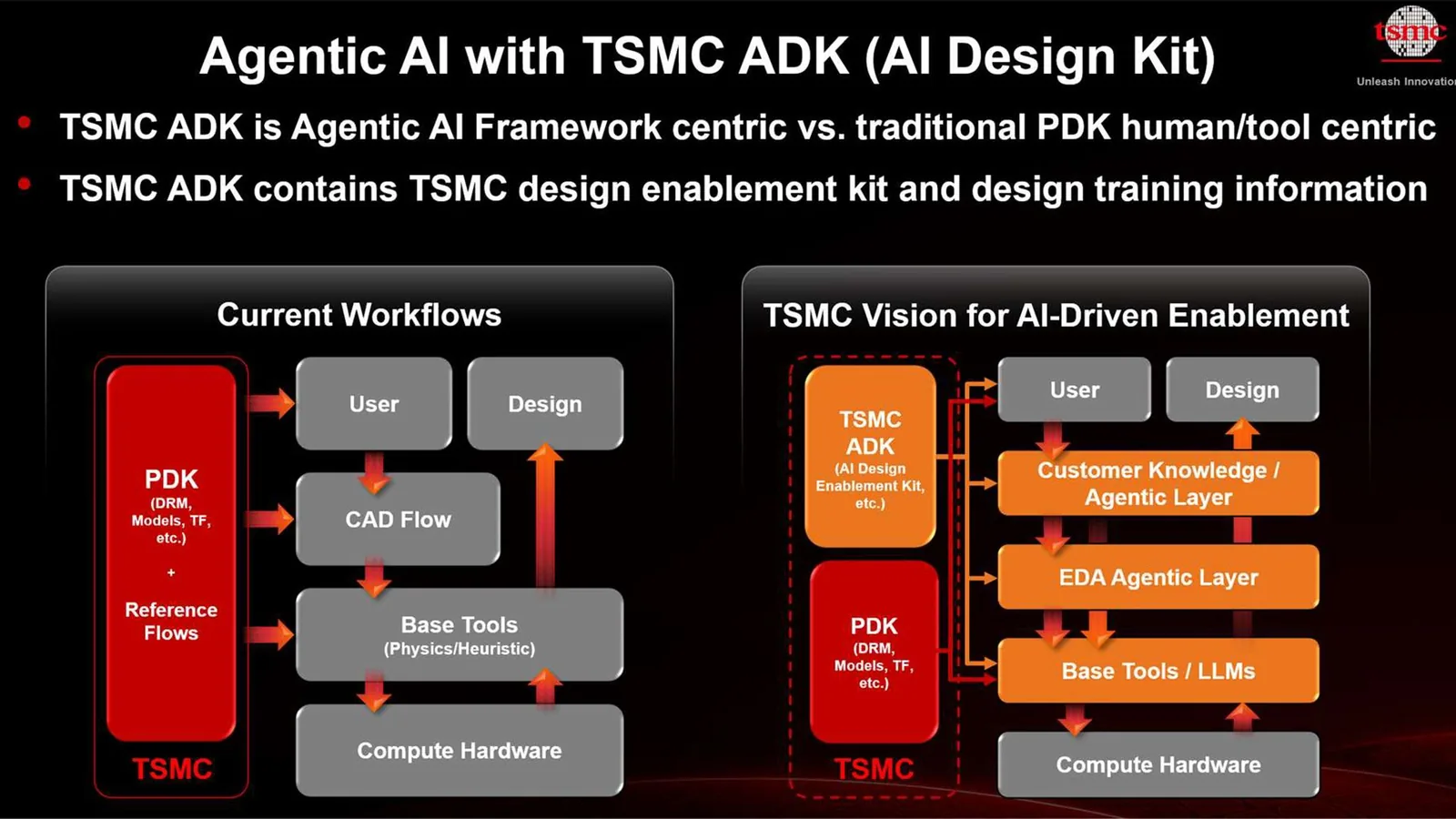
TSMC unveiled its AI Design Kit (ADK) at the 2026 Europe OIP Ecosystem Workshop in Munich, a package that lets AI agents automate chip development using foundry expertise. The first node supported will be A14, where design rules are 3.6 times more numerous than on N5-derived technologies. The move matters because customers want to cut chip development cycles from 18 months to 12 months even as leading-edge nodes get harder to use.
How ADK automates chip layout and optimization
TSMC said the ADK complements its traditional process design kits (PDKs) with process-specific information, implementation guidelines and design methodologies for AI agents. It combines TSMC technology knowledge, electronic design automation tool expertise and customers proprietary design methods to automate physical implementation and optimization. The company head of ecosystem and alliance management Aveek Sarkar said the goal is to layer TSMC technology-specific learning with customer orchestration and design expertise to support next-generation design flows.
Complexity is the driver. Compared with N5-derived nodes including N4 variants, design rules rose by 2.3 times on N3P, 3.1 times on N2P and 3.6 times on A14, while standard library cells rose by 2.8 times, 5 times and 4.6 times respectively. With more metallization stack options and EDA tool settings, possible configurations become massive and conventional optimization approaches reach productivity limits, according to TSMC. Agentic AI could help explore more options faster, improve power, performance and area results, and ease adoption of new processes.
What faster chip design means for jobs and costs
Early ADK includes metal pitches, standard cell heights, routing track patterns, library naming conventions and guidelines. EDA agents such as Cadence InnoStack or Synopsys Implementation Agent can take a natural-language prompt and generate a qualified automatic placement and routing reference flow for A14, covering setup, cell usage, placement and routing optimization, power grid and wide-wire configuration. Work that took engineers weeks of script preparation can be started from a prompt, though TSMC did not disclose exact time savings. An orchestration agent at the customer site then coordinates diagnostics, power grid, timing closure, design rule checks and congestion tasks across floorplanning, placement, clock synthesis, routing, sign-off and engineering change orders, running iterations around the clock.
The ADK does not replace PDKs or EDA software from Cadence, Synopsys, Siemens EDA and others, and it focuses on physical implementation rather than architecture or logic design. TSMC disclosed no quantified power, performance and area gains, no measured cycle reduction and no commercial availability date. Smaller fabless firms could access advanced methods without large in-house teams, while deeper integration of foundry-specific data and orchestration could also make switching foundries harder, extending TSMC advantages beyond process technology itself.
// Read next
AI labs near cryptography breakthrough as expert panel prepares statement
A 21-expert cryptography panel lists a forthcoming statement as researchers point to an AI breakthrough in theoretical …
Musk: Google Wants to Rent More Computing Capacity From SpaceX
Elon Musk says Google is interested in renting additional computing power from SpaceX, a signal of how tight AI infrast…
RTX 5090 Cable Melt Triggers Air Quality Alarm in PC Owner Room
A Reddit user says a melting 12+4-pin cable on a Gigabyte RTX 5090 filled the room with particles and damaged the GPU p…
YouTuber builds working USB graphics card for 20 cents
Bitluni turned a 13-cent CH570 microcontroller into a monochrome USB graphics card using PWM video tricks and SRAM cach…