Tencent open-sources DFly2 to speed up sparse AI models
Tencent released DFly2, a 0.85B speculative decoder that reuses sparse KV cache and lifted throughput by up to 81% on long-context coding tasks.
AIXVZ
AI agents that sell for you. AIXVZ builds sales agents and automates routine business processes — from first contact to deal.
Learn more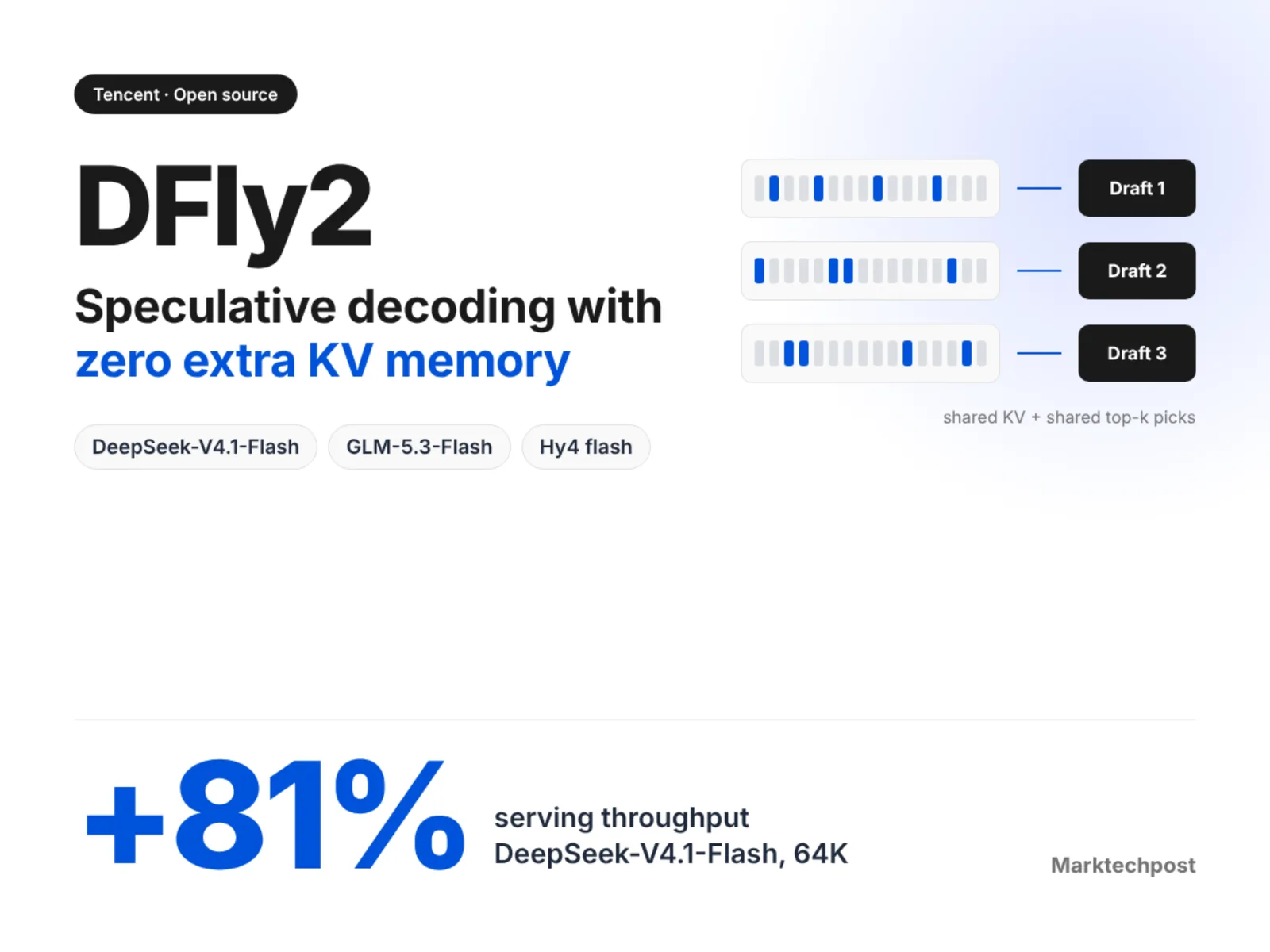
Tencent has open-sourced DFly2, a speculative decoding drafter built for natively sparse large language models. The 0.85B-parameter, 5-layer drafter ships with Hy4 flash and targets DeepSeek-V4.1-Flash, GLM-5.3-Flash and Hy4 flash. Its key claim is up to 81% more serving throughput on DeepSeek-V4.1-Flash at 64K context, a result that matters because long-context agents are now limited by memory and decoding cost.
How DFly2 shares cache and cuts memory
DFly2 comes from Tencent Hunyuan AI Infra team and is described in the paper DFly2: Turbocharging Long-Context Speculative Decoding by Sharing the Target Sparsity. Speculative decoding uses a small drafter to propose tokens that the larger target model verifies in one pass, keeping output lossless. DFly2 pairs each draft layer with one sparse attention layer in the target and shares two things: the paired layer latent KV cache and the indexer selection of top-k positions. Each draft layer starts from its paired target layer weights, while the target last-layer hidden state is gated into the draft block with intra-block correction slot by slot.
Conventional drafters attend over the whole prefix and store their own KV cache, which competes with concurrency in long-context serving. DFly2 keeps no KV cache of its own and skips prefill entirely, with prefill-to-decode transfer adding only one last-layer hidden state. Each draft token attends to at most about 2K keys, so drafting cost stays roughly flat at any context length. On DeepSeek-V4.1-Flash, a selection made one step early covers close to 90% of what later block tokens select, while a same-size sliding window recovers less than 20%. At 32K context, removing the drafter cache lets the same memory pool hold 1.73 times as many requests.
Benchmark gains and limits for AI workloads
For teams serving long documents, code agents and chatbots, the reported gains translate into more concurrent users or faster per-user decoding on the same GPUs. Serving tests used Nvidia H20 GPUs with vLLM, TP8 per instance, while the Hy4 flash vLLM recipe defaults to 8x H200. At matched per-user decode speed versus DSpark on DeepSeek-V4.1-Flash, Tencent reports 28% more throughput on short text, 62% on CodeSpan 64K and 81% on SWE 64K. At matched throughput, each user decodes 15% to 24% faster. End-to-end greedy speedup at concurrency one is 2.97x on DeepSeek-V4.1-Flash, 2.36x on GLM-5.3-Flash and 3.19x on Hy4 flash. Deployment is via tencent/Hy4-flash, a 220B-total, roughly 12B-active mixture-of-experts model with 1M context, served in vLLM and SGLang, with training for other sparse models via AngelSpec on one 8-GPU node.
All benchmark numbers are self-reported by Tencent, with DFlash and DSpark retrained on the same recipe as baselines. The margin over the stronger baseline is 3.9% to 10.5% in average accepted length on general workloads, rising to 10.0% to 31.5% on long-context and agentic workloads up to 128K. On agentic sets DFly2 stays within 4% of its general average, while DSpark falls by 11% to 21%. The smallest win is only 3.9% over DSpark on Hy4 flash general tasks at temperature zero. Separate Hy4 flash agentic claims of up to 4.2x faster decoding and about 30% over same-recipe DSpark come from the company announcement, not independent testing, so buyers should wait for third-party serving tests before planning capacity.
// Read next
AI labs near cryptography breakthrough as expert panel prepares statement
A 21-expert cryptography panel lists a forthcoming statement as researchers point to an AI breakthrough in theoretical …
Musk: Google Wants to Rent More Computing Capacity From SpaceX
Elon Musk says Google is interested in renting additional computing power from SpaceX, a signal of how tight AI infrast…
RTX 5090 Cable Melt Triggers Air Quality Alarm in PC Owner Room
A Reddit user says a melting 12+4-pin cable on a Gigabyte RTX 5090 filled the room with particles and damaged the GPU p…
YouTuber builds working USB graphics card for 20 cents
Bitluni turned a 13-cent CH570 microcontroller into a monochrome USB graphics card using PWM video tricks and SRAM cach…