Stanford Researchers Claim Practical Witness Encryption for Bitcoin
Stanford and Byzantine Research say their Praxis scheme cuts witness encryption costs by ten orders of magnitude, potentially enabling Bitcoin bridges without operators.
AIXVZ
AI agents that sell for you. AIXVZ builds sales agents and automates routine business processes — from first contact to deal.
Learn more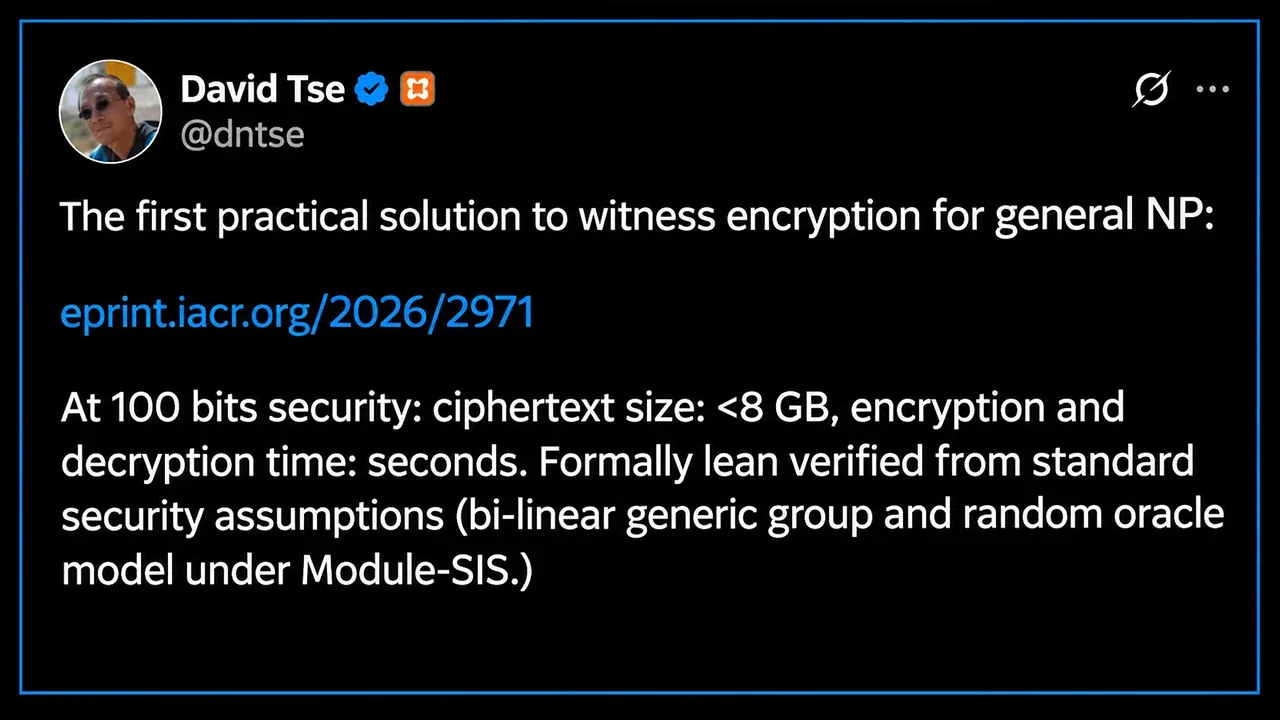
Stanford University professor David Tse with Byzantine Research colleagues Nikhil Vanjani and Psi Vesely introduced Praxis on Nov. 23, 2026, a witness encryption scheme for general NP statements. The construction produces a 7.88 GiB ciphertext at the 100-bit security level, down from more than 110 billion GiB in an earlier 2026 design. If validated, it could enable Bitcoin bridges and conditional payments without changing Bitcoin consensus rules.
How Praxis cuts encryption costs by ten orders
The paper, titled “Praxis: Practical Witness Encryption for NP” and published through the International Association for Cryptologic Research, addresses a cryptographic idea first proposed in 2013 by Sanjam Garg, Craig Gentry, Amit Sahai and Brent Waters. Witness encryption reverses normal encryption: a message is locked to a mathematical statement, and anyone holding evidence that satisfies it can decrypt. That evidence, called a witness, could show a payment occurred, a computation was correct, or a blockchain reached a set length, with no key to distribute. Praxis uses Groth16 with the BN254 elliptic curve, with one fixed verification key for every NP relation and conditions expressible through programs written in Rust.
Praxis reduces ciphertext size and encryption costs by more than ten orders of magnitude compared with the construction by Hair and Sahai, and decryption costs by more than six orders of magnitude. Encryption needs about 20 billion base-field multiplications and 12 GB of memory, while decryption with a valid proof needs an average of 8.6 billion multiplications and about 5 GB when the ciphertext is streamed. The researchers estimate both operations run within seconds on a laptop. Gains come partly from replacing enormous matrices with smaller components combined through cryptographic pairings, and from trading polynomial-time decryption for a bounded search. Security is argued in bilinear generic group and random oracle models under the Module-SIS lattice assumption, with machine-checked proofs in Lean 4.
What trustless bridges could mean for holders
For Bitcoin, the appeal is enforcing complex spending conditions without expanding its limited scripting language. Instead of Bitcoin verifying a computation, developers could encrypt the material needed to spend bitcoin against a statement that the computation was done correctly. A bridge withdrawal could require a valid proof that assets were withdrawn or destroyed on another chain; whoever holds that proof decrypts the spending data and Bitcoin processes a normal transaction. Robin Linus said if the work survives peer review it will fundamentally improve Bitcoin bridges by removing operators and making deposits and withdrawals non-interactive. Researcher Eric Wall suggested Bitcoin might be technologically saved, while other cited uses include atomic swaps, private auctions, time-locked payments and covenants.
The paper remains research, not production code. The Groth16 implementation needs an honest trusted setup: retained secret randomness could allow fabricated proofs and decryption under that verification key, so removing bridge operators does not remove all trust. A 7.88 GiB ciphertext cannot go directly into Bitcoin transactions and needs reliable off-chain storage and distribution. Independent peer review is still required to confirm the security claims and practical limits.
// Read next
FT: Russian VC revealed as multibillion-dollar Tether co-owner
Vitaly Bezrodnykh, founder of Fulgur Ventures, holds a previously undisclosed multibillion-dollar stake in Tether, per …
Binance wins conditional approval for Bhutan regional hub
Binance received in-principle approval from Bhutan’s Gelephu Central Bank to build an Asia hub, weeks after a $6.3 bill…
Bitcoin and gold are 2026's worst-performing major assets
Bitcoin is down 32% in 2026 and gold 16%, placing both at the bottom of the year's major-asset rankings — a pairing mar…
Kalshi fights states over prediction market taxes and gambling rules
New York, New Jersey and Kentucky are testing whether federal oversight shields Kalshi from state gambling laws as Bern…