Sim-trained robot model completes 18 of 30 real-world trials
Researchers say a 27-billion-parameter open-weight model learned pickup and alignment in simulation, then ran on an untrained dual-arm robot with mixed results.
AIXVZ
AI agents that sell for you. AIXVZ builds sales agents and automates routine business processes — from first contact to deal.
Learn more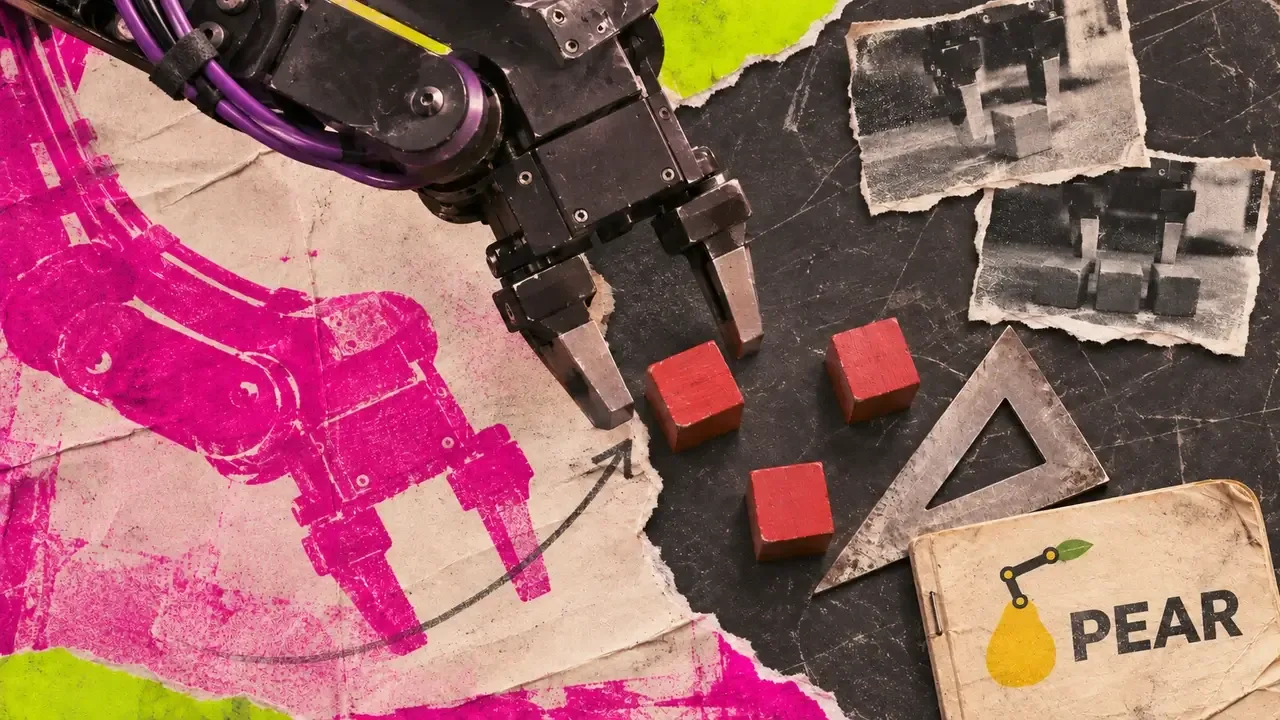
Researchers behind PEAR reported that a robot-control model completed 18 of 30 physical trials after learning its skills entirely in simulation, compared with zero for the base model. The preprint submitted Nov. 13 describes post-training of Qwen3.8-27B, an open-weight reasoning model with 27 billion parameters, using reinforcement learning without demonstrations. The finding matters because it tests whether simulated practice can carry over to different physical hardware without direct training on it.
Pickup and alignment tests on untrained hardware
The physical test used a dual-arm YAM robot, which none of the compared models received training on in this study. It included 20 pickup attempts across ten objects and ten alignment attempts across five block layouts, with each object or layout tried twice. The final model succeeded in 12 pickup attempts and six alignment attempts. A checkpoint trained only on the LIBERO simulation benchmark completed seven of the 30 trials. The final model had continued training on the corresponding two tasks in RoboDojo using a different robot.
At each turn, the model reads camera images and the robot state, reasons in text, and specifies changes to the gripper pose. Inverse kinematics translates the target pose into joint movements, which a controller executes. The prompt supplies coordinate frames, gripper orientation, cameras, and task-completion conditions, and the authors acknowledge that performance depends on those descriptions. All three models used the same high reasoning-effort setting, with trials having a 25-round budget and failing if a single round exceeded 32,000 reasoning tokens. Successful attempts by the final model required 7 to 24 rounds.
Speed demo used different model precision
The speed figures describe a different operating setup from the physical evaluation. The authors say reasoning before every move slows tasks. Their separate decoding demonstration reached 747 tokens per second on a GB300 using lower-precision NVFP4 weights and DFlash2, a decoding accelerator. That suggests about 4.3 seconds to generate an average high-effort reasoning round. The reported evaluations used BF16 weights because quantization reduced accuracy, so the speed demonstration and physical success rate describe different operating conditions. The public PEAR repository provides training infrastructure and deployment recipes.
The result remains an author-reported experiment pending independent replication, and turning it into a broadly useful robot system will require wider task coverage and shorter reasoning delays. The paper covers only pickup and block alignment, both practiced in simulation before the real-robot test. It does not show transfer to unpracticed task types, other robots, or production settings, and the base-model comparison does not establish general robot competence.
// Read next
FT: Russian VC revealed as multibillion-dollar Tether co-owner
Vitaly Bezrodnykh, founder of Fulgur Ventures, holds a previously undisclosed multibillion-dollar stake in Tether, per …
Binance wins conditional approval for Bhutan regional hub
Binance received in-principle approval from Bhutan’s Gelephu Central Bank to build an Asia hub, weeks after a $6.3 bill…
Bitcoin and gold are 2026's worst-performing major assets
Bitcoin is down 32% in 2026 and gold 16%, placing both at the bottom of the year's major-asset rankings — a pairing mar…
Kalshi fights states over prediction market taxes and gambling rules
New York, New Jersey and Kentucky are testing whether federal oversight shields Kalshi from state gambling laws as Bern…