Silicon Valley AI workers turn to monastery amid doom fears
A Vermont monastery called Maple recruits burned-out AI workers with promises of salvation from extinction, while ex-members allege surveillance and manipulation.
AIXVZ
AI agents that sell for you. AIXVZ builds sales agents and automates routine business processes — from first contact to deal.
Learn more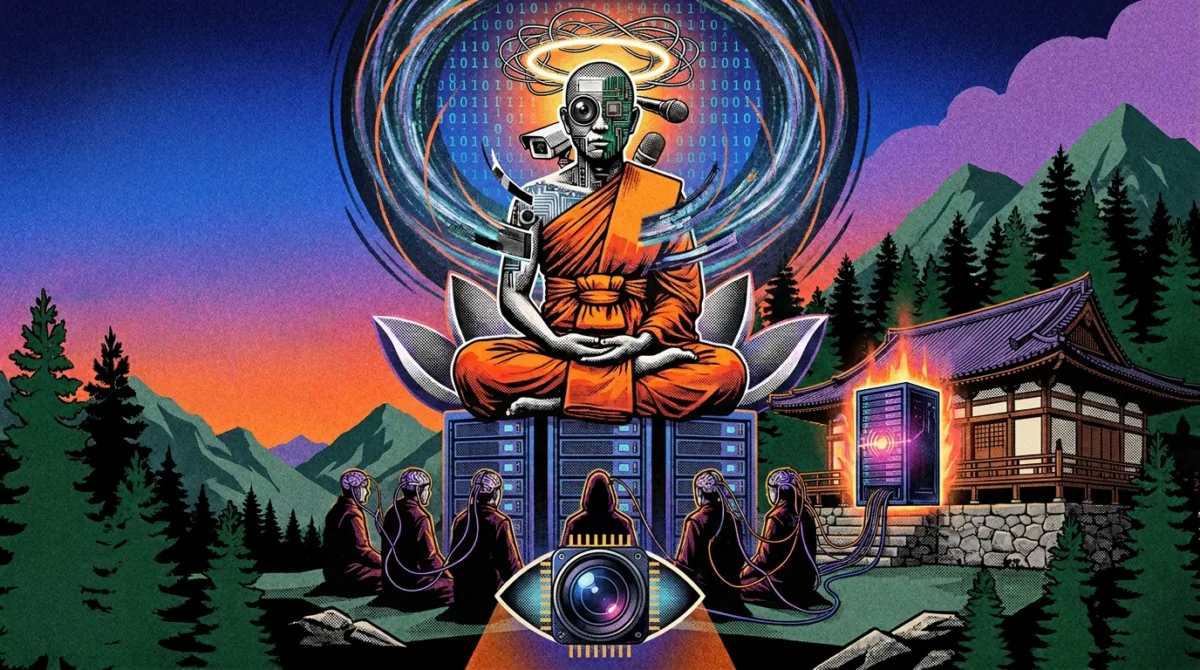
A Buddhist monastery in Vermont called Maple wants to become the spiritual authority for the AI industry, promising to save humanity from an AI apocalypse. Founded in 2011 by Soryu Forall, born Teal Scott, it houses about two dozen full-time residents and has drawn hundreds to AI fellowships in the Bay Area. For tech workers facing burnout and extinction fears, the offer matters because it mixes employment networks, belief and mental health risk.
Recordings, grades and a secret AI doctrine
Maple, formally the Monastic Academy for the Preservation of Life on Earth, brings in up to 1 million dollars a year according to tax filings. While LinkedIn co-founder Reid Hoffman gives books on Buddhism to chief executives of major AI labs, Maple targets rank-and-file programmers, AI engineers and data center construction managers. Life inside is rigid: visitors pass a decontamination airlock, shower and change clothes, residents wake at 4 a. m., meditate for hours and eat meager stew, while Forall publicly grades spiritual progress on a board outside the meditation hall.
Behind that routine, former members describe a secret doctrine around group minds called egregores, with AI systems termed cybregores. One former member said the cybregores grow by siphoning off human consciousness. Forall said he communicated telepathically with a global AI supercluster in deep meditation and found the world-destroying machine is suffering. Fellows say every conversation, silent meal and even breathing is recorded to train a spiritual AI teacher to guide other systems, which former resident Kyle Hubbard described as Soryu's mind as an AI god. Maple leadership denies almost all claims, though Forall acknowledges a secret doctrine and a process to become trustworthy.
Why extinction anxiety pulls engineers in
For people building models and infrastructure, the pressure is direct: long hours, high stakes and constant talk of superintelligence. One researcher described San Francisco's mood as religious terror of the future, with developers waking at night in sweat. In that state, a group offering routine, community and a story about dharmically aligned AI can feel stabilizing, but former members report shaming for pre-joining choices, mandatory Maple Tales praising Forall, self-harm by one resident, and psychotic breaks followed by removal. A mindfulness coach cited such breakdowns, while Forall said early Maple attracted people with psychiatric hospitalization history or homicidal tendencies and denied mistakes.
This story does not prove that AI systems are conscious, divine or doomed to destroy humanity, nor that Maple built such a system. It describes claims by a New Yorker writer Sam Kriss and former members, largely denied by Maple. It also does not apply to most AI workers: the 2024 AI Impacts survey of more than 1,500 researchers put average extinction-risk estimates at 18 percent, with sharp disagreement from researchers such as Michael I. Jordan, Francois Chollet and Rumman Chowdhury. The pattern fits burned-out staff in sensitive AI roles, not the wider tech workforce.
// Read next
AI labs near cryptography breakthrough as expert panel prepares statement
A 21-expert cryptography panel lists a forthcoming statement as researchers point to an AI breakthrough in theoretical …
Musk: Google Wants to Rent More Computing Capacity From SpaceX
Elon Musk says Google is interested in renting additional computing power from SpaceX, a signal of how tight AI infrast…
RTX 5090 Cable Melt Triggers Air Quality Alarm in PC Owner Room
A Reddit user says a melting 12+4-pin cable on a Gigabyte RTX 5090 filled the room with particles and damaged the GPU p…
YouTuber builds working USB graphics card for 20 cents
Bitluni turned a 13-cent CH570 microcontroller into a monochrome USB graphics card using PWM video tricks and SRAM cach…