SID-2 agentic search matches Opus and beats Astra in swarm mode
SID AI says its SID-2 search agent matches Claude Opus 5.5 alone and reaches 0.720 NDCG with 12 agents, while pricing starts at $0.25 per million input tokens.
AIXVZ
AI agents that sell for you. AIXVZ builds sales agents and automates routine business processes — from first contact to deal.
Learn more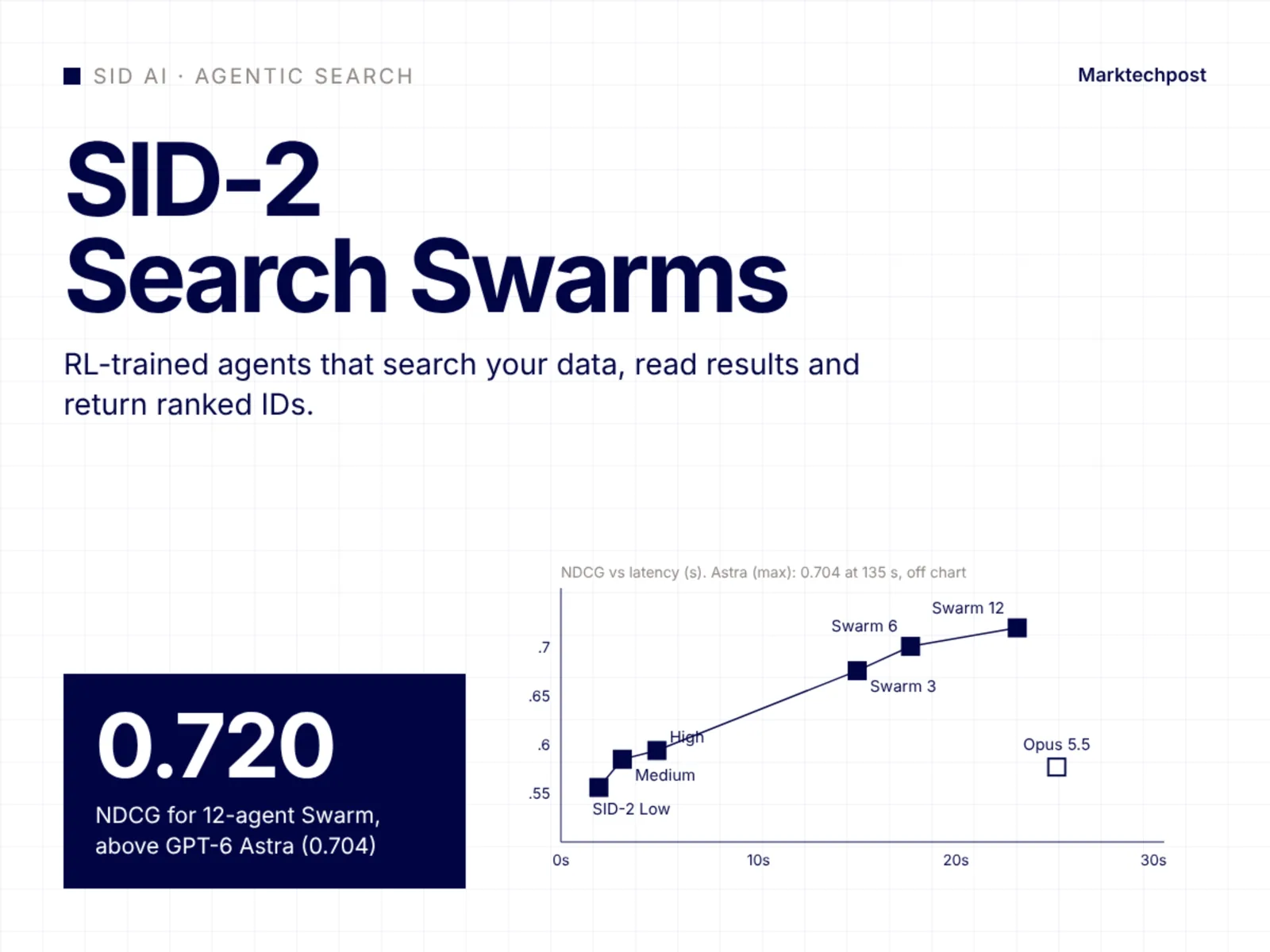
SID AI has released SID-2, a second-generation agentic search model, alongside SID-2 Swarm. A single SID-2 agent matches Claude Opus 5.5 on retrieval quality, while a 12-agent swarm scores 0.720 NDCG, above GPT-6 Astra at 0.704 on SID's own 506-question benchmark. For teams running search over private data, it promises frontier-level retrieval without reindexing or moving data.
How SID-2 searches and steers results
SID-2 is a small search specialist, not a general chat model. Instead of a fixed rewrite, embed, search and rerank pipeline, it searches, reads results, adapts and searches again. Developers connect it to their own backend through a text_search tool for keyword search and a search tool for vector search, and the model finishes by calling report_helpful_ids with ranked document IDs. SID-2 Swarm runs several agents that message each other and fork context into new agents, with each agent exploring a separate slice of the corpus.
The model has a 262k-token context window per the report, listed as 256k on sid. ai/models, and runs as a hosted API at platform. sid. ai with reference paths on Baseten and SageMaker. It offers low, medium and high reasoning effort, each trained as a separate expert and merged with multi-teacher on-policy distillation. Metric Steering lets users target NDCG, F1 or Recall at k, with k from 1 to 50. Training used two-stage reinforcement learning, first for retrieval quality only, then with a multiplicative latency penalty on positive rewards, plus proposer-solver self-play against a frozen SID-1 solver.
Speed, price and limits for buyers
On SID's benchmark across 19 corpora including HotpotQA, Enron emails, SEC filings, PubMed and BrowseComp-Plus, SID-2 Medium scored 0.585 NDCG in 3.11 seconds versus Claude Opus 5.5 medium at 0.577 in 25.1 seconds. A 6-agent swarm scored 0.701 NDCG in 17.7 seconds versus GPT-6 Astra max at 0.704 in 135 seconds, with retrieval backend time excluded. Pricing is $0.25 per million input tokens and $1.00 per million output tokens, $0.50 and $2.00 for Swarm, with cached input at 10% of input price. SDKs cover Python, TypeScript and Go, and the reference implementation uses the OpenAI client format.
All scores are self-reported from the company's technical report, with no disclosed model size, weights or independent evaluations yet. Astra still leads on California law, SEC filings and FiQA, while Swarm leads on 11 of 19 corpora, and the lowest-effort SID-2 scored 0.556 NDCG. The figures also assume 1 B200 GPU at 8 concurrent queries, so buyers with different infrastructure or corpora may see different latency, cost and accuracy.
// Read next
AI labs near cryptography breakthrough as expert panel prepares statement
A 21-expert cryptography panel lists a forthcoming statement as researchers point to an AI breakthrough in theoretical …
Musk: Google Wants to Rent More Computing Capacity From SpaceX
Elon Musk says Google is interested in renting additional computing power from SpaceX, a signal of how tight AI infrast…
RTX 5090 Cable Melt Triggers Air Quality Alarm in PC Owner Room
A Reddit user says a melting 12+4-pin cable on a Gigabyte RTX 5090 filled the room with particles and damaged the GPU p…
YouTuber builds working USB graphics card for 20 cents
Bitluni turned a 13-cent CH570 microcontroller into a monochrome USB graphics card using PWM video tricks and SRAM cach…