Saylor Points to STRC Returns as Bitcoin Falls Near $64,000
Strategy says its STRC preferred shares returned 1% over one month while bitcoin fell 17.3%, even as its 850,364 BTC holdings slipped below cost.
AIXVZ
AI agents that sell for you. AIXVZ builds sales agents and automates routine business processes — from first contact to deal.
Learn more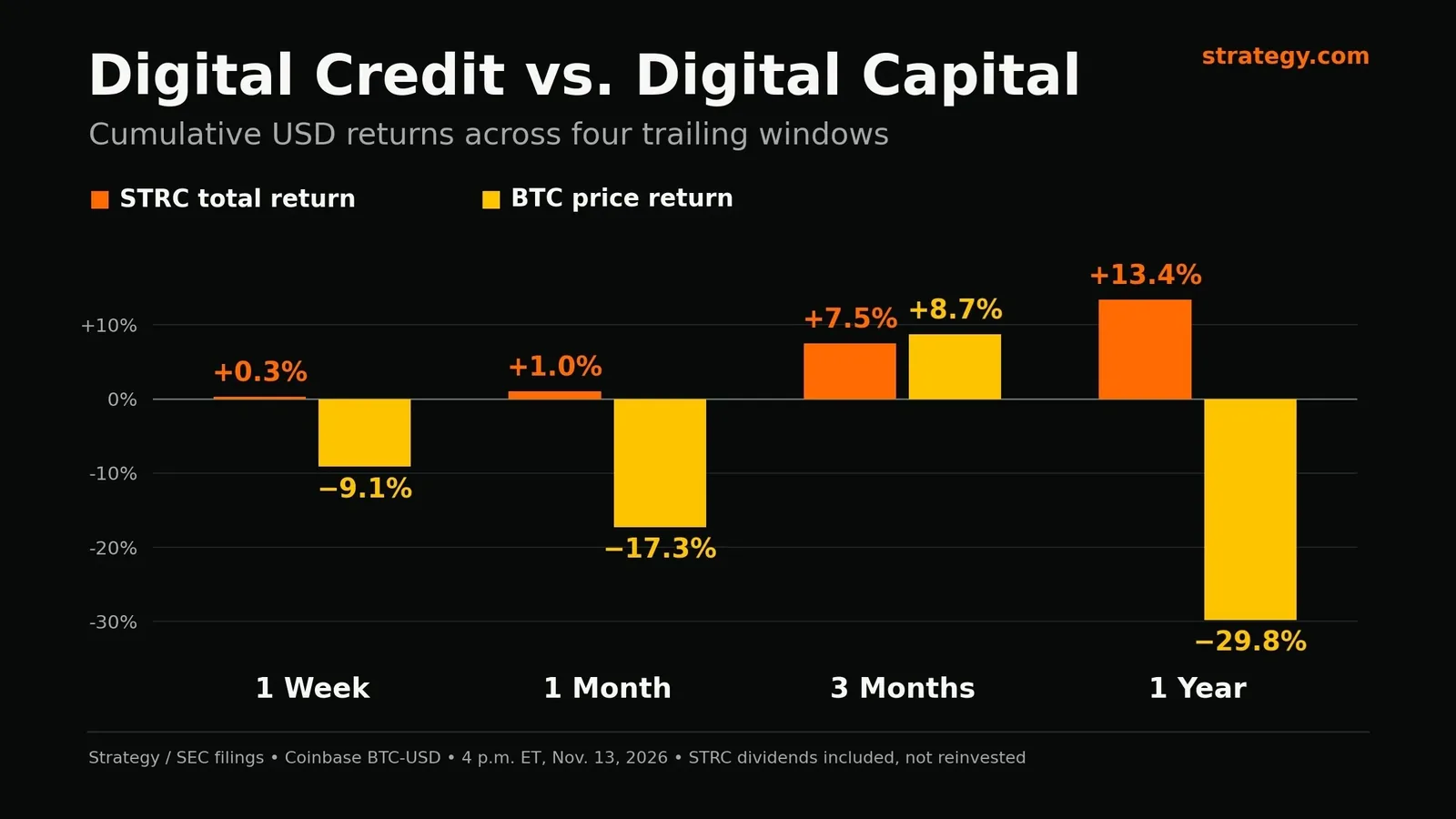
Strategy founder Michael Saylor said its income-paying preferred shares known as STRC delivered a positive total return while bitcoin traded near $64,000 on Nov. 14. Bitcoin was down more than 21% over one month, pushing the value of the company's 850,364 BTC holdings more than $9 billion below their purchase cost. The contrast highlights the different mechanics behind holding bitcoin directly and holding a corporate income claim tied to it.
STRC returns and bitcoin slide in numbers
Saylor compared STRC and bitcoin performance on X on Nov. 14, using data through 4 p. m. Eastern time on Nov. 13. He described the model as bitcoin serving as digital capital that Strategy converts into digital credit. Over the past month in that comparison, bitcoin fell 17.3%, while STRC's price was essentially flat and dividends brought its total return to 1.0%. The chart also showed STRC returned 0.3% over one week and 13.4% over one year, while bitcoin fell 9.1% and 29.8% over the same periods. Over three months, bitcoin gained 8.7%, exceeding STRC's 7.5% return. The figures counted STRC dividends without assuming those payouts were used to purchase more shares.
Market data cited on Nov. 14 showed bitcoin trading at $64,428, down 5.85% over 24 hours. Losses reached 14.37% over seven days, 21.21% over one month and 32.22% over one year. The one-month decline exceeded the 17.3% drop in Saylor's comparison because of the different cutoff time. STRC closed at $99.91 on Nov. 13 with a 12% variable annualized dividend rate, which amounts to $12 a year per $100 stated amount per share if the rate remains unchanged. During Nov. 2-8, Strategy bought 1,036 BTC for $81.9 million, financed by common-stock sales, and spent $188.3 million buying back 1,887,464 of its own STRC shares. Economist Peter Schiff questioned the assumptions behind STRC payments on Nov. 12, focusing on payment sustainability.
What preferred shares mean for holders
Direct bitcoin ownership gives the holder the cryptocurrency itself, while owning preferred shares creates a financial claim on the issuer. STRC distributions depend on corporate funding, and its trading price can move independently of bitcoin. As of Nov. 8, Strategy held a $4.77 billion designated dollar reserve for preferred-stock dividends and debt interest, alongside $146.2 million in separate cash. During Nov. 2-8, it used $21.1 million from the reserve to pay preferred-stock dividends. Valuing its disclosed 850,364 BTC at $64,428 produces approximately $54.79 billion, against a $64.16 billion purchase cost, implying an unrealized loss of approximately $9.37 billion based on its last reported holdings.
Saylor's chart measured historical investor returns, not a guarantee of future payments. STRC's variable dividend rate can be adjusted by the company, and continued distributions require available corporate funds and reserves. Bitcoin's price remains volatile, and further declines would widen the gap between the market value of Strategy's holdings and their acquisition cost. For holders of common or preferred securities, the relevant factors are dividend funding, reserve levels, share issuance and repurchases, rather than the bitcoin price alone.
// Read next
FT: Russian VC revealed as multibillion-dollar Tether co-owner
Vitaly Bezrodnykh, founder of Fulgur Ventures, holds a previously undisclosed multibillion-dollar stake in Tether, per …
Binance wins conditional approval for Bhutan regional hub
Binance received in-principle approval from Bhutan’s Gelephu Central Bank to build an Asia hub, weeks after a $6.3 bill…
Bitcoin and gold are 2026's worst-performing major assets
Bitcoin is down 32% in 2026 and gold 16%, placing both at the bottom of the year's major-asset rankings — a pairing mar…
Kalshi fights states over prediction market taxes and gambling rules
New York, New Jersey and Kentucky are testing whether federal oversight shields Kalshi from state gambling laws as Bern…