Sakana AI says 30B Namazu Small beats Nvidia 120B Super model
Sakana AI claims its 30B Namazu Small averages 60.1 across 25 benchmarks, ahead of Nvidia Nemotron 3 Super at 56.2, with web research as its clear strength.
AIXVZ
AI agents that sell for you. AIXVZ builds sales agents and automates routine business processes — from first contact to deal.
Learn more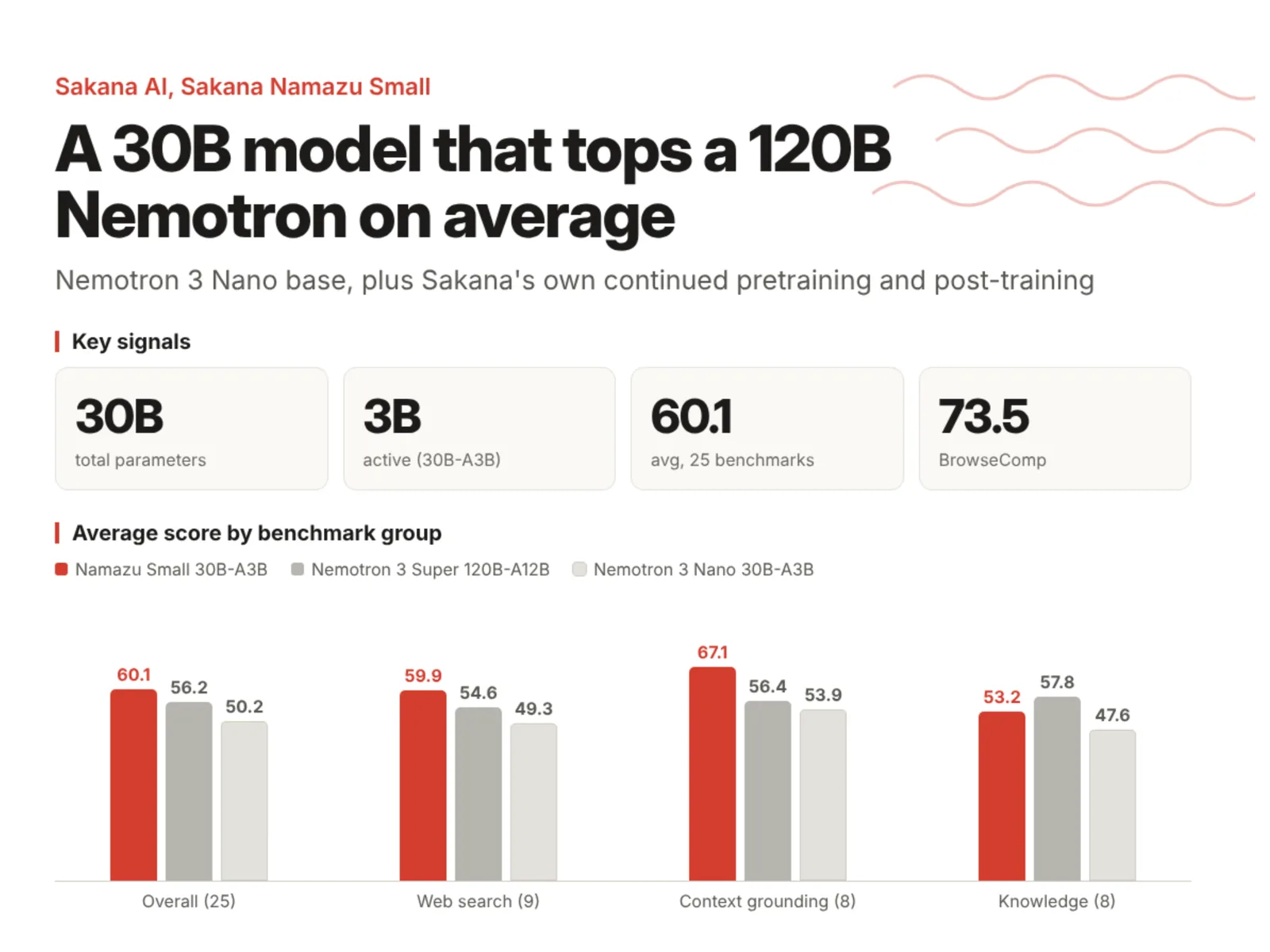
Sakana AI has released Sakana Namazu Small, a 30-billion-parameter reasoning model built on the pretrained base of Nvidia Nemotron 3 Nano. The Japan-based lab says its in-house continued pretraining and post-training lifted the model to a 60.1 average across 25 benchmarks, ahead of Nvidia Nemotron 3 Super at 56.2 and Nemotron 3 Nano at 50.2. For workers who research online and read long documents, the claim points to smaller models handling heavy lookup work.
30B model tuned for web research and long documents
Namazu Small is labeled 30B-A3B, meaning 30 billion total parameters with 3 billion active, according to Sakana AI. It belongs to the Sakana Namazu family of models built on open models and finished with Sakana post-training, with the larger Sakana Namazu based on Kimi K2.6. Sakana targets three uses: everyday conversation, research with web search, and reading long documents. The model is described as a reasoning model that organizes needed information and works step by step toward an answer.
Sakana started from the pretrained base of Nemotron 3 Nano, not Nvidia post-trained release, then applied continued pretraining and post-training techniques developed for this release and built on methods from the original Sakana Namazu. The base is a hybrid Mamba-Transformer mixture-of-experts architecture. Nvidia lists Nemotron 3 Nano at 30B total and 3B active parameters, with context up to 1M tokens. Sakana has not disclosed context length or specific hardware for Namazu Small, saying only that it is small enough for a private environment, while the Nano base was designed for DGX Spark, H100 and B200 GPUs.
Strong search scores, weak memory for facts
The practical appeal is web research and grounded long-document question answering. On BrowseComp, Namazu Small scored 73.5, about double Nemotron 3 Super at 36.1 and well above Nano at 29.3. On DeepSearchQA it reached 84.3 against 65.4 for Super. Citation and long-context scores also rose: LLM-jp LongBench hit 86.0 versus 67.0 for Nano, FaithEval reached 78.3 versus 59.1 for Super, LongBench-Cite hit 80.2 and ALCE reached 60.2. Across the suite, it beat Super on 13 of 25 tests and Nano on 22 of 25.
All scores are self-reported by Sakana, and closed-book knowledge remains weak. On SimpleQA Verified it scored 6.8, below Nano at 9.1 and Super at 18.1. Japanese SimpleQA was 8.0 versus 24.9 for Super, and HealthBench fell to 40.6 from Nano 47.5. Sakana itself says tasks using only internal knowledge did not improve much. That limits use for health or factual recall without sources, and the undisclosed context length and deployment details make independent comparison difficult.
// Read next
AI labs near cryptography breakthrough as expert panel prepares statement
A 21-expert cryptography panel lists a forthcoming statement as researchers point to an AI breakthrough in theoretical …
Musk: Google Wants to Rent More Computing Capacity From SpaceX
Elon Musk says Google is interested in renting additional computing power from SpaceX, a signal of how tight AI infrast…
RTX 5090 Cable Melt Triggers Air Quality Alarm in PC Owner Room
A Reddit user says a melting 12+4-pin cable on a Gigabyte RTX 5090 filled the room with particles and damaged the GPU p…
YouTuber builds working USB graphics card for 20 cents
Bitluni turned a 13-cent CH570 microcontroller into a monochrome USB graphics card using PWM video tricks and SRAM cach…