Russia allows regulated crypto trading as Moscow Exchange plans launch
Russia activated rules for organized crypto trading on November 22, with Moscow Exchange planning Bitcoin, Ethereum and USDT pilot trades on December 1.
AIXVZ
AI agents that sell for you. AIXVZ builds sales agents and automates routine business processes — from first contact to deal.
Learn more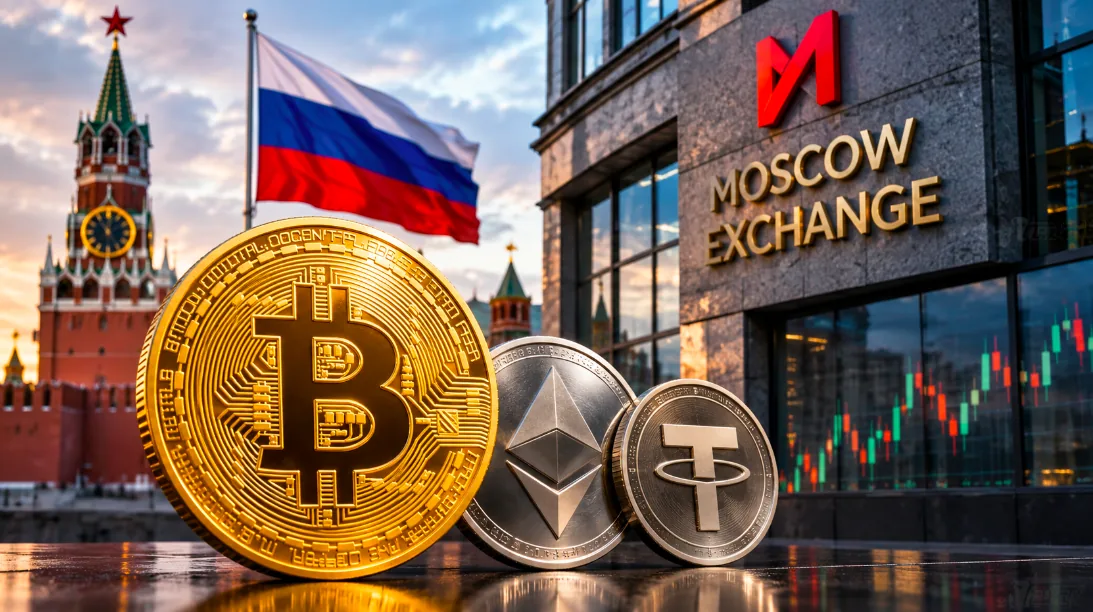
Russia has activated rules allowing organized cryptocurrency trading from November 22, opening a path for traditional exchanges to offer digital assets under Bank of Russia oversight. Moscow Exchange plans pilot transactions in Bitcoin, Ethereum and USDT from December 1, using its existing securities infrastructure and clearing through the National Clearing Centre. The move matters because it could let investors buy crypto through brokers rather than crypto-native platforms.
Approval, brokers and December pilot plan
Trading has not started automatically. Exchanges must have their trading rules approved by the Bank of Russia and complete operational preparations before organizing transactions. Under the framework, venues must register participating brokers, asset managers and clearing institutions, keep transaction records, monitor activity, calculate market prices and report information to the central bank. The goal is stronger oversight of a market that previously relied on specialized platforms and alternative arrangements. Moscow Exchange is preparing pilot trades from 6:50 a. m. to 11:50 p. m. Moscow time, with same-day and next-day settlement options. The exchange has already tested the infrastructure with professional participants. Nonqualified investors face an annual purchase limit of 300,000 rubles through each intermediary, while qualified investors are expected to have broader access without that cap.
Russia built toward this step over several months. Broader digital currency legislation reportedly took effect in September, creating a legal basis for exchanges, brokers and digital asset depositories. Cryptocurrency payments for everyday purchases remain prohibited inside the country. The new exchange-trading rules therefore extend regulated investment access without legalizing crypto as a means of payment. The development was noted by financial news account Watcher. Guru, which highlighted that exchange-based trading is permitted subject to central bank approval. For Bitcoin, the structure resembles the wider pattern of established financial institutions adding digital assets alongside conventional products. Unlike company shares, Bitcoin runs on a decentralized network with a predetermined issuance schedule and a maximum supply of about 21 million coins, a feature often cited in its long-term investment case.
What regulated access means for investors
For people already using brokerage accounts, the practical change is access and custody mechanics rather than a new asset. Eligible investors could buy and hold Bitcoin, Ethereum and USDT through familiar intermediaries, with centralized clearing, defined trading hours and recorded prices. That may lower operational friction for those who avoided standalone crypto exchanges, separate wallets and unfamiliar withdrawal procedures. It also places activity under market monitoring and reporting to the central bank. The purchase cap means smaller retail participants face a defined ceiling per intermediary, while larger or qualified participants operate under different conditions. Actual usefulness will depend on fees, liquidity, broker participation and how easily holdings can be deposited and withdrawn.
The rules do not prove new demand will appear. Some volume may move from existing platforms instead of representing additional buying, and higher access does not by itself support higher prices. It is also unclear whether Moscow Exchange will meet the December 1 pilot date, what volumes will follow, and how settlement will work in practice. Moscow Exchange and its National Clearing Centre remain subject to US sanctions, raising compliance questions, particularly around dollar-linked assets such as USDT, and likely limiting international participation. For now, the framework is authorization, not a functioning market.
// Read next
FT: Russian VC revealed as multibillion-dollar Tether co-owner
Vitaly Bezrodnykh, founder of Fulgur Ventures, holds a previously undisclosed multibillion-dollar stake in Tether, per …
Binance wins conditional approval for Bhutan regional hub
Binance received in-principle approval from Bhutan’s Gelephu Central Bank to build an Asia hub, weeks after a $6.3 bill…
Bitcoin and gold are 2026's worst-performing major assets
Bitcoin is down 32% in 2026 and gold 16%, placing both at the bottom of the year's major-asset rankings — a pairing mar…
Kalshi fights states over prediction market taxes and gambling rules
New York, New Jersey and Kentucky are testing whether federal oversight shields Kalshi from state gambling laws as Bern…