Rhoda AI bets internet video can train generalist robots
Rhoda AI raised $450 million to train robots on internet-scale video, aiming to move manipulation from lab demos to factory and warehouse work.
AIXVZ
AI agents that sell for you. AIXVZ builds sales agents and automates routine business processes — from first contact to deal.
Learn more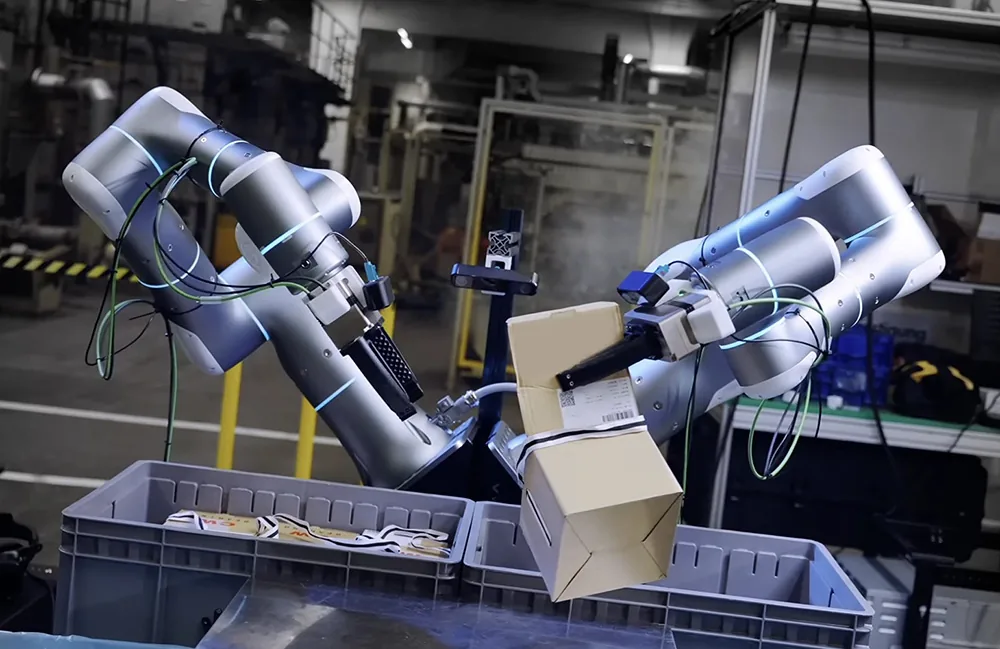
Rhoda AI emerged from 18 months of stealth with $450 million in Series A funding to build generalized AI models for robots trained on video data. The Palo Alto company is working with customers in automotive, manufacturing, logistics and e-commerce to deploy its direct video action model. The bet is that internet-scale video can do for physical AI what text from the internet did for ChatGPT.
How the direct video action model works
Rhoda AI calls its approach direct video action, or DVA, recently extended with mobile DVA that combines manipulation and mobility into one policy. The model looks at a history of video frames plus action and language tokens, then predicts video for the next few hundred milliseconds, about the next half second. That predicted scene goes to an action converter that outputs robot actions, the robot executes them, makes a new observation and repeats the loop. Co-founder and CEO Jagdeep Singh described the cycle as observation, prediction, conversion to action, execution, then a new observation and prediction.
Many physical AI developers are building vision-language-action models that learn from images or video and text instructions, but Rhoda AI said those models still struggle with real-world variability. Singh argued that tele-operation data produced lab demonstrations such as folding T-shirts or making coffee that were not robust enough for deployment. He said the number of autonomous manipulation-capable robots solving real-world problems today is effectively zero. The company links that gap to data scale, noting that language models trained on text ranging from Shakespeare to Reddit had no equivalent dataset for the physical world.
What video-trained robots mean for factory work
For manufacturing and logistics employers facing labor shortages, the pitch is a robot that needs only 10 to 20 hours of task-specific training after video pretraining, similar to onboarding a new assembly-line worker. Rhoda AI said it owns the AI layer and can run on its own hardware or third-party hardware, while skills can be trained by Rhoda AI or third parties. Internally it is prioritizing manufacturing and logistics skills, which Singh presented as a path to make production in high-cost economies viable again and to repatriate offshored industries.
Rhoda AI has not disclosed deployment numbers, performance metrics or customer names, and its claim of generality rests on company statements rather than independent results. The approach assumes that broad video, including baseball, darts, waves and trees, teaches physics better than curated human manipulation clips alone. It remains unknown whether 10 to 20 hours of post-training will hold across changing layouts, lighting and product mixes outside pilot sites.
// Read next
AI labs near cryptography breakthrough as expert panel prepares statement
A 21-expert cryptography panel lists a forthcoming statement as researchers point to an AI breakthrough in theoretical …
Musk: Google Wants to Rent More Computing Capacity From SpaceX
Elon Musk says Google is interested in renting additional computing power from SpaceX, a signal of how tight AI infrast…
RTX 5090 Cable Melt Triggers Air Quality Alarm in PC Owner Room
A Reddit user says a melting 12+4-pin cable on a Gigabyte RTX 5090 filled the room with particles and damaged the GPU p…
YouTuber builds working USB graphics card for 20 cents
Bitluni turned a 13-cent CH570 microcontroller into a monochrome USB graphics card using PWM video tricks and SRAM cach…