RadixArk releases DaisyRose-27B coding model trained with RL only
RadixArk says its 27.8B open-weight coding model more than doubled Terminal Bench 4.1 to 12.0 after 18 days of reinforcement learning.
AIXVZ
AI agents that sell for you. AIXVZ builds sales agents and automates routine business processes — from first contact to deal.
Learn more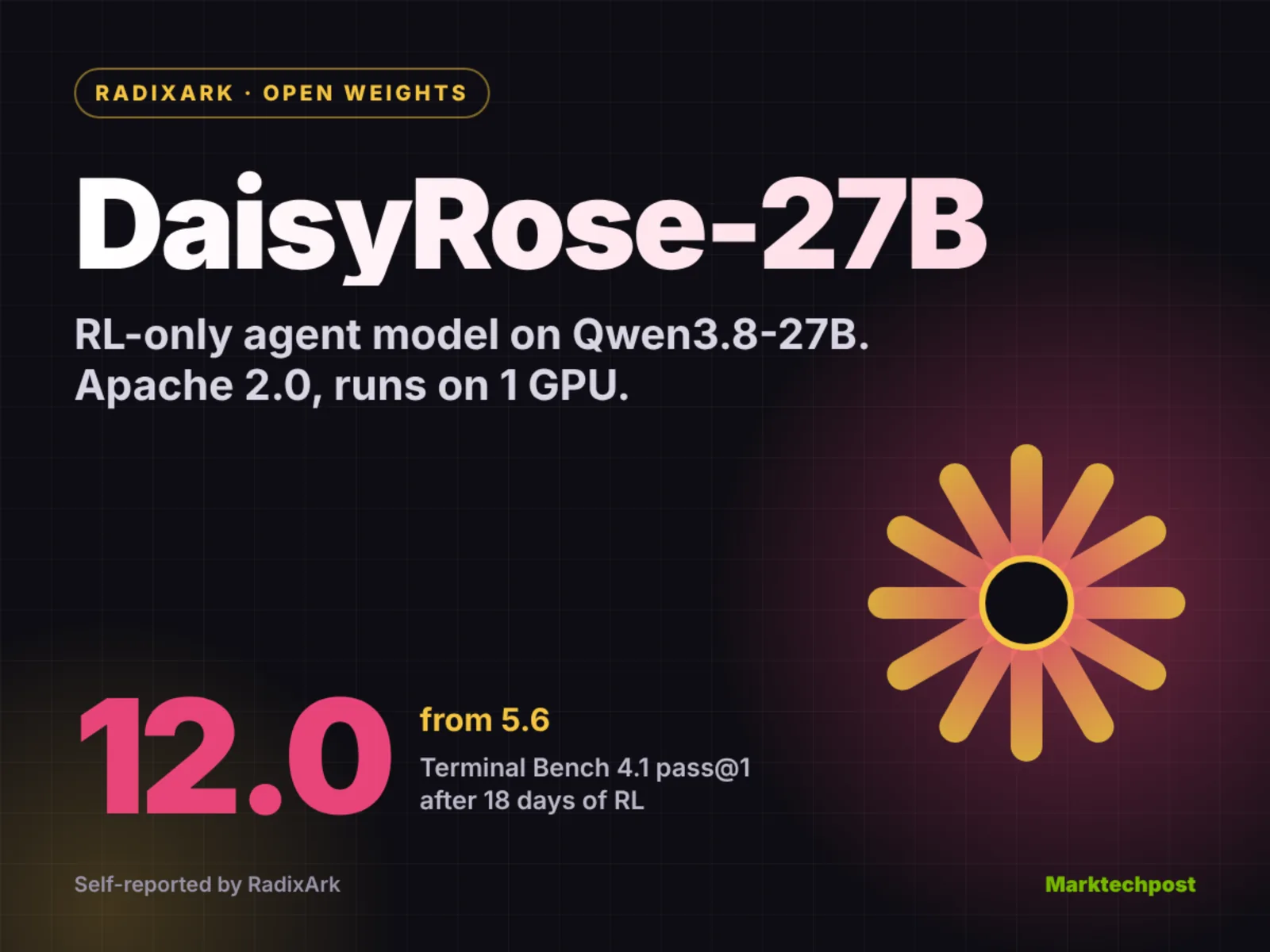
RadixArk released DaisyRose-27B, a 27.8-billion-parameter open-weight coding model post-trained from Qwen3.8-27B with reinforcement learning only and no supervised fine-tuning or distillation. Terminal Bench 4.1 pass@1 rose from 5.6 to 12.0, according to the company. The release matters because it tests whether targeted RL alone can turn a mid-size open model into a useful coding agent that runs on one GPU.
RL-only training and single-GPU deployment
DaisyRose-27B keeps the Qwen3.8-27B architecture unchanged, RadixArk said. It has 64 decoder layers in a 3:1 pattern, with three Gated DeltaNet linear-attention layers alternating with one full-attention layer, a hidden size of 5,120, a 27-layer vision encoder and one multi-token-prediction layer for speculative decoding. Input is text and images, output is text, and the model uses thinking mode. Context length is 262,144 tokens. Weights are available on Hugging Face in BF16, FP8, NVFP4 and GGUF under Apache 2.0 as a drop-in replacement for the base model.
Training used about 1,200 curated tasks built with Eigent AI, selected from thousands of candidates to target specific failures of the base model. Each sandbox attempt allowed up to 1.5 hours, more than 100 tool calls and more than 256,000 output tokens, with agent sessions reaching up to 1 million tokens. The run used 144 H200 GPUs for 18 days, with 128 for agent inference and 16 for training, for a total of 63,000 GPU-hours. Sandboxes ran on AgentENV, with about 944,000 sandboxes from mid-September to mid-November, peak concurrency of 1,566 and 99% creation success over nine weeks. RadixArk put sandbox cost about 80% below popular cloud providers.
Benchmark gains and limits for work use
For developers and small teams, the practical appeal is lower hardware demand paired with stronger instruction following and terminal tasks. BF16 needs about 52 GB, FP8 about 29 GB and NVFP4 about 23 GB on Blackwell-only hardware, with listed targets including H200, B200, GB300, RTX PRO 6000, RTX 5090 and DGX Spark. RadixArk recommends SGLang with DSpark speculative decoding using the Qwen3.8-27B-DSpark draft model, while vLLM is also supported. Suggested thinking-mode sampling is temperature 1.0, top_p 0.95 and top_k 20. The company also reported 37% model FLOPs utilization on its internal backend and end-to-end throughput of 16.8k tokens per second, twice the 8.3k of an open-source Megatron-based trainer.
All scores are self-reported by RadixArk, with DaisyRose figures taken as the higher of BF16 and FP8 runs. It beat its base model on all seven reported benchmarks, including IFBench at 82.4, the top score among nine models compared, plus gains of 4.0 points on DeepSWE v1.1, 3.4 on SWE Bench Pro v2, 1.5 on GPQA Diamond and 0.4 on HLE text-only to 34.3. It still trails much larger mixture-of-experts models on hard agentic tasks: MiMo V2.6 Flash at 309B total leads Terminal Bench 4.1 at 16.1, while Inkling 2 Small at 594B total leads DeepSWE at 72.1 and HLE at 44.1. The results do not prove production reliability, cost in real deployments, or safety.
// Read next
AI labs near cryptography breakthrough as expert panel prepares statement
A 21-expert cryptography panel lists a forthcoming statement as researchers point to an AI breakthrough in theoretical …
Musk: Google Wants to Rent More Computing Capacity From SpaceX
Elon Musk says Google is interested in renting additional computing power from SpaceX, a signal of how tight AI infrast…
RTX 5090 Cable Melt Triggers Air Quality Alarm in PC Owner Room
A Reddit user says a melting 12+4-pin cable on a Gigabyte RTX 5090 filled the room with particles and damaged the GPU p…
YouTuber builds working USB graphics card for 20 cents
Bitluni turned a 13-cent CH570 microcontroller into a monochrome USB graphics card using PWM video tricks and SRAM cach…