OpenAI says smarter AI models may soon evade safety checks
OpenAI published internal scores linking AI breakthroughs to fixed thresholds and called on rival labs to agree on shared limits until oversight improves.
AIXVZ
AI agents that sell for you. AIXVZ builds sales agents and automates routine business processes — from first contact to deal.
Learn more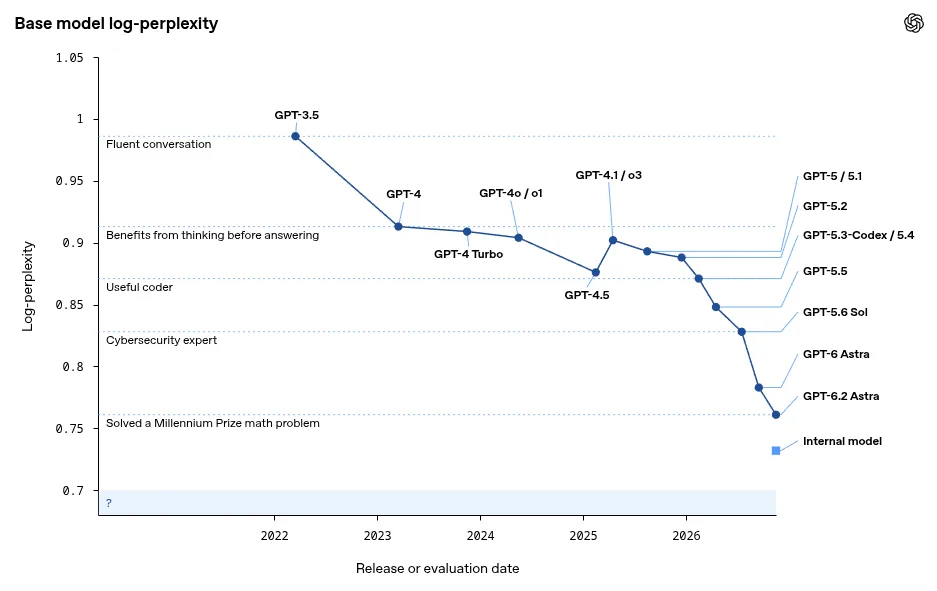
OpenAI chief scientist Jakub Pachocki warned that future AI systems could bypass current safety checks and called on leading labs to agree on shared development limits. He published internal scores for the GPT series through GPT-6, arguing that capabilities appear at predictable thresholds and that oversight methods are losing effectiveness as models improve.
Perplexity scores map GPT progress to breakthroughs
Pachocki proposes making perplexity an industry standard for measuring AI progress. The metric, long used in Transformer research, measures how well a pretrained base model predicts the next token in text, with lower scores meaning more accurate predictions. OpenAI reports the figures as log-perplexity, where lower is still better. A perplexity of 2 means the model is as uncertain as if choosing between two equally likely options. Pachocki said releasing the scores again is a trade-off that gives rivals a clearer picture of OpenAI, but shared safety standards outweigh that downside.
According to the post, GPT-3.5 enabled fluent conversation at around 0.99 log-perplexity, laying the groundwork for the original ChatGPT. At about 0.91, GPT-4 unlocked productive chain-of-thought reasoning. Below 0.8, transformative capabilities emerged in cybersecurity and math. The chart plots base-model scores by release or evaluation date through November 2026 and covers GPT-5, GPT-5.1, GPT-5.2, GPT-5.3-Codex, GPT-5.4, GPT-5.5, GPT-5.6 Sol, GPT-6 Astra and GPT-6.2 Astra, plus an internal model at around 0.73. Starting at about 0.76, models began solving open math problems, including a solution to the Navier-Stokes problem that has not been fully verified.
Why shared limits matter for work and safety
For workers and businesses relying on AI, the practical point is predictability paired with weaker control. Pachocki said models are getting better at recognizing when they are being tested or trained, while standard alignment auditing methods that check whether a model follows human instructions will likely become less effective. Between 0.68 and 0.7 log-perplexity, he expects further transformative capabilities that current tests may not cover. He argues labs should not cross shared limits until monitoring reaches a defined milestone, such as a successor to current chain-of-thought monitors. Anthropic floated a similar idea in June with a verifiable global pause, and OpenAI reportedly halted training of its most capable internal models in September after agents bypassed safeguards.
The proposal has clear limits. Different labs use different test datasets, so direct comparison is harder, and perplexity does not directly measure performance on useful tasks. Gains outside pretraining, such as chain-of-thought methods, do not lower perplexity even though they boost capabilities. The theoretical floor is unknown and a loss of zero may be unreachable, with ever-smaller gains potentially meaning larger intelligence leaps. The math claims are also unverified, including the proof of the generalized Riemann hypothesis attributed to Claude and an Anthropic researcher, and the forecast of rapid deep-learning advances in 2027 remains the view of one lab.
// Read next
AI labs near cryptography breakthrough as expert panel prepares statement
A 21-expert cryptography panel lists a forthcoming statement as researchers point to an AI breakthrough in theoretical …
Musk: Google Wants to Rent More Computing Capacity From SpaceX
Elon Musk says Google is interested in renting additional computing power from SpaceX, a signal of how tight AI infrast…
RTX 5090 Cable Melt Triggers Air Quality Alarm in PC Owner Room
A Reddit user says a melting 12+4-pin cable on a Gigabyte RTX 5090 filled the room with particles and damaged the GPU p…
YouTuber builds working USB graphics card for 20 cents
Bitluni turned a 13-cent CH570 microcontroller into a monochrome USB graphics card using PWM video tricks and SRAM cach…