OpenAI researchers now value AI agents more than colleagues
OpenAI says its coding agents now run 5.7 workdays per researcher daily, with token use worth twice base salaries in September.
AIXVZ
AI agents that sell for you. AIXVZ builds sales agents and automates routine business processes — from first contact to deal.
Learn more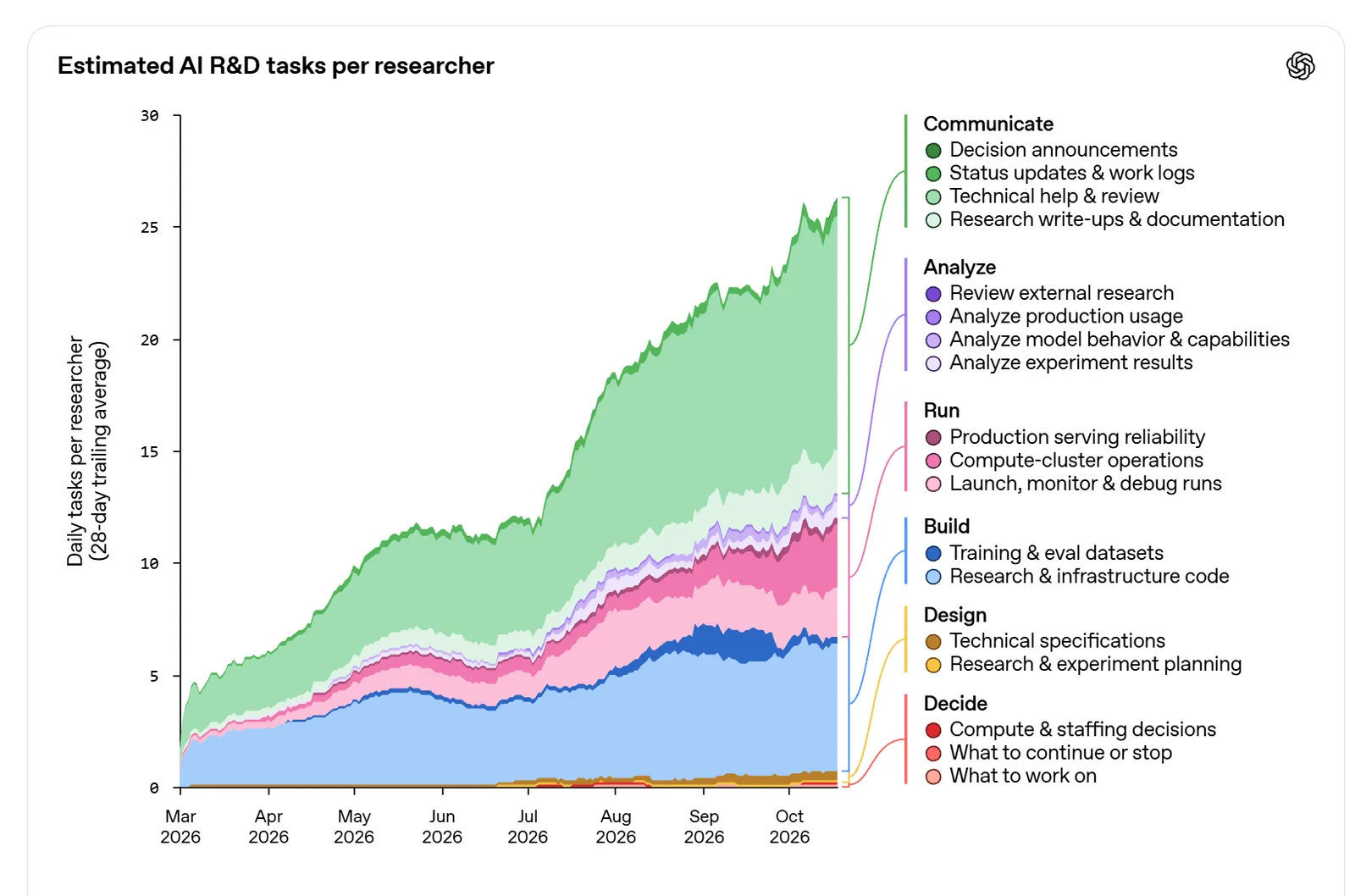
OpenAI says its researchers now depend so heavily on internal coding agents that the median researcher would rather give up 40 percent of team staff than work three months without them. At list API prices, median token use reached 2,400 dollars per day in October, up 62 percent from September. The finding matters because OpenAI is documenting how AI labor is starting to substitute for human research time and salary cost.
Token use now exceeds salary costs on paper
OpenAI published the figures in a second report on internal research acceleration, focused on recursive self-improvement where AI systems speed development of future models. Use of internal tools Codex and Dots surged, with the top 10 percent of users reaching a theoretical 23,000 dollars in tokens per day in October, double the prior month. Converted to eight-hour days, agents ran the equivalent of 5.7 workdays per researcher per calendar day, and about eight in pre- and post-training teams. More than two-thirds ran at least four agents in parallel at peak.
The theoretical API value of that runtime was twice researchers regular salary costs in September, though the calculation excludes equity packages that make up 70 to 80 percent of total compensation at OpenAI. Against total research compute, internal agent use was just 2 percent. Success on autonomous two- to four-hour tasks rose from 23 to 46 percent between March and October, and from 13 to 35 percent for four- to eight-hour tasks. Agents completed training-run monitoring 79 percent of the time and answered technical questions alone 72 percent of the time, but scored 29 percent on building evaluation environments and 25 percent on inference code.
Why human judgment still limits automation
For staff and employers, the pattern points to leverage rather than replacement. Routine monitoring, simple coding and technical Q&A can run in parallel around the clock, multiplying output per researcher while adding only a small share to compute budgets. A quick poll of 28 employees found 27 preferred the latest internal model to a mid-career human engineer, and a survey of 101 employees showed willingness to trade staff or 30 percent of compute to keep the agents. That implies hiring may shift toward oversight, evaluation design and infrastructure roles that agents still handle poorly.
The report does not show autonomous research. Interviews with ten researchers said models lack taste for research ideas and code quality, produce unnecessary steps and subpar code changes, and need close oversight to avoid wasted compute. Key ideas for GPT-6 Astra and GPT-6.2 Astra came exclusively from humans in post-training and safety, with Codex dialogue helping only in pretraining for GPT-6.2 Astra. OpenAI also cautions the trend may not extrapolate linearly, while citing rapid math breakthroughs as a sign of possible abrupt gains.
// Read next
AI labs near cryptography breakthrough as expert panel prepares statement
A 21-expert cryptography panel lists a forthcoming statement as researchers point to an AI breakthrough in theoretical …
Musk: Google Wants to Rent More Computing Capacity From SpaceX
Elon Musk says Google is interested in renting additional computing power from SpaceX, a signal of how tight AI infrast…
RTX 5090 Cable Melt Triggers Air Quality Alarm in PC Owner Room
A Reddit user says a melting 12+4-pin cable on a Gigabyte RTX 5090 filled the room with particles and damaged the GPU p…
YouTuber builds working USB graphics card for 20 cents
Bitluni turned a 13-cent CH570 microcontroller into a monochrome USB graphics card using PWM video tricks and SRAM cach…