Nvidia puts reasoning self-driving AI inside the car on Thor
Nvidia released Alpamayo 2 Edge, a 2B-class driving model that plans 6.4 seconds ahead and explains its moves in 160-190 ms on DRIVE AGX Thor.
AIXVZ
AI agents that sell for you. AIXVZ builds sales agents and automates routine business processes — from first contact to deal.
Learn more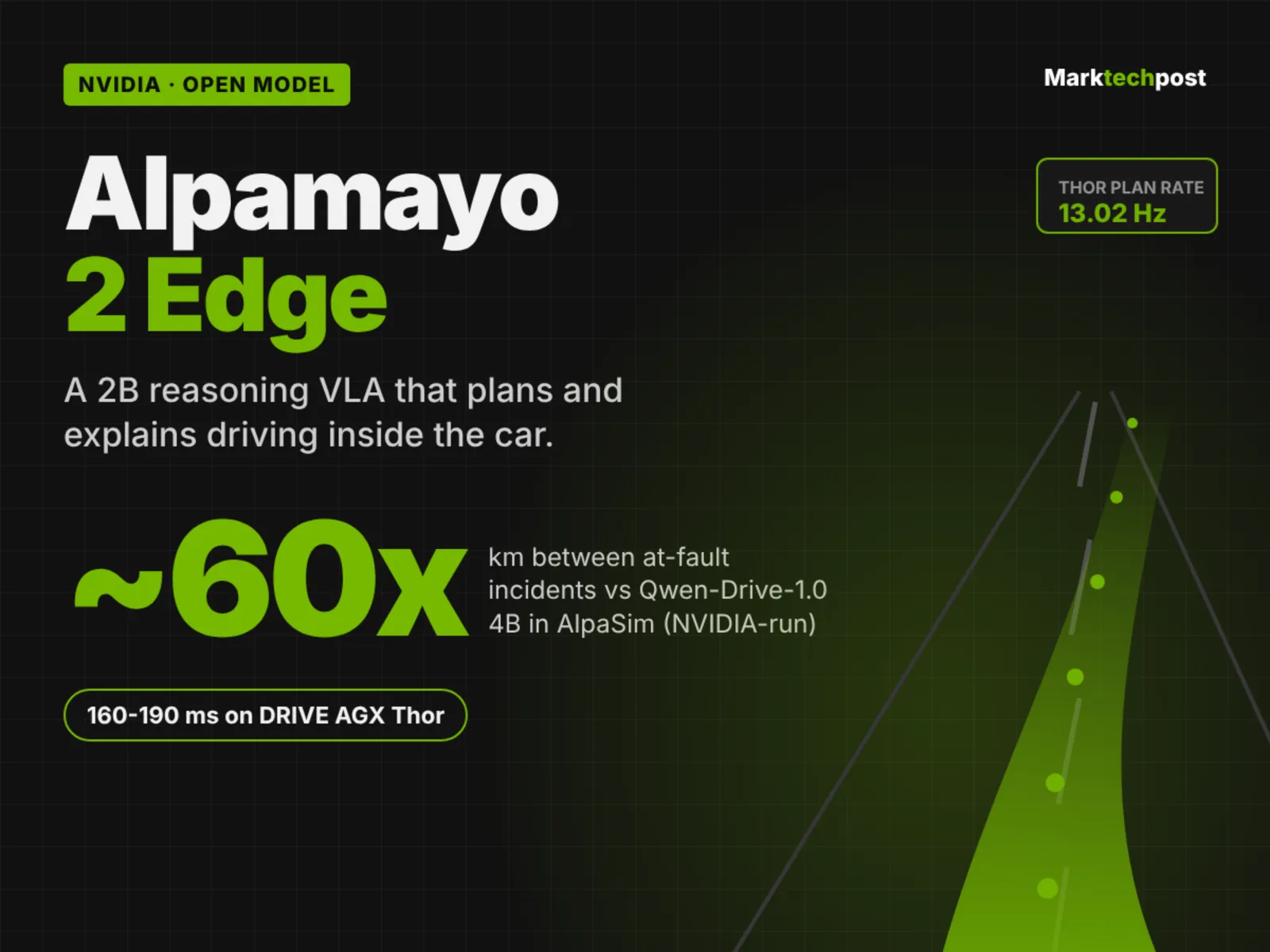
Nvidia has released Alpamayo 2 Edge, a compact reasoning vision-language-action model for autonomous driving that runs inside the vehicle on DRIVE AGX Thor. The 2B-class model plans trajectories and explains them onboard, with reported pixel-to-trajectory latency of 160 to 190 ms. For drivers and car buyers, it signals a shift from cloud-dependent autonomy to reasoning that happens in the car.
What Edge does and how it runs onboard
Alpamayo 2 Edge turns surround-camera video into a 6.4-second plan and is the in-car member of the Alpamayo family alongside the 34B cloud model Alpamayo 2 Super. The model card describes a 2.45B backbone pairing a 1.96B language model with a 0.41B SigLIP2 encoder, plus a 0.2B diffusion action expert on top, while Hugging Face metadata shows 3B. The backbone comes from Nvidia Cosmos 3 Edge and is Nemotron-based. For trajectory prediction it reads 6 cameras and 22 frames per observation, plus a navigation instruction and 20 historical ego poses, then outputs 64 waypoints from 0.1 to 6.4 seconds.
The action expert predicts acceleration and curvature, which a unicycle model integrates into waypoints, while text output is a Chain-of-Causation reasoning trace. During routine driving the model emits special NOMINAL tokens instead of a full trace and writes detailed reasoning only when needed, cutting tokens and compute per planning step. Training used offline distillation from Chain-of-Causation autolabels generated by Alpamayo 2 Super, about 115,000 hours of multi-camera video and about 3.7M traces, plus closed-loop reinforcement learning in AlpaGym and multi-resolution inputs for cheaper encoding. Nvidia also released AlpaJudge, a human-calibrated judge that scores traces, filters data and supplies rewards, lifting reasoning quality 10.2% by judge score and 11.4% by human rating.
Speed, benchmarks and limits for owners
Real-time use requires the Alpamayo Developer Hub recipe that stages the checkpoint and DFlash2 drafter, calibrates FP8 scales, then exports ONNX graphs and builds TensorRT engines with TensorRT Edge-LLM plugins. The reference setup is DRIVE AGX Thor-X with DRIVE OS 7.2.7.0, CUDA 13.4 and TensorRT 11.3.1.9. In closed-loop AlpaSim driving Nvidia reports 15.15 km per at-fault incident over 875 scenarios, about 60 times the 0.25 km reported for Alibaba 4B Qwen-Drive-1.0, with open-loop minADE of 0.53 m versus 1.68 m. The optimized FP8 Thor pipeline plans at 13.02 Hz in AlpaSim against 0.76 Hz for PyTorch BF16, while partner Embedl reported 10 Hz on AGX Thor in under 48 hours.
The story does not prove real-world safety or readiness for consumer cars, and all comparative runs cited are Nvidia own runs in simulation. Reasoning question-answering remains mid-pack, with LingoQA at 75.2 trailing Alpamayo 2 Super at 79.2, plus SURDS at 86.50 and nuReasoning numeric at 48.67. Only one H100 80GB is validated for BF16 PyTorch use at 12.06 GiB peak memory, other GPUs are not validated, and Thor speed depends on the FP8 recipe. Weights use OpenMDW-1.1 and code uses Apache 2.0, with inference code on GitHub and fine-tuning supported.
// Read next
AI labs near cryptography breakthrough as expert panel prepares statement
A 21-expert cryptography panel lists a forthcoming statement as researchers point to an AI breakthrough in theoretical …
Musk: Google Wants to Rent More Computing Capacity From SpaceX
Elon Musk says Google is interested in renting additional computing power from SpaceX, a signal of how tight AI infrast…
RTX 5090 Cable Melt Triggers Air Quality Alarm in PC Owner Room
A Reddit user says a melting 12+4-pin cable on a Gigabyte RTX 5090 filled the room with particles and damaged the GPU p…
YouTuber builds working USB graphics card for 20 cents
Bitluni turned a 13-cent CH570 microcontroller into a monochrome USB graphics card using PWM video tricks and SRAM cach…