Nvidia AI Day Seoul drew 2,000 attendees focused on robotics and
More than 2,000 developers and executives met at COEX for AI Day Seoul, with robotics demos, agent workshops and Korean-language certification exams.
AIXVZ
AI agents that sell for you. AIXVZ builds sales agents and automates routine business processes — from first contact to deal.
Learn more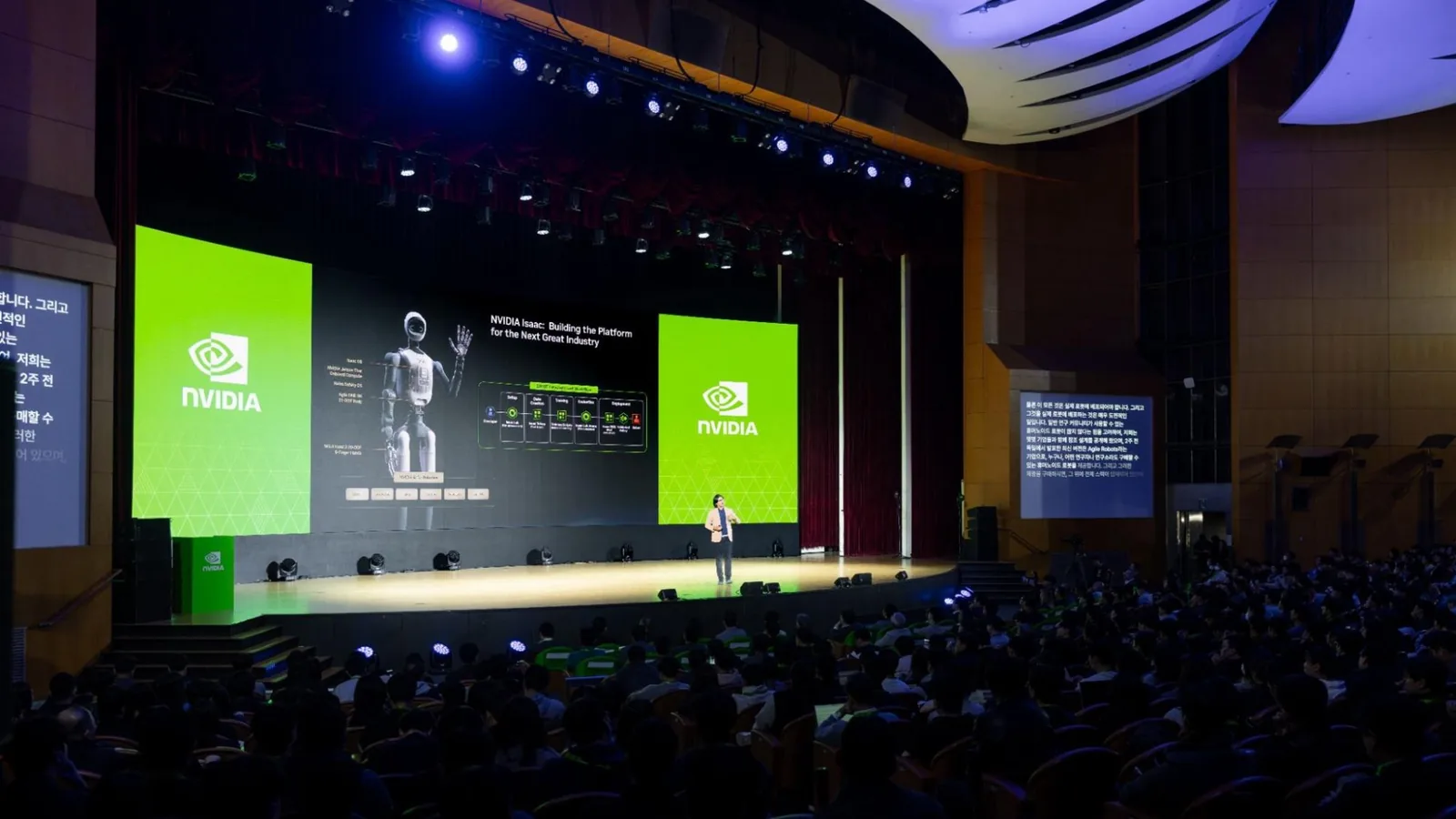
Nvidia gathered more than 2,000 attendees over two days at COEX for AI Day Seoul, focused on physical AI and AI agents. Industry groups, startups and developer communities joined plenary talks, bootcamps and certification exams, with sessions set to appear on Nvidia On-Demand. For workers in manufacturing, software and cloud services, the program signals where enterprise hiring and tooling are heading.
Korea robotics push and enterprise agents
At the plenary sessions, Deepu Talla, vice president of robotics and edge AI at Nvidia, said Korea is punching above its weight in robotics. He named Doosan Robotics, Hyundai Motor Group, LG Electronics and SK Group, as well as startups Real World and Luda Robotics, as companies using Nvidia platforms to bring general-purpose robotics into real-world use. Jonathan Cohen, vice president of applied research at Nvidia, showed how enterprises can build agents they own and control. Breakout sessions featured speakers from Coupang Intelligent Cloud, Doosan Robotics, LG AI Research, LG Electronics, NAVER Cloud, SK Telecom and Upstage.
The event combined training, community meetings and research discussion. More than 500 developers took part in full-day Nvidia Deep Learning Institute workshops and Nvidia Certification exams in Korean, including the new AI Model and Application Development exam. Workshops covered deploying and optimizing AI inference at scale, building end-to-end robotics workflows with the Nvidia Isaac platform and developing secure AI agents. The Agentic AI 10x Bootcamp Community Day brought together Pseudo Lab, Python Korea, PyTorchKR, HAERAE, Hugging Face KREW, Graph User Group, Womxn Who Code Korea and Dnol. The AI for Science Forum brought together the Korea Institute of Science and Technology Information, Korean universities and Nvidia Research.
What developers and employers gain
For developers and technical staff, the practical value was in credentials and shared tooling. Certification in Korean lowers the language barrier for local engineers, while workshops on inference deployment, Isaac robotics workflows and secure agents map directly to production roles in factories, logistics and cloud operations. Research engineer Hyunho Yang from SK Telecom, who works on omnimodal foundation models, described candid conversations with fellow developers and said their passion was a source of inspiration. Community participation of this kind often helps engineers compare implementation choices and find collaborators outside their employer.
The announcements do not prove commercial deployment at scale or specific performance gains. Five finalists from the Hangul Day hackathon, co-hosted with Fastcampus, built agents trained on Korean language and culture with the OpenShell runtime, with winning team FlyGate receiving an Nvidia DGX Spark system. Ten Nvidia Inception startups pitched at Physical AI Startup Connect, including AIM Intelligence, Avikus, GoLe Robotics, MOVIN, Neubility, ROAI, ROBROS, TESOLLO, TwelveLabs and XYZ. These were demonstrations, pitches and training results, relevant mainly to participants and firms already working with Nvidia platforms.
// Read next
AI labs near cryptography breakthrough as expert panel prepares statement
A 21-expert cryptography panel lists a forthcoming statement as researchers point to an AI breakthrough in theoretical …
Musk: Google Wants to Rent More Computing Capacity From SpaceX
Elon Musk says Google is interested in renting additional computing power from SpaceX, a signal of how tight AI infrast…
RTX 5090 Cable Melt Triggers Air Quality Alarm in PC Owner Room
A Reddit user says a melting 12+4-pin cable on a Gigabyte RTX 5090 filled the room with particles and damaged the GPU p…
YouTuber builds working USB graphics card for 20 cents
Bitluni turned a 13-cent CH570 microcontroller into a monochrome USB graphics card using PWM video tricks and SRAM cach…