Morgan Stanley Raises Bitcoin ETF Stake to $924 Million
Morgan Stanley increased its IBIT position by 18% to about $924 million. For markets, the signal is institutional demand bought on weakness, not a price call.
AIXVZ
AI agents that sell for you. AIXVZ builds sales agents and automates routine business processes — from first contact to deal.
Learn more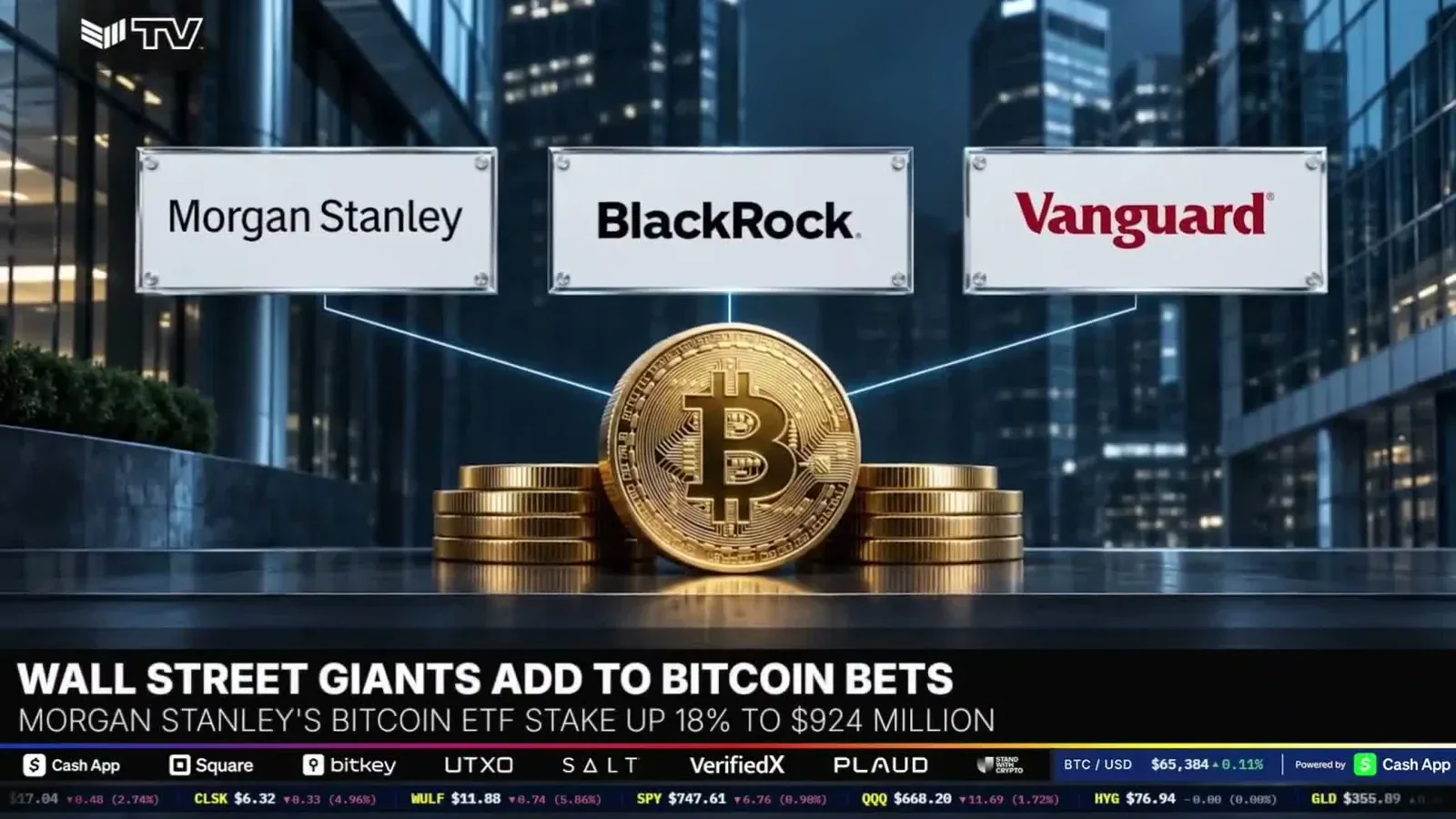
Morgan Stanley has increased its position in BlackRock's iShares Bitcoin Trust (IBIT) by 18 percent, bringing the stake to about $924 million, according to the bank's latest quarterly disclosure to the US Securities and Exchange Commission. The move adds to a steady build-up of regulated Bitcoin exposure at one of the largest wealth managers in the United States.
The filing matters because of how it is structured, not only because of the headline number. Morgan Stanley does not hold Bitcoin directly on its balance sheet for most clients; it buys shares of a spot exchange-traded fund that holds the coin, which gives advisers a familiar ticker, intraday liquidity and a custody arrangement that fits existing risk models. That is the channel through which Bitcoin exposure now reaches portfolios that would never open a crypto exchange account.
Buying the dip, not chasing the price
The pattern is accumulation rather than momentum chasing. In the previous quarter Morgan Stanley raised its IBIT share count by about 23 percent to roughly 16.5 million shares while the dollar value of the position fell, because Bitcoin's price declined over the same period. In other words, the bank added exposure while the asset was getting cheaper. The latest increase to $924 million follows the same logic: more shares bought into weakness, with the reported value now reflecting a recovery in Bitcoin toward the $65,000 area.
That distinction between share count and dollar value is the part most headlines miss. A rising dollar figure can simply mean Bitcoin went up; a rising share count means someone actually bought more. Here both are moving in the same direction, which is a stronger signal than either one alone.
What it means for the market
For the broader market, the signal is institutional rather than speculative. Morgan Stanley now combines three routes to the same asset: IBIT for clients who want the largest and most liquid fund, its own Morgan Stanley Bitcoin Trust launched this year with a lower fee, and structured notes linked to IBIT for investors who want defined payoff profiles. When a bank builds that many doors into one asset, it is treating Bitcoin as a permanent product line, not a trade.
The limits are equally clear. A 13F filing shows what the bank held at quarter-end, not what it holds today, and $924 million is a small fraction of IBIT's tens of billions in assets. One wealth manager adding to a position does not set the price of Bitcoin. What it does set is the direction of travel: regulated, recurring, advisor-led demand, bought on weakness, at the largest institutions in finance.
// Read next
FT: Russian VC revealed as multibillion-dollar Tether co-owner
Vitaly Bezrodnykh, founder of Fulgur Ventures, holds a previously undisclosed multibillion-dollar stake in Tether, per …
Binance wins conditional approval for Bhutan regional hub
Binance received in-principle approval from Bhutan’s Gelephu Central Bank to build an Asia hub, weeks after a $6.3 bill…
Bitcoin and gold are 2026's worst-performing major assets
Bitcoin is down 32% in 2026 and gold 16%, placing both at the bottom of the year's major-asset rankings — a pairing mar…
Kalshi fights states over prediction market taxes and gambling rules
New York, New Jersey and Kentucky are testing whether federal oversight shields Kalshi from state gambling laws as Bern…