Meta explains how plain-language picks steer Facebook Feed
Meta detailed how Facebook Your Algorithm turns typed interests into Feed and Reels ranking, using LLMs for profile building, retrieval and filtering.
AIXVZ
AI agents that sell for you. AIXVZ builds sales agents and automates routine business processes — from first contact to deal.
Learn more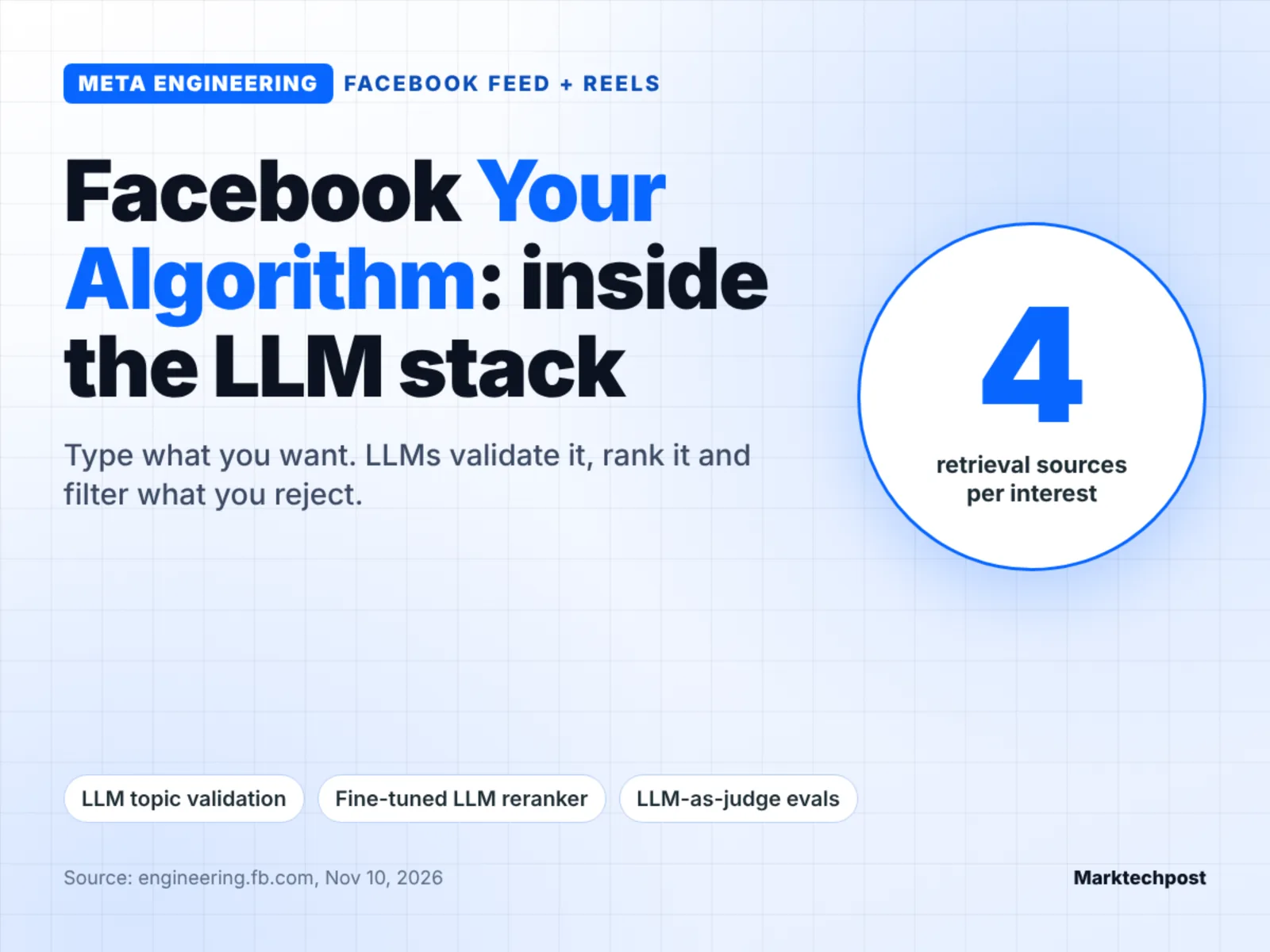
Meta has published an engineering deep dive on Facebook Your Algorithm, a preference page that lets people describe in plain language what they want in Feed and Reels. The feature was announced on October 13, 2026, and the new post shows how large language models sit inside a production recommender. For users, it matters because stated interests now directly shape retrieval, ranking and filtering across both surfaces.
LLMs handle profiles, retrieval and filtering
Your Algorithm has three parts, according to Meta. A one-sentence Lately Summary describes recent viewing, an Interested In list is prefilled from past activity, and a Not Interested In list holds exclusions. People can type interests, move them between lists or delete them, with access through the three-dot menu on posts. Meta frames explicit preferences as a fix for implicit engagement signals, which scale well but adapt slowly and miss nuance.
Meta splits the preference lifecycle into four components: profile generation, preference management, ranking and delivery optimization. One language model turns refreshed interest signals into readable topic names and writes the Lately Summary. A smaller, cheaper model checks that a typed phrase is a coherent topic, detects duplicates and maps it to a clean topic name. Validated interests are enriched with an embedding and search keywords, then saved to a shared store that both Feed and Reels read, while a separate component runs integrity and safety checks.
What explicit controls change for daily scrolling
Each Interested In topic drives four retrieval sources. Two match content directly through search and clusters of closely related topics, while two extend reach through the content graph and item-to-item similarity. Passing candidates get a late-stage ranking promotion after a relevance check, with controls to prevent flooding: repeats are spaced out, each interest has a daily contribution cap, retrieval fetches for one interest per request, and new interests get temporary extra weight. Changes reach the feed faster through an extra fetch outside the normal cycle.
Not Interested In filtering works in layers at every stage. Ranking uses embedding comparison to remove close matches, demotion rules push down near matches, and a fine-tuned language-model reranker reviews the final list and returns only items to remove. Quality requests such as less AI-generated or sexually suggestive content map to dedicated demotion signals, requests naming a creator filter that creator directly, and on-device cache invalidation removes queued items before display. Meta discloses no metrics, latency figures or model names, so its claims about speed, reliability and effectiveness stay unverified.
// Read next
AI labs near cryptography breakthrough as expert panel prepares statement
A 21-expert cryptography panel lists a forthcoming statement as researchers point to an AI breakthrough in theoretical …
Musk: Google Wants to Rent More Computing Capacity From SpaceX
Elon Musk says Google is interested in renting additional computing power from SpaceX, a signal of how tight AI infrast…
RTX 5090 Cable Melt Triggers Air Quality Alarm in PC Owner Room
A Reddit user says a melting 12+4-pin cable on a Gigabyte RTX 5090 filled the room with particles and damaged the GPU p…
YouTuber builds working USB graphics card for 20 cents
Bitluni turned a 13-cent CH570 microcontroller into a monochrome USB graphics card using PWM video tricks and SRAM cach…