Luxor confirms Bitcoin mining hijack via Commander, pledges full
Luxor confirmed attackers redirected client hashrate through Commander on Nov. 14, patched the flaw within two hours and promised full compensation for lost mining revenue.
AIXVZ
AI agents that sell for you. AIXVZ builds sales agents and automates routine business processes — from first contact to deal.
Learn more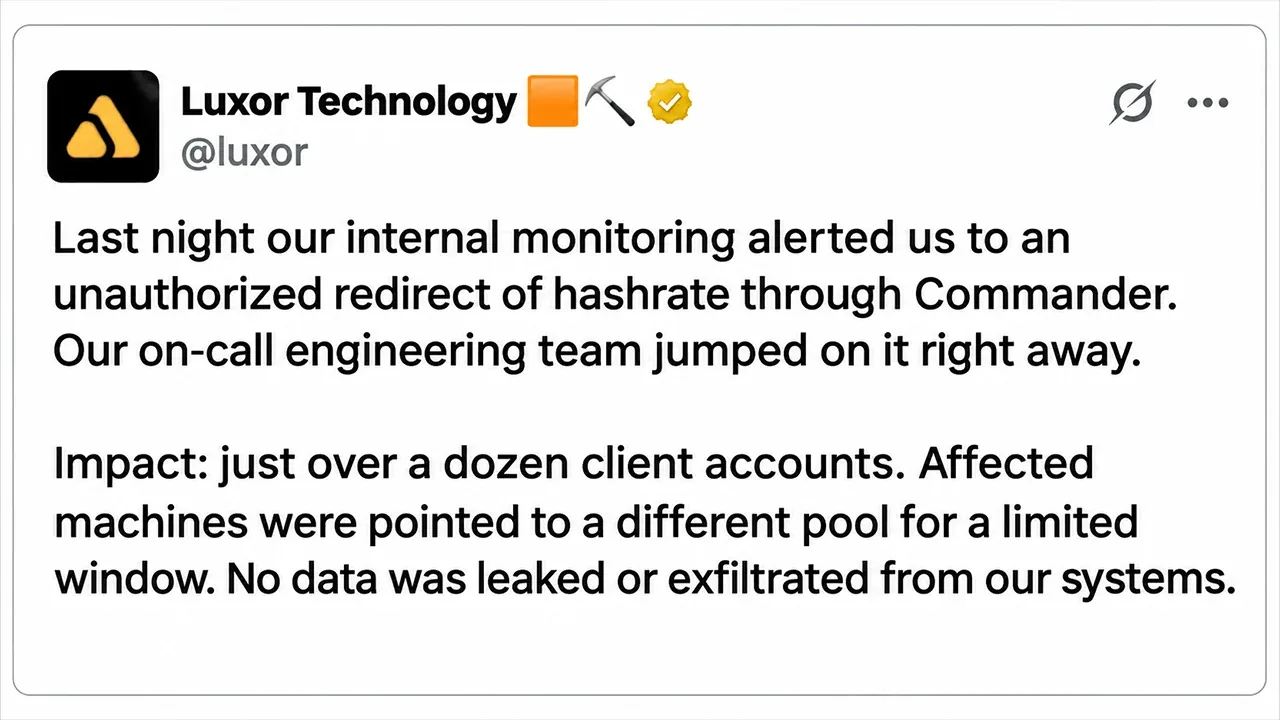
Luxor Technology confirmed that attackers redirected customer Bitcoin mining hashrate through its Commander management platform on Nov. 14, affecting just over a dozen client accounts for a limited window. The company said engineers patched the flaw within two hours and will pay affected clients in full for redirected hashrate. The case matters because it shows mining revenue can be diverted by changing pool settings, without stealing coins or data.
Patch in two hours, pool and firmware untouched
Luxor said internal monitoring detected unauthorized modifications to mining pool configurations on the evening of Nov. 14, with chief executive Nick Hansen placing the start at around 6 p. m. Pacific time on Saturday. Affected machines were pointed to a different pool for a limited period, while Luxor stated that no data was leaked or exfiltrated from its systems. The company said the compromise was confined to Commander, with its mining pool and LuxOS firmware remaining unaffected. Engineers patched Commander within two hours and then began restoring affected equipment to original configurations. Luxor added that affected customers will receive additional information by email and that a comprehensive post-mortem will follow.
Hansen described the intrusion as a sophisticated AI-enabled vector, but Luxor has not publicly detailed the mechanism or published technical findings on how attackers gained access. Before the confirmation, reports circulating late Saturday suggested about 64,000 machines representing an estimated 13 exahash per second had been redirected toward the Ocean mining pool. Those figures remain independently unverified, and Luxor disclosure of just over a dozen accounts does not establish the total machine count. Ocean, a noncustodial Bitcoin mining pool launched in 2023 with backing from Jack Dorsey, showed unusual activity on its public dashboard. A suspected destination address was linked to an estimated 0.65761026 BTC in shares, while blockchain records showed no confirmed incoming transactions, suggesting no collected payout.
What miners and holders should take away
For mining operators, the direct effect is lost time and diverted computational power rather than a wallet theft, and Luxor compensation pledge addresses that revenue gap as if the hashrate had mined normally. The company statement was issued Sunday, Nov. 15, 2026, and CoreX Hosting, which first publicized the suspected attack, later reported unauthorized hashrate had declined to about 100 petahash per second. For other holders of Bitcoin, the incident does not involve a protocol flaw or exchange balances, but it underlines dependence on remote fleet-management software and pool settings. Operators relying on similar dashboards may need to review access controls, change credentials and monitor configuration changes until Luxor publishes its review.
The story does not prove how the AI-assisted method worked, how many machines were involved, or how much computational power was diverted in total. Estimated rewards of about 0.657 BTC reflect shares shown on a dashboard, not completed payments, and available records show no confirmed receipt by the suspected address. The pledge covers only affected Commander clients for the limited redirection window, not wider market effects. Until Luxor releases technical detail, the central unanswered issue is how attackers obtained sufficient control to redirect industrial mining equipment.
// Read next
FT: Russian VC revealed as multibillion-dollar Tether co-owner
Vitaly Bezrodnykh, founder of Fulgur Ventures, holds a previously undisclosed multibillion-dollar stake in Tether, per …
Binance wins conditional approval for Bhutan regional hub
Binance received in-principle approval from Bhutan’s Gelephu Central Bank to build an Asia hub, weeks after a $6.3 bill…
Bitcoin and gold are 2026's worst-performing major assets
Bitcoin is down 32% in 2026 and gold 16%, placing both at the bottom of the year's major-asset rankings — a pairing mar…
Kalshi fights states over prediction market taxes and gambling rules
New York, New Jersey and Kentucky are testing whether federal oversight shields Kalshi from state gambling laws as Bern…