Lawyer runs DeepSeek on eight old V100 GPUs with near-NVFP4 precision
A South Carolina trial lawyer upgraded a private eight-V100 server to run about 80 percent of DeepSeek V4.1 Flash at 4-bit precision, trading a small speed loss for higher fidelity.
AIXVZ
AI agents that sell for you. AIXVZ builds sales agents and automates routine business processes — from first contact to deal.
Learn more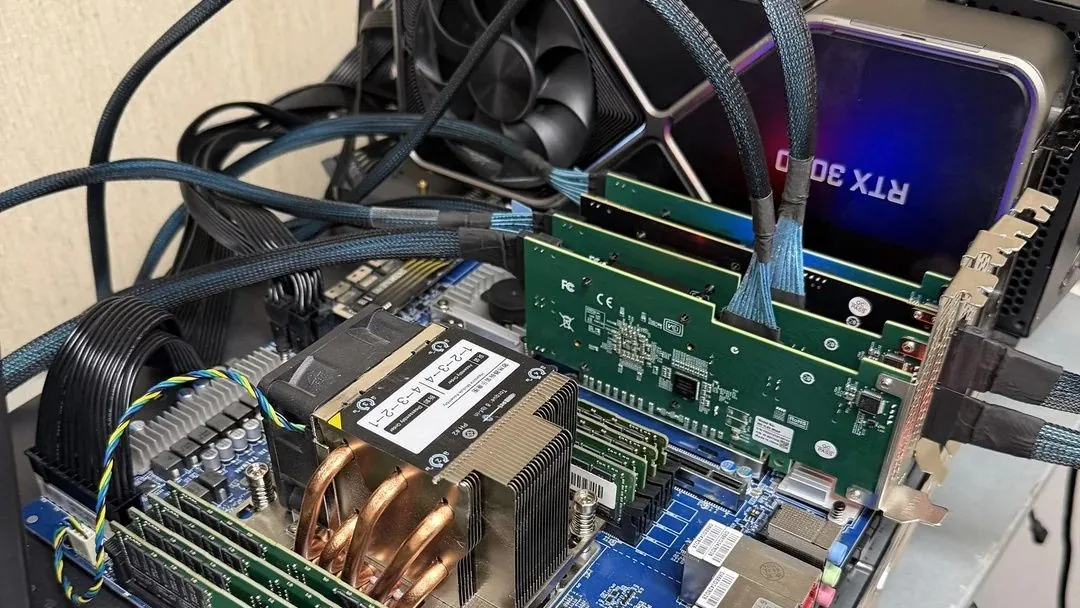
Trial lawyer Nick Mermiges in Columbia, South Carolina upgraded his private AI server built on eight used Nvidia V100 GPUs to run about 80 percent of DeepSeek V4.1 Flash work at 4-bit NVFP4 precision. The build, called Volta Max uPLIft, also added 1TB of RAM and an Nvidia RTX 3090, and fixed crashes traced to a bad power supply. The change matters for professionals who want capable models to run on-premises so documents never leave the office.
From 2-bit weights to selective 4-bit experts
The server runs DeepSeek V4.1 Flash with a legal harness, the workflows and checks the lawyer wraps around the model for his law practice. The previous Volta sPLIt build kept model weights at 2-bit, totaling 248.8GB, while the new Hugging Face package is about 556GB. DeepSeek V4.1 Flash uses 384 routed experts in each of 40 layers, or 15,360 in total, which the builder estimates at about 269 GiB at official precision. Eight 32GB V100 cards provide 256 GiB in total, so the full model at that precision did not fit.
The workaround keeps every expert on the cards at 2-bit and upgrades the most-used ones to NVFP4 until memory is full. In the two-request setup he now runs, 5,949 experts, or about 38.7 percent, are at NVFP4. Most-used was counted from a mix of four kinds of text weighted equally, including his own legal harness traffic. In single-request testing, between 80 percent and 86 percent of decode routes landed on NVFP4 experts, lowest for general text and highest for source code, with a prediction of 78 percent to 85 percent for two requests. The V100s remain on borrowed time with R580, the last Nvidia driver branch to support them, and the GPUs stay capped at 1,522 MHz.
Higher fidelity, slightly slower output
Measured against Nvidia's own NVFP4 version of DeepSeek V4.1 Flash as reference, fidelity improved. Same next token rose to 95.1 percent from 92.2 percent, KL divergence fell to 0.079 nats from 0.196, and changed multiple-choice answers across 513 questions fell from 79 to 8. The builder noted accuracy was about the same across builds, so the gain is fidelity to the reference rather than higher test scores. Code output fell to 150-180 tokens per second from 160-215, with code 3 percent to 30 percent slower and legal writing 9 percent to 23 percent slower depending on prompt length. Legal output benched at 86 to 106 tokens per second and prose at 78 to 86, while two simultaneous requests raised total output to 159.0 tokens per second versus 118.9 for one.
The story does not prove that old V100 clusters match frontier systems or suit every firm. Each request needs its own slot with state kept on the cards, leaving room for 6,215, 5,949 and 5,663 NVFP4 experts for one, two and three slots, so added concurrency may push more calls back to 2-bit. Tests cited were on the first release, not the newer two-request setup, and the RTX 3090 has not yet taken over the small draft model. The next step described is eight more V100s and a second server with 512GB of RAM for parallel agents, alongside two DGX Sparks already running the model at 1M context.
// Read next
AI labs near cryptography breakthrough as expert panel prepares statement
A 21-expert cryptography panel lists a forthcoming statement as researchers point to an AI breakthrough in theoretical …
Musk: Google Wants to Rent More Computing Capacity From SpaceX
Elon Musk says Google is interested in renting additional computing power from SpaceX, a signal of how tight AI infrast…
RTX 5090 Cable Melt Triggers Air Quality Alarm in PC Owner Room
A Reddit user says a melting 12+4-pin cable on a Gigabyte RTX 5090 filled the room with particles and damaged the GPU p…
YouTuber builds working USB graphics card for 20 cents
Bitluni turned a 13-cent CH570 microcontroller into a monochrome USB graphics card using PWM video tricks and SRAM cach…