Lawyer runs DeepSeek on 12 used Nvidia V100s for $9,450
A lawyer expanded a home server to 12 used Nvidia V100s to run all DeepSeek V4.1 Flash experts in 4-bit precision at up to 184 tokens per second.
AIXVZ
AI agents that sell for you. AIXVZ builds sales agents and automates routine business processes — from first contact to deal.
Learn more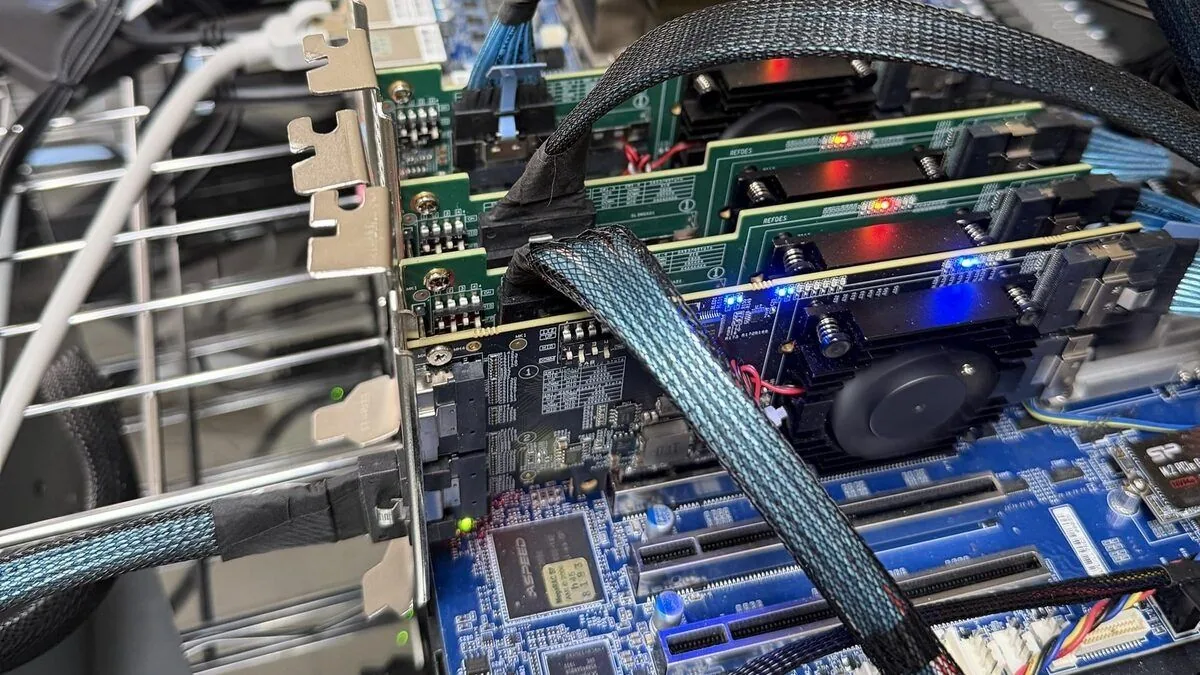
A lawyer identified as Nick Mermiges has expanded his private AI server to 12 used Nvidia V100 graphics cards at a total cost of $9,450, and now runs every DeepSeek V4.1 Flash expert at 4-bit NVFP4 precision. The system reaches up to 184 tokens per second on code tasks and starts answering long documents in about half the time of his prior build. For readers tracking AI costs, it shows how older hardware can still run a current open model locally.
How 12 old cards fit the full model
The build uses three boards with four V100 cards each, up from eight cards in the previous version. The eight 32GB cards provided 254 GiB of memory, while the model experts in Nvidia NVFP4 format need 278.9 GiB. His earlier workaround kept every expert on the cards at 2-bit precision, with 5,949 experts, about 38.7%, upgraded to NVFP4 until memory was full. With 12 cards, all 15,360 experts fit in NVFP4 with none compressed further, according to his GitHub repository.
The V100 dates to 2018 and has no FP4 or FP8 tensor cores, so each NVFP4 value must be unpacked in software into half precision before computation. The author explains that the compact format still helps because the cards read fewer bytes, not because they compute faster. Model layers are split as 0-13, 14-27 and 28-39 across the three boards, with each section divided among four cards. Cards on one board share Nvidia NVLink, while transfers between boards cross host PCIe through two switches, adding latency for the third board.
What private AI servers mean for work
Measured performance shows the first code token with 256K context arriving in 58 seconds, compared with 108.4 seconds after the previous upgrade. Prompt reading past 32K runs at about 4,500 tokens per second, up from roughly 2,200 tokens per second in the first build. Code decoding is 23% faster at 1K context but shows little gain at 32K and above, so the main benefit is shorter waiting time. He says single-request decoding beats published DGX Spark stacks at half the price of three units, and three simultaneous requests at 128K reached about 360 tokens per second on code.
The claims cover speed and memory fit, not answer quality in use, which the author acknowledges. Power settings were raised from 150 W to 175 W per card with clocks lowered from 1,522 MHz to 1,452 MHz, and a test at 200 W caused the host to trip under four long chats. Four optimizations were disabled after missing targets, and batching beyond three sections gains little. The setup has been his default DeepSeek machine since Monday, but it remains one enthusiast build rather than proof that used V100s suit every office workload.
// Read next
AI labs near cryptography breakthrough as expert panel prepares statement
A 21-expert cryptography panel lists a forthcoming statement as researchers point to an AI breakthrough in theoretical …
Musk: Google Wants to Rent More Computing Capacity From SpaceX
Elon Musk says Google is interested in renting additional computing power from SpaceX, a signal of how tight AI infrast…
RTX 5090 Cable Melt Triggers Air Quality Alarm in PC Owner Room
A Reddit user says a melting 12+4-pin cable on a Gigabyte RTX 5090 filled the room with particles and damaged the GPU p…
YouTuber builds working USB graphics card for 20 cents
Bitluni turned a 13-cent CH570 microcontroller into a monochrome USB graphics card using PWM video tricks and SRAM cach…