Intel retakes CPU share on desktop strength as AMD sets server record
Intel regained overall x86 share in Q3 2026 on a desktop rebound, while AMD hit records in mobile and server CPUs as total shipments fell.
AIXVZ
AI agents that sell for you. AIXVZ builds sales agents and automates routine business processes — from first contact to deal.
Learn more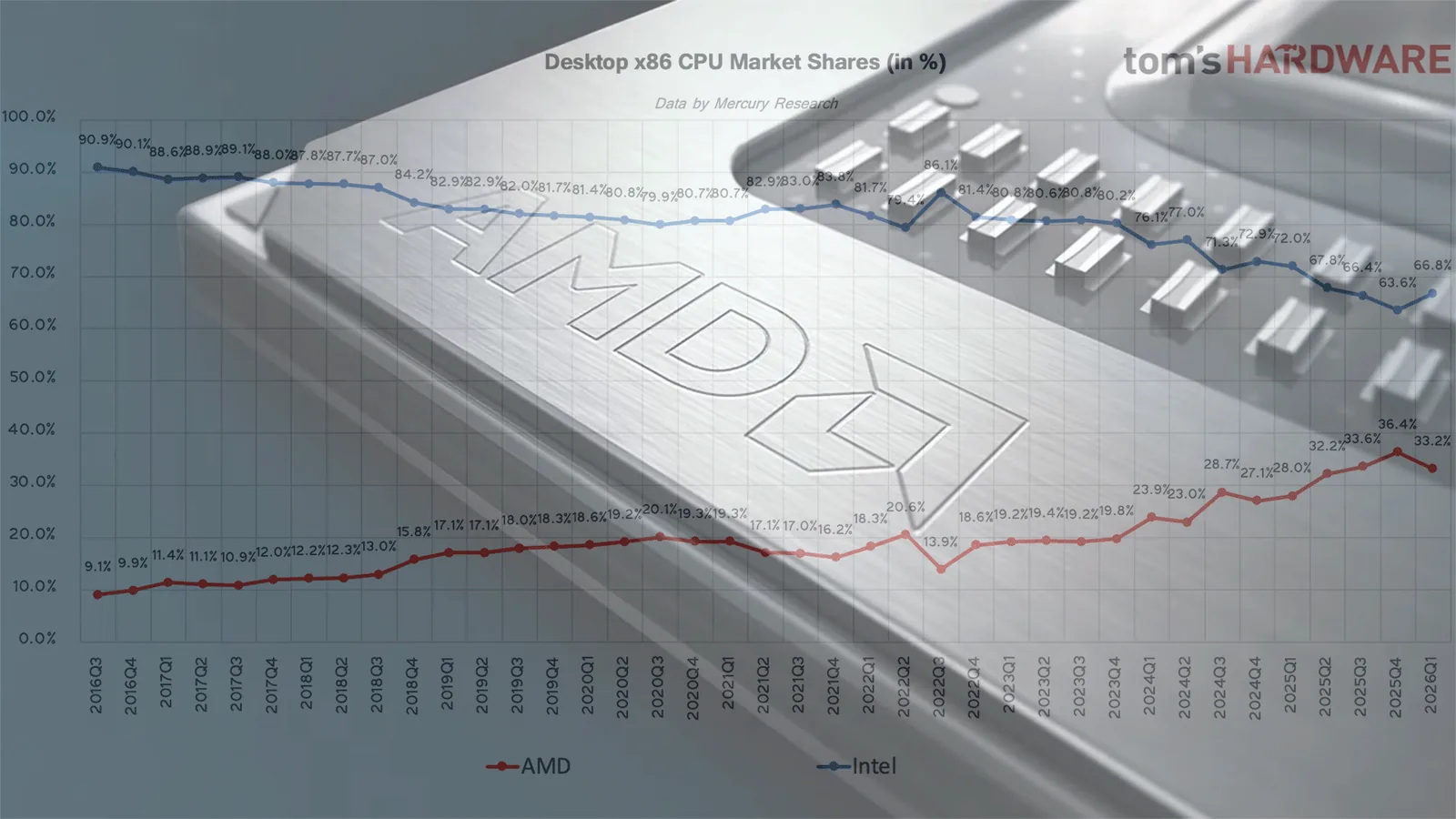
Intel regained overall x86 CPU market share from AMD for the first time since the second quarter of 2025, driven by a sharp rebound in desktop shipments. Industry shipments totaled 68.93 million x86 CPUs in the third quarter of 2026, with 60.8 million client CPUs and 8.13 million data center processors. The shift matters because weaker PC demand is raising prices and changing what computers companies and households can afford.
Desktop rebound and record server shipments
Mercury Research reported that total x86 shipments fell quarter over quarter and year over year as client demand softened on high component prices, while server CPU unit sales grew by more than 20% year over year. Jon Peddie Research estimated client shipments at 60.8 million units, down from 62.93 million in the prior quarter and about 65 million a year earlier. Intel lifted its desktop unit share to 70.1%, up 5 points sequentially and 3.7 points year over year, while AMD fell to 29.9% from 34.9% in the prior quarter. In servers, AMD reached a record 35.5% unit share, up from 34.5% sequentially and 27.8% a year earlier, with Intel at 64.5%.
Mobile processors drove the quarterly client decline, with notebook CPU shipments falling by more than 10% from the prior quarter, according to Mercury Research. AMD still edged higher in mobile to a record 29.2% share, up from 28.9% sequentially and 21.9% a year earlier, while Intel held 70.8%. Analyst Dean McCarron said the third quarter PC CPU market declined more than expected after a stronger than expected second quarter, suggesting some demand was pulled forward. Mercury Research also said weaker mobile demand may have let Intel direct more silicon to mainstream desktop CPUs, a segment both suppliers had undersupplied. Rising memory prices, including DRAM and 3D NAND, plus higher costs for graphics cards and SSDs, weighed on PC and gaming PC demand.
What weaker PC sales mean for buyers
For people planning to buy or replace a computer, the data point to lean inventories at PC makers and a weak DIY channel, which can mean fewer promotions and higher configured prices when memory and storage costs rise. Workers and employers face a split market: mainstream desktops became more available through Intel supply, while notebooks faced a sharper pullback that could delay refresh cycles. For data center employment and enterprise budgets, continued server growth tied to AI infrastructure buildout supports demand for conventional data center processors and workstation-class CPUs used in smaller departmental AI servers. Jon Peddie Research president Dr. Jon Peddie said PC conditions are expected to remain difficult into the first half of 2027.
The figures describe shipments to system makers, which occur months before finished PCs reach stores, not final retail sales. Both AMD and Intel expect client CPU shipments to fall by more than 20% sequentially in the fourth quarter, but part of that pattern is seasonal because fourth quarter chips supply first quarter systems. AMD’s overall x86 share excluding embedded and semi-custom fell 0.6 points sequentially but rose 4.5 points year over year. The story does not show that one supplier has secured a lasting lead across PCs, and it does not apply evenly to gamers, notebook buyers, or console owners affected by AMD’s smaller game console business.
// Read next
AI labs near cryptography breakthrough as expert panel prepares statement
A 21-expert cryptography panel lists a forthcoming statement as researchers point to an AI breakthrough in theoretical …
Musk: Google Wants to Rent More Computing Capacity From SpaceX
Elon Musk says Google is interested in renting additional computing power from SpaceX, a signal of how tight AI infrast…
RTX 5090 Cable Melt Triggers Air Quality Alarm in PC Owner Room
A Reddit user says a melting 12+4-pin cable on a Gigabyte RTX 5090 filled the room with particles and damaged the GPU p…
YouTuber builds working USB graphics card for 20 cents
Bitluni turned a 13-cent CH570 microcontroller into a monochrome USB graphics card using PWM video tricks and SRAM cach…