Humyn Labs raises $47M to bring robot training into real world
Humyn Labs raised $47 million and passed $50 million in annualized revenue by recording how people work across 20 countries for AI labs.
AIXVZ
AI agents that sell for you. AIXVZ builds sales agents and automates routine business processes — from first contact to deal.
Learn more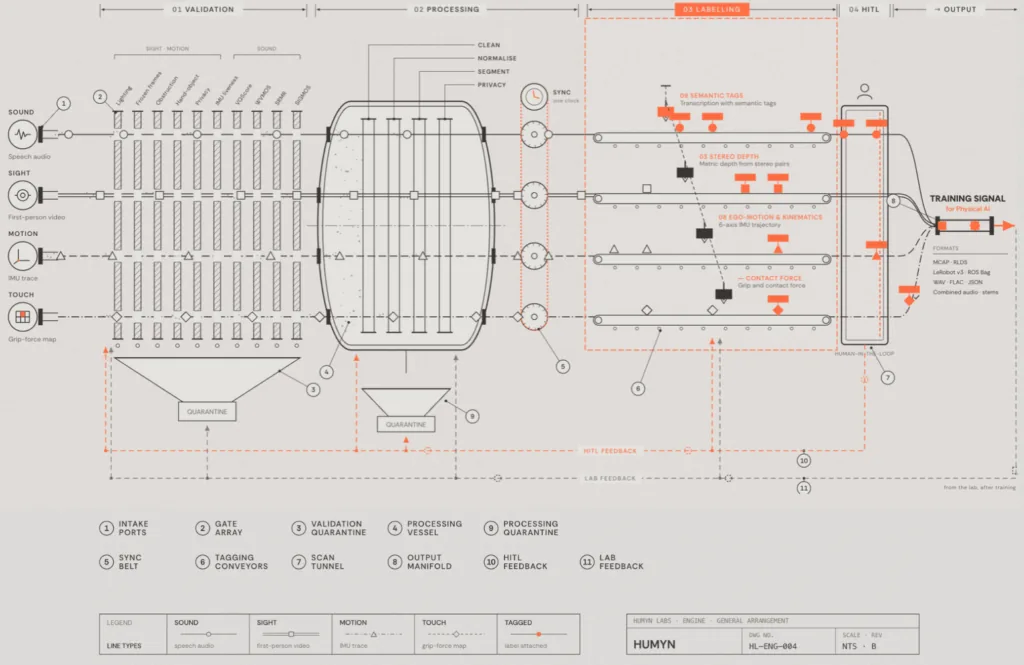
Humyn Labs, a physical AI research and deployment company, raised $47 million in Series A funding and said it passed $50 million in annualized revenue within six months of operations. The company works with frontier AI labs, robotics firms and world-model developers to collect real-world training data across more than 20 countries. The gap matters because many robots still learn in simulation, while paid deployment depends on how they handle homes, stores and factories.
How Humyn collects vision, sound, touch and motion
The round consists of $26 million in equity led by Accel and $21 million in venture debt led by Lighthouse Canton. Equity participants include Prosus Ventures, BeeGlobal, Finserv Intelligence through Bajaj Finance, Bajaj Alts AI Opportunities Fund, Dallas Venture Capital, Lighthouse Canton, Jump Trading LLC and angel investor Anita Pramoda, former CFO of Epic. Debt participant Trifecta Capital joined Lighthouse Canton in the venture-debt portion, according to The Robot Report. Co-founders Ishank Gupta and Manish Agarwal said the capital will fund deployment-readiness infrastructure in Brazil, Korea and India, capture hardware and an enrichment engine, plus presence in San Francisco, London and Seoul.
Humyn gathers data across four modalities: vision, sound, touch and motion. It uses proprietary capture devices to record how people perform specific jobs to a lab’s requirements, then converts the recordings into labelled, training-ready datasets with verified provenance. Gupta told The Robot Report the company works backward from what researchers need and builds bespoke collection and enrichment programs. Operations focus on Latin America, Southeast Asia, South Asia and East Asia, with on-ground collection partners in 20 countries. Audio collection emphasizes different languages, while vision, touch and motion are more industry-specific and often collected together.
Why real-world data decides robotics jobs and costs
The company divides its work into residential, commercial and industrial settings, with manufacturing and factory work classed as industrial and warehousing, retail and hospitality classed as commercial. Its data is designed to work across robot embodiments, from stationary arms for manipulation-only assembly tasks to mobile systems that must manipulate and navigate in hotels and warehouses. For workers, that means automation pressure will differ by task type: repetitive stationary handling first, mobile service work later. For employers and labs, better real-world datasets can shorten testing, reduce failed pilots and lower the cost of moving a robot from lab trials to paid operation.
What this does not prove is that more human demonstration data alone solves deployment. Humyn describes itself as a data and deployment partner, not a robot maker, and its revenue claim is annualized after six months of operations. The average robotics deployment cycle is still undefined, and the company’s co-founders frame faster real-sim-real iteration as an opportunity rather than a solved problem. The story applies mainly to AI labs and robotics developers buying training data, not to households or small businesses buying robots today.
// Read next
AI labs near cryptography breakthrough as expert panel prepares statement
A 21-expert cryptography panel lists a forthcoming statement as researchers point to an AI breakthrough in theoretical …
Musk: Google Wants to Rent More Computing Capacity From SpaceX
Elon Musk says Google is interested in renting additional computing power from SpaceX, a signal of how tight AI infrast…
RTX 5090 Cable Melt Triggers Air Quality Alarm in PC Owner Room
A Reddit user says a melting 12+4-pin cable on a Gigabyte RTX 5090 filled the room with particles and damaged the GPU p…
YouTuber builds working USB graphics card for 20 cents
Bitluni turned a 13-cent CH570 microcontroller into a monochrome USB graphics card using PWM video tricks and SRAM cach…