Homelabber links four Nvidia V100s to a mini PC for 128GB VRAM
An Australian homelabber paired four used 32GB Nvidia V100s with a Lenovo mini PC, using coreboot and OCuLink docks to run local AI models for about $3,500.
AIXVZ
AI agents that sell for you. AIXVZ builds sales agents and automates routine business processes — from first contact to deal.
Learn more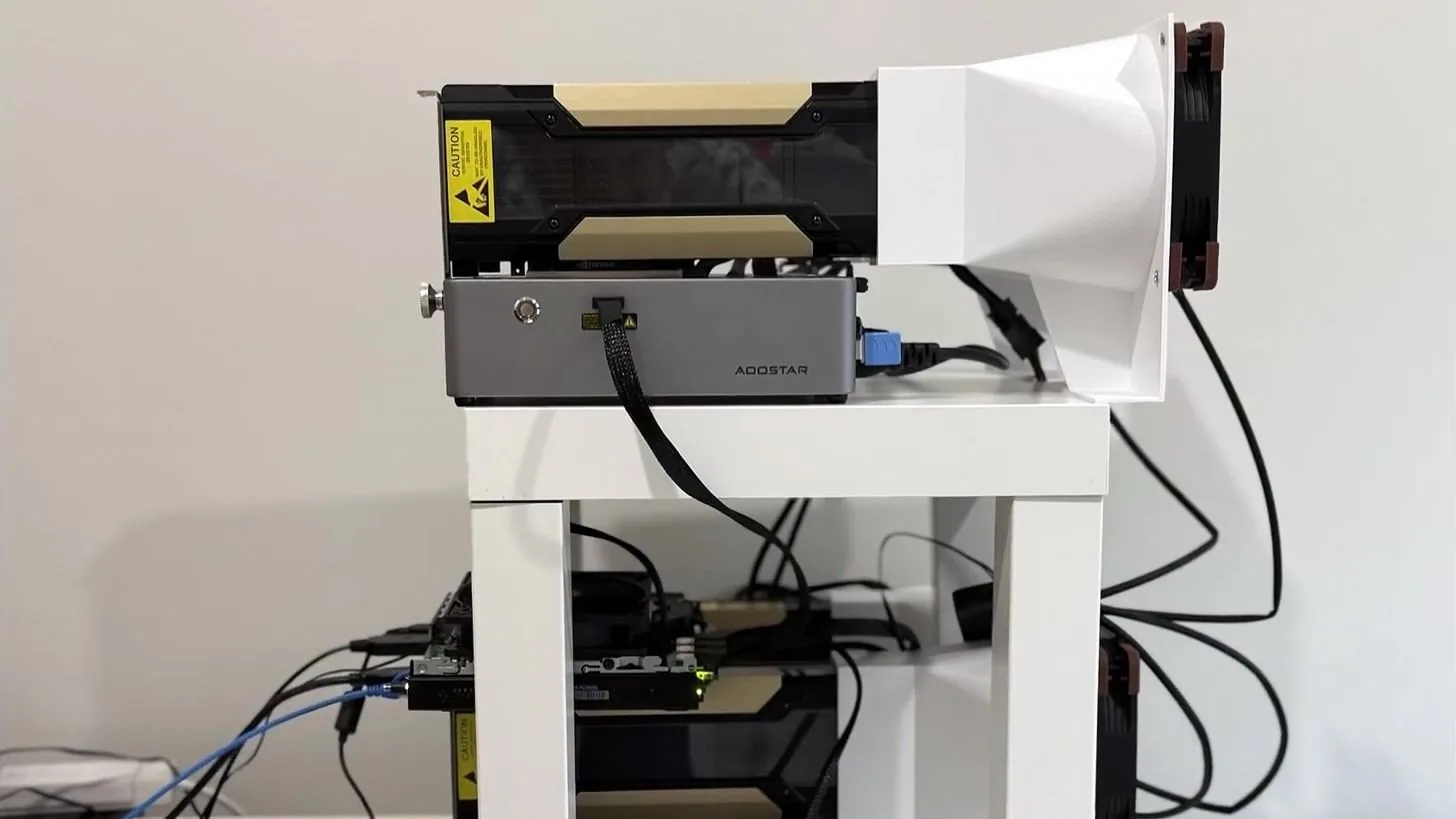
Australian homelabber Michael built a local AI system from four used 32GB Nvidia V100 cards and a refurbished Lenovo M720q Tiny mini PC, unlocking 128GB of VRAM for about $3,500 in the US. The system runs Qwen3.8-27B at about 285 tokens per second in total across four cards, with each card handling a separate copy. The builder says the machine runs almost around the clock and should pay for itself in about three months.
How OCuLink, coreboot and solder fixed the limits
The Tiny PC uses an i5-9400T processor with 64GB of DDR4 memory, plus a Lenovo 01AJ940 riser and a CEACENT CNOL4PE08 PCIe switch card. That card uses a 24-lane PEX8724 switch to provide an x8 link in and four x4 OCuLink ports out, giving each GPU a PCIe Gen3 x4 connection. Each V100 sits in an AOOSTAR AG01 eGPU dock with a built-in 800W power supply, connected through a dual PCIe 8-pin to CPU 8-pin adapter.
The stock setup could not boot four cards. The Tiny only powers its riser slot when a card pulls the presence pin, which required a solder bridge on the back of the riser. Lenovo BIOS also leaves only a 128GB window for 64-bit devices, while each 32GB V100 needs 64GB, so a third card hung at POST. The builder flashed coreboot 26.09 with an EDK2 payload and above-4G allocation, expanding the window to about 486GB, with patches for always-on riser power, Wake-on-LAN override and merged memory type range registers.
What 128GB of used datacenter VRAM can do
For local model work, memory capacity matters more than peak speed. The four-card system reaches 44.7 TFLOPS in FP32 at a 71C peak with each card capped at 200W, compared with Nvidia rating of 14 TFLOPS per 250W card. A single RTX 5090 is rated at 104.8 TFLOPS at 575W, almost double the 56 TFLOPS of four V100s. The builder says his setup offers four times the VRAM and about twice the total memory bandwidth at about half the price of a 5090 in Australia.
The performance claims are specific to his software setup and cooling. Qwen3.8-27B Q6 reaches about 40 tokens per second on one card and about 285 per second with four parallel requests. The larger Qwen3.8-Flash-Next-125B-A6B IQ4_XS reaches about 43 tokens per second, or about 116 with eight requests. The builder calls full 128GB use a party trick but uses the parallel setup to process stock-announcement data going back to the early 1990s, involving millions of documents for his business.
// Read next
AI labs near cryptography breakthrough as expert panel prepares statement
A 21-expert cryptography panel lists a forthcoming statement as researchers point to an AI breakthrough in theoretical …
Musk: Google Wants to Rent More Computing Capacity From SpaceX
Elon Musk says Google is interested in renting additional computing power from SpaceX, a signal of how tight AI infrast…
RTX 5090 Cable Melt Triggers Air Quality Alarm in PC Owner Room
A Reddit user says a melting 12+4-pin cable on a Gigabyte RTX 5090 filled the room with particles and damaged the GPU p…
YouTuber builds working USB graphics card for 20 cents
Bitluni turned a 13-cent CH570 microcontroller into a monochrome USB graphics card using PWM video tricks and SRAM cach…