Google Gemini 4 Neon beats Carbon while running twice as fast
Google DeepMind released Gemini 4 Neon, its fourth model in seven weeks, scoring 61 on the Intelligence Index at lower cost and nearly double the speed of Carbon.
AIXVZ
AI agents that sell for you. AIXVZ builds sales agents and automates routine business processes — from first contact to deal.
Learn more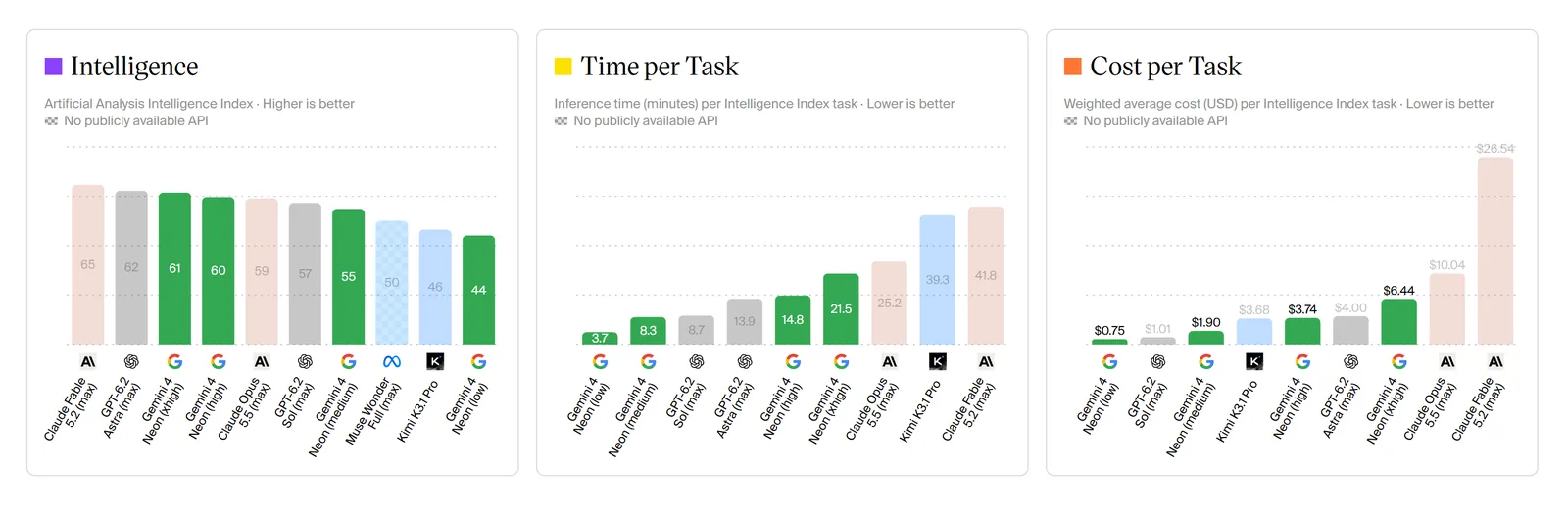
Google DeepMind has released Gemini 4 Neon, its fourth AI model in seven weeks, which scores 61 points on the Intelligence Index against 60 for Gemini 4 Carbon. Neon generates about 110 tokens per second, almost twice Carbon's 57 tokens per second, while per-task costs fall by roughly 17 percent. The release places Google third behind OpenAI and Anthropic on independent benchmarks.
Neon pricing, speed and benchmark scores
Neon offers a one-million-token context window for text, images, audio and video, and Google positions it between Carbon and Hydrogen. At its highest reasoning level, xhigh, it ranks third behind OpenAI's GPT-6.2 Astra and Anthropic's Claude Fable 5.2, according to Artificial Analysis. Through Google AI Studio and Gemini for Business, one million input tokens costs three dollars, or 0.15 dollars when cached, and one million output tokens costs 15 dollars. That list price is 25 percent below Carbon's regular price of four and 20 dollars, but 50 percent above Carbon's promotional price in effect through the end of November.
Artificial Analysis puts Neon's per-task cost at xhigh at 6.44 dollars, about 17 percent below Carbon's undiscounted figure of 7.76 dollars. Neon uses about 15 percent more output tokens per task than Carbon, so the saving comes entirely from the lower per-token list price. At the second-highest level, high, Neon matches Carbon's intelligence score while cutting per-task costs in half. Benchmark processing time drops from about 36 minutes to roughly 21 minutes because of the higher generation speed. Google continues to ship at a rapid pace, with four models released in seven weeks.
What cheaper coding and vision mean for work
On the Coding Agent Index inside Google Antigravity, Neon at xhigh scores 59 points, ahead of Carbon at 55 points and Claude Fable 5.2 and Claude Opus 5.5 at 58 points each. An average coding task costs 6.86 dollars with Neon, compared with 12.61 dollars for Opus and 15.47 dollars for Fable. In the SWE-sweep test, the Antigravity environment triples Neon's hit rate to 39.0 percent, according to Google. On visual processing, Neon at high reaches 33.4 percent on the GDP. pdf document test, five points ahead of Carbon, and leads presentation quality on the AA-Briefcase test with 1771 Elo points. Google also reports leads on the Vals Index, Zapier's AutomationBench at 56.3 percent and RiemannBench at 84.0 percent, plus a cyber variant with 90.5 percent on SEC-bench Pro and 51.26 percent on WebExploitBench v1.2.
Neon does not prove across-the-board superiority. On the GDP. pdf test it falls to 28.0 percent at xhigh after leading at high, showing higher reasoning does not always help. Google omits OpenAI and Anthropic leaders from its own comparison table, and Carbon's promotional price remains cheaper until the end of November. The Model Card claim of blocking 100 percent of indirect prompt-injection attacks on the Gray-Swan benchmark is brief and limited to one test. The results matter mainly for developers and security teams buying large volumes of model output.
// Read next
AI labs near cryptography breakthrough as expert panel prepares statement
A 21-expert cryptography panel lists a forthcoming statement as researchers point to an AI breakthrough in theoretical …
Musk: Google Wants to Rent More Computing Capacity From SpaceX
Elon Musk says Google is interested in renting additional computing power from SpaceX, a signal of how tight AI infrast…
RTX 5090 Cable Melt Triggers Air Quality Alarm in PC Owner Room
A Reddit user says a melting 12+4-pin cable on a Gigabyte RTX 5090 filled the room with particles and damaged the GPU p…
YouTuber builds working USB graphics card for 20 cents
Bitluni turned a 13-cent CH570 microcontroller into a monochrome USB graphics card using PWM video tricks and SRAM cach…