Franklin Templeton Adds HYPE Token to Crypto Index ETF
Franklin Templeton will add Hyperliquid’s HYPE to its $17 million EZPZ index ETF around December 1, making it the eighth holding alongside Bitcoin and Ether.
AIXVZ
AI agents that sell for you. AIXVZ builds sales agents and automates routine business processes — from first contact to deal.
Learn more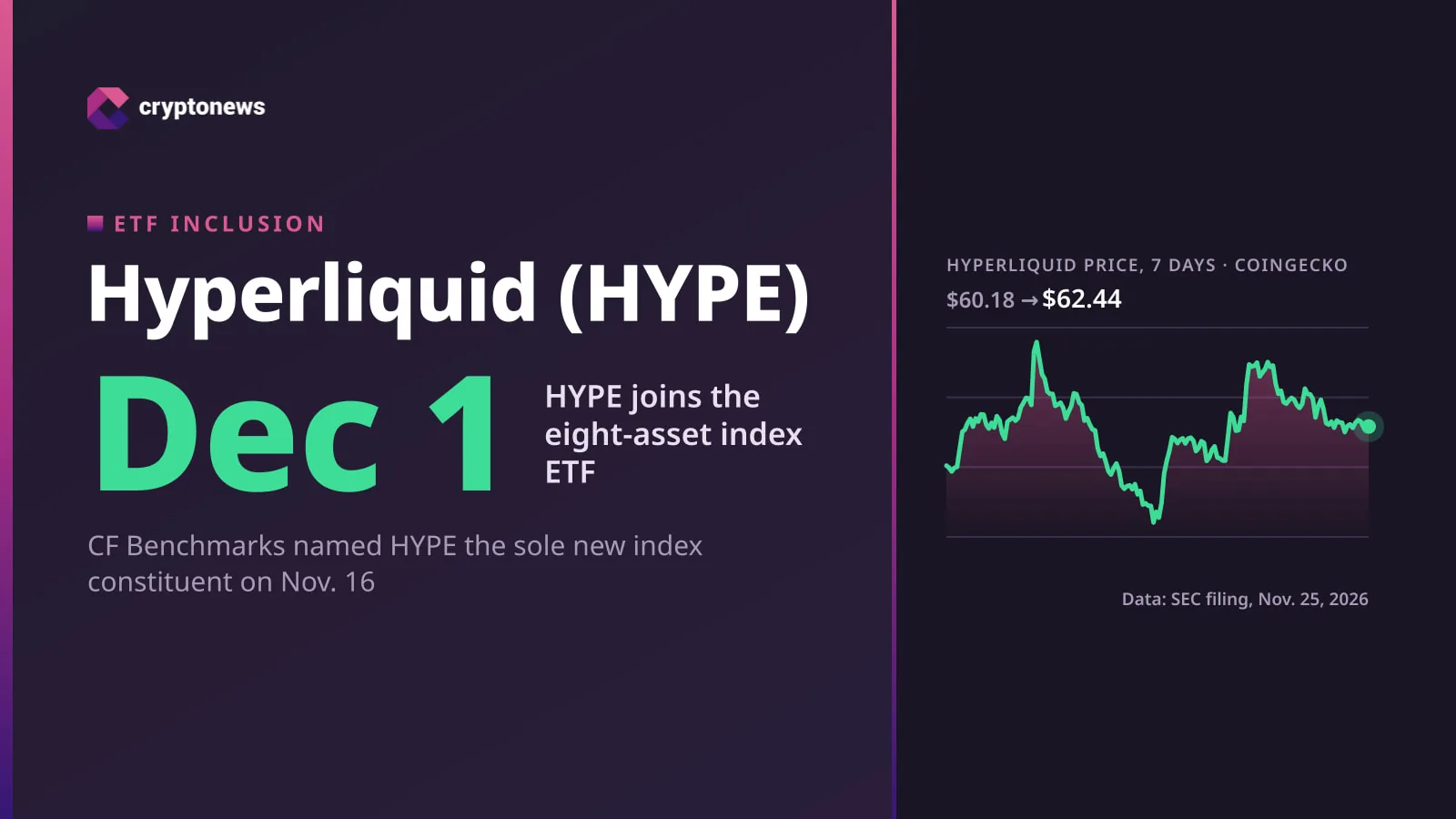
Franklin Templeton will add Hyperliquid’s HYPE token to its Franklin Crypto Index ETF (EZPZ) on or around December 1, according to a prospectus supplement filed with the SEC on November 25. HYPE becomes the eighth asset in the fund’s benchmark, the CF Institutional Digital Asset Index, after index administrator CF Benchmarks named it the sole new constituent on November 16. The move puts a two-year-old token inside a regulated US fund even as Hyperliquid’s own trading platform remains closed to US users.
HYPE becomes eighth holding in EZPZ fund
After the change, the index and the fund will hold eight assets: Bitcoin, Ether, XRP, Solana, Stellar Lumens, Dogecoin, Cardano and HYPE. The fund plans to hold the assets at approximately their index weights, with quarterly rebalancing and future constituent changes decided under the index provider’s rules. The filing does not specify the weighting for HYPE. The supplement amends a prospectus dated December 1, 2025, and relies on generic listing standards adopted by Cboe BZX and approved by the SEC under reference SR-CboeBZX-2025-104, which lets the fund add assets without separate approval. EZPZ trades on Cboe BZX, charges a 0.19% fee and holds actual tokens. Net assets were about 17.02 million dollars as of September 30, up from 10.22 million dollars at the end of December 2025, with Bitcoin accounting for 76.39% of the portfolio.
HYPE is entering its third US index product. Bitwise added it to the Bitwise 10 Crypto Index ETF in July, replacing Polkadot and Avalanche, and Hashdex added it to its Nasdaq CME crypto index ETF in September at a 3.36% entry weighting. Three US spot HYPE exchange-traded products from 21Shares, Bitwise and Grayscale have launched since May, with cumulative net inflows of 272 million dollars as of November 24. The timing coincides with a weak market and new supply: HYPE traded at 63.97 dollars at 13:30 UTC on Sunday, up from about 59.80 dollars on the filing day but down 31% over 30 days, while a token unlock scheduled for December 6 was estimated near 578 million dollars. Regulatory discussion is continuing, with CFTC Chairman Michael Selig outlining on November 19 two routes for onchain platforms to reach US retail traders, and Hyperliquid reporting 7.3 billion dollars in total value locked, up from 4.13 billion dollars in early January, with 80.3 million dollars in revenue over the past 30 days.
Small purchase, wider access for holders
For holders of diversified crypto funds, the change means automatic exposure to HYPE without buying the token directly, with custody, rebalancing and tax reporting handled inside the ETF structure. The dollar purchase will be modest because the fund holds only about 17 million dollars and remains dominated by Bitcoin, so the practical effect on HYPE supply and price is limited. The broader effect is access and legitimacy: inclusion in three index products extends institutional distribution for an asset launched on November 29, 2024, and shows how the Cboe generic listing route allows new tokens to enter regulated funds quickly once an index provider acts. Investors tracking unlocks and rebalancing dates now have two near-term markers, the index change around December 1 and the December 6 unlock.
The filing does not prove sustained demand for HYPE or for small index crypto funds, and it does not set a portfolio weight or forecast flows. The December 6 unlock size is an estimate based on late-November prices and will move with the market. The story affects current and prospective EZPZ holders and HYPE holders watching index demand; it does not change access to Hyperliquid trading for US residents, which remains restricted, nor does it apply to holders of other funds unless their index providers act.
// Read next
FT: Russian VC revealed as multibillion-dollar Tether co-owner
Vitaly Bezrodnykh, founder of Fulgur Ventures, holds a previously undisclosed multibillion-dollar stake in Tether, per …
Binance wins conditional approval for Bhutan regional hub
Binance received in-principle approval from Bhutan’s Gelephu Central Bank to build an Asia hub, weeks after a $6.3 bill…
Bitcoin and gold are 2026's worst-performing major assets
Bitcoin is down 32% in 2026 and gold 16%, placing both at the bottom of the year's major-asset rankings — a pairing mar…
Kalshi fights states over prediction market taxes and gambling rules
New York, New Jersey and Kentucky are testing whether federal oversight shields Kalshi from state gambling laws as Bern…