Fidelity Strategist Holds Bullish Bitcoin View Despite Drop Below $58K
Fidelity strategist Jurrien Timmer stays bullish on bitcoin after its slide below $58,000, pointing to cycle history and a rising power-law support line.
AIXVZ
AI agents that sell for you. AIXVZ builds sales agents and automates routine business processes — from first contact to deal.
Learn more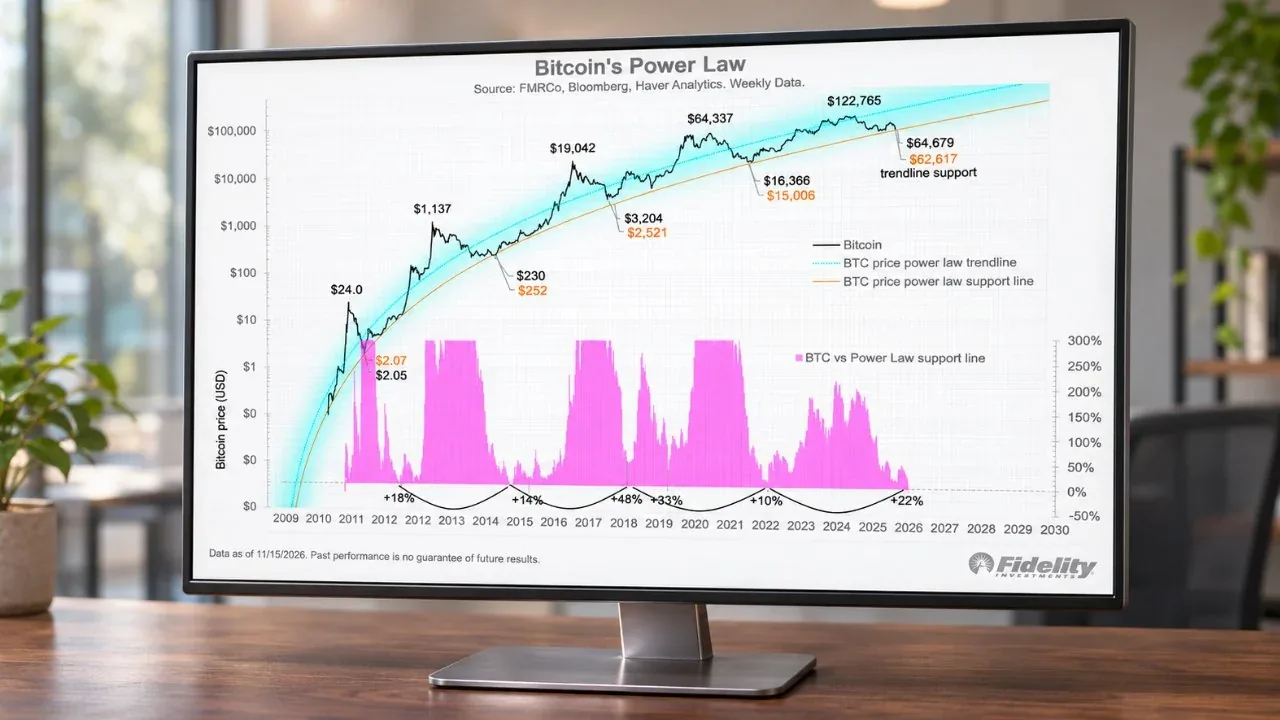
Fidelity Investments director of global macro Jurrien Timmer reaffirmed his bullish outlook after bitcoin fell below $58,000 on Nov. 20, citing its four-year cycle and power law math. The slide put the price about 7.4% below the support line on his Nov. 15 chart. For holders, the message is patience with a warning attached.
Power law support and the Nov. 20 slide
Timmer applies a power law relationship between bitcoin age and price, with a lower curve estimating where price may find support as the network ages. His weekly chart put bitcoin at $64,679 on Nov. 15, above the model support of $62,617. Five days later he placed support near $62,000 and described it as rising, giving no specific price or percentage decline that would change his view. He said on X that it was disheartening to sit again on that support curve.
Bitcoin had traded above $61,000 earlier on Nov. 20 before losing nearly $3,000 between 11 a. m. and noon Eastern. The decline later reached about $57,960. As of 8:46 p. m. Eastern, bitcoin was down about 5% over 24 hours and more than 13% over seven days. In February, Timmer had identified an attractive entry point near $65,000. Bitcoin then touched about $57,800 in late June before recovering over the summer and returning near $80,000 by September.
Why the framework could still break down
For a normal holder, the practical point is how Timmer defines risk. He said a fall well below the support line, currently at $62,000 and rising, would put his entire framework in doubt. That turns the model into a simple check rather than a forecast: holding above or near the line keeps the long-term view intact, while a sustained break below it removes the basis for his call. It does not set a buy or sell level and does not protect against further short-term losses.
The story does not prove that bitcoin must recover or that the four-year cycle still holds. Fidelity Digital Assets analyst Zack Wainwright found in February that volatility had declined even as price climbed above $126,000 in October 2025, with 17 new one-year volatility lows counted by January 2026. He concluded the familiar pattern may no longer apply. Timmer also saw a possible path to $100,000 after two lows, but that depended on a breakout above $80,000.
// Read next
FT: Russian VC revealed as multibillion-dollar Tether co-owner
Vitaly Bezrodnykh, founder of Fulgur Ventures, holds a previously undisclosed multibillion-dollar stake in Tether, per …
Binance wins conditional approval for Bhutan regional hub
Binance received in-principle approval from Bhutan’s Gelephu Central Bank to build an Asia hub, weeks after a $6.3 bill…
Bitcoin and gold are 2026's worst-performing major assets
Bitcoin is down 32% in 2026 and gold 16%, placing both at the bottom of the year's major-asset rankings — a pairing mar…
Kalshi fights states over prediction market taxes and gambling rules
New York, New Jersey and Kentucky are testing whether federal oversight shields Kalshi from state gambling laws as Bern…