Ethereum Glamsterdam Upgrade May Slip to 2027 Over Gas Changes
Ethereum developers weigh delaying Glamsterdam to early 2027 after gas repricing proposals threaten compatibility for around 15,000 smart contracts.
AIXVZ
AI agents that sell for you. AIXVZ builds sales agents and automates routine business processes — from first contact to deal.
Learn more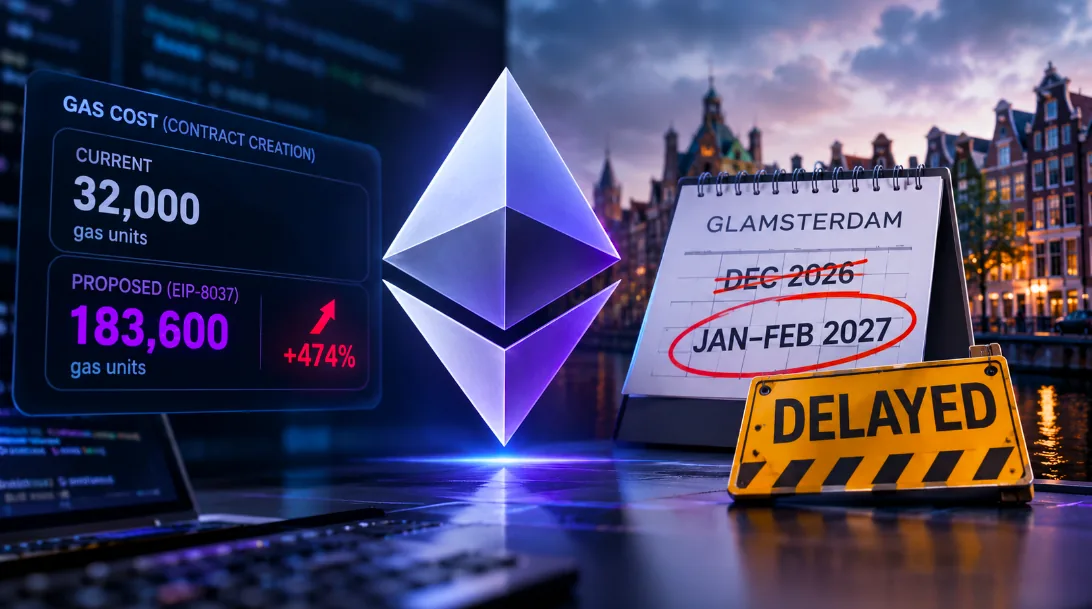
Ethereum’s Glamsterdam upgrade could slip to January or February 2027 as developers assess whether gas-pricing changes would break existing applications. Security testing flagged compatibility risks for as many as 15,000 smart contracts. The delay matters because the upgrade rewrites core cost rules that decentralized apps and fees depend on.
Gas repricing puts 15,000 contracts at risk
The dispute centers on two proposals, EIP-8037 and EIP-8038, which would change how Ethereum charges for creating blockchain state and accessing stored data. One key change would raise the base gas cost of creating a smart contract from 32,000 to 183,600 units, an increase of about 474% before execution and code-storage costs. Some deployed contracts assume fixed gas consumption and could fail under the new rules. Ethereum Foundation developer Marius van der Wijden has warned that as many as 15,000 programs could be affected.
The schedule has already shifted. The Glamsterdam activation planned for the Hoodi test network on October 26 was postponed while developers investigated the issue. Developers have discussed a tentative Hoodi activation during the week of December 14, with a mainnet upgrade in late January or February 2027 if testing and application fixes proceed successfully. Developers have not confirmed a new mainnet launch date. The next developer meeting, scheduled for November 26, could provide greater clarity. This follows an earlier fixed vulnerability involving validator deposits.
What the delay means for holders and builders
For holders and users, a delay would not change balances or ownership, but it postpones expected capacity gains and prolongs uncertainty around transaction costs and app behavior. Developers face a choice: keep the proposed gas changes and give affected projects time to adapt, or revise the specifications and require more testing. The key signals to watch are the November 26 developer discussions, progress on fixing affected contracts, and confirmation of a revised Hoodi activation. A careful fix could reduce the risk of failures reaching the main network.
The story does not prove that Ethereum’s scaling plan has failed, nor does it set a final launch date. Glamsterdam is still intended to improve transaction processing, block validation and gas accounting, potentially raising the gas limit from about 60 million to 200 million gas per block. Its long-term significance may depend less on when it launches and more on whether developers deliver higher capacity without disrupting applications already running.
// Read next
FT: Russian VC revealed as multibillion-dollar Tether co-owner
Vitaly Bezrodnykh, founder of Fulgur Ventures, holds a previously undisclosed multibillion-dollar stake in Tether, per …
Binance wins conditional approval for Bhutan regional hub
Binance received in-principle approval from Bhutan’s Gelephu Central Bank to build an Asia hub, weeks after a $6.3 bill…
Bitcoin and gold are 2026's worst-performing major assets
Bitcoin is down 32% in 2026 and gold 16%, placing both at the bottom of the year's major-asset rankings — a pairing mar…
Kalshi fights states over prediction market taxes and gambling rules
New York, New Jersey and Kentucky are testing whether federal oversight shields Kalshi from state gambling laws as Bern…