Developer replaces Linux with 24KB assembly OS to run AI faster
A 24KB bare-metal OS boots in 74 milliseconds and runs the Qwen3-0.6B model up to 54% faster than the same setup on Linux.
AIXVZ
AI agents that sell for you. AIXVZ builds sales agents and automates routine business processes — from first contact to deal.
Learn more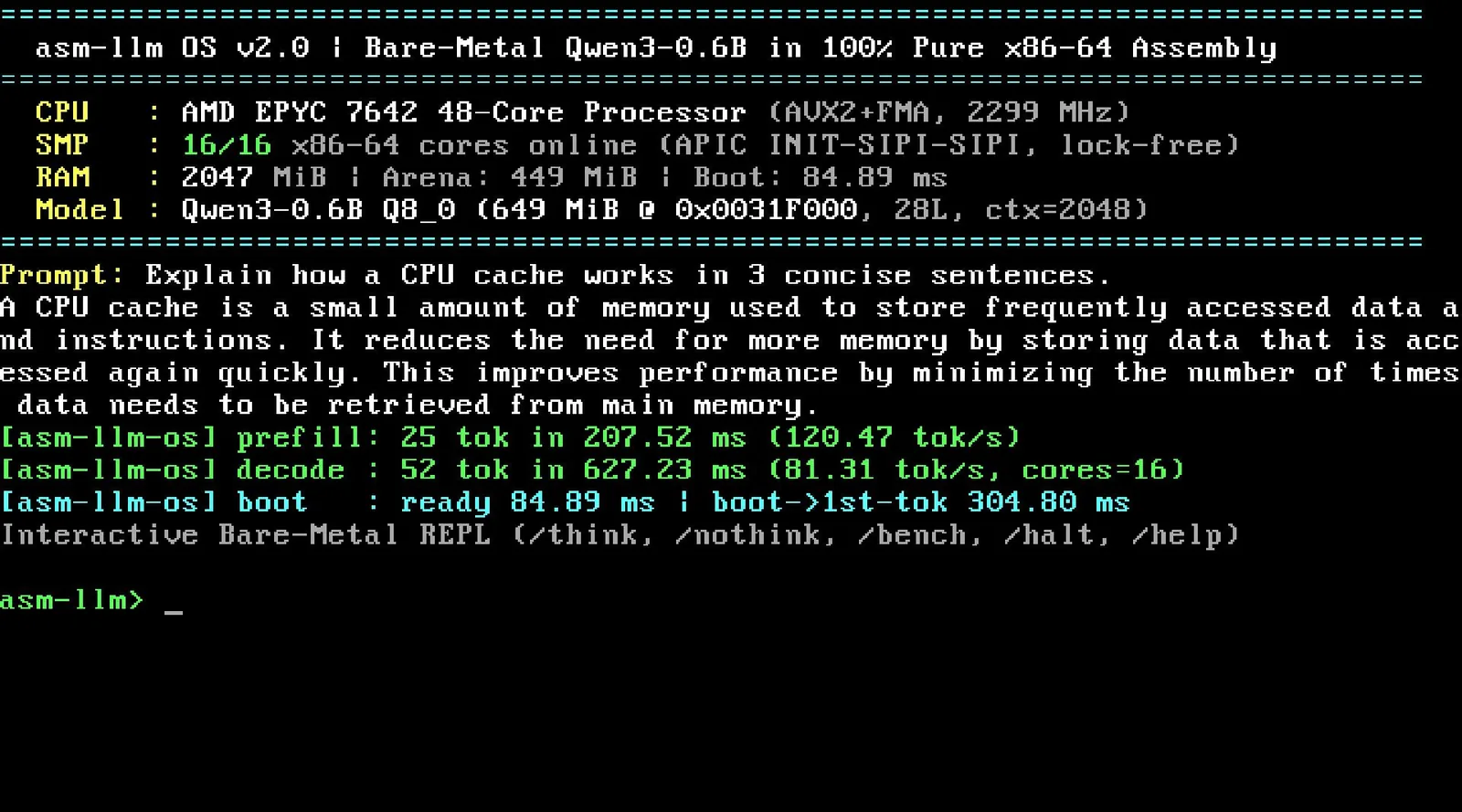
Developer Alexey Fateev removed Linux entirely and wrote a 24KB bare-metal operating system in pure assembly to run AI models. The system boots in 74-94 milliseconds directly into a chat interface and ran the Qwen3-0.6B model up to 54% faster than llama. cpp on Linux. For PC owners, it raises a direct question about how much performance is lost to operating system overhead.
24KB OS runs 649MB model without Linux
Fateev, known as alesha-pro on GitHub, published the project as Bare-Metal Bootable Qwen3-0.6B OS in 24 KB of Pure Assembly. The Multiboot binary named asm-llm-os. elf measures 24,252 bytes and was written from scratch without Linux, Windows, C, Rust, or libc, using hand-written NASM assembly with modern SMP support. Interaction is handled through 80x25 color VGA text mode, PS/2 keyboard input, and serial communication. The OS itself loads the Qwen3-0.6B Q8_0 model weighing 649MB, making the model roughly 28,000 times larger than the OS that hosts it.
The project includes full MIT-licensed source code, an ISO builder, and a setup guide at github. com/alesha-pro/llm. asm. A Linux-hosted version of the same assembly inference binary is also available and measures only 14KB, because about 10KB of code for booting, processor initialization, keyboard handling, and display output can be omitted. The fastest reported result came from Fateev’s AMD EPYC 7642 system, where four threads reached 78.89 tokens per second compared with 51.08 tokens per second under Linux, a gain of 54%. Even the smallest measured improvement, using 16 threads, was a 31% increase in generation speed.
What faster local AI means for your PC
The result matters because local AI performance is often limited by memory handling, scheduling, and background processes rather than raw processor speed. By removing the general-purpose operating system, Fateev’s design dedicates almost all memory and CPU time to model inference, producing measurably higher tokens per second on identical hardware. For workers experimenting with small open models for writing, coding assistance, or offline analysis, that can mean faster responses without buying new hardware. It also points to continued interest in lightweight local AI systems that preserve privacy by keeping prompts and documents on the machine instead of sending them to cloud services.
This does not prove that mainstream computers should abandon Linux or Windows. The test covers one small 0.6-billion-parameter Qwen3 model, one developer’s AMD EPYC 7642 machine, and comparison against one Linux llama. cpp configuration. The bare-metal system offers only text display, keyboard input, and serial output, with no browser, drivers, networking stack, or everyday applications. It is therefore relevant mainly to enthusiasts, systems programmers, and local-AI experimenters, not to ordinary laptop or office PC users.
// Read next
AI labs near cryptography breakthrough as expert panel prepares statement
A 21-expert cryptography panel lists a forthcoming statement as researchers point to an AI breakthrough in theoretical …
Musk: Google Wants to Rent More Computing Capacity From SpaceX
Elon Musk says Google is interested in renting additional computing power from SpaceX, a signal of how tight AI infrast…
RTX 5090 Cable Melt Triggers Air Quality Alarm in PC Owner Room
A Reddit user says a melting 12+4-pin cable on a Gigabyte RTX 5090 filled the room with particles and damaged the GPU p…
YouTuber builds working USB graphics card for 20 cents
Bitluni turned a 13-cent CH570 microcontroller into a monochrome USB graphics card using PWM video tricks and SRAM cach…