Cmpnd Brings Weight-Space Programming to DSPy With dspy-wsp
Cmpnd released dspy-wsp, a prototype optimizer where GPT-6-Astra edits small model weights directly, lifting Typed Decisions scores by up to 16 points.
AIXVZ
AI agents that sell for you. AIXVZ builds sales agents and automates routine business processes — from first contact to deal.
Learn more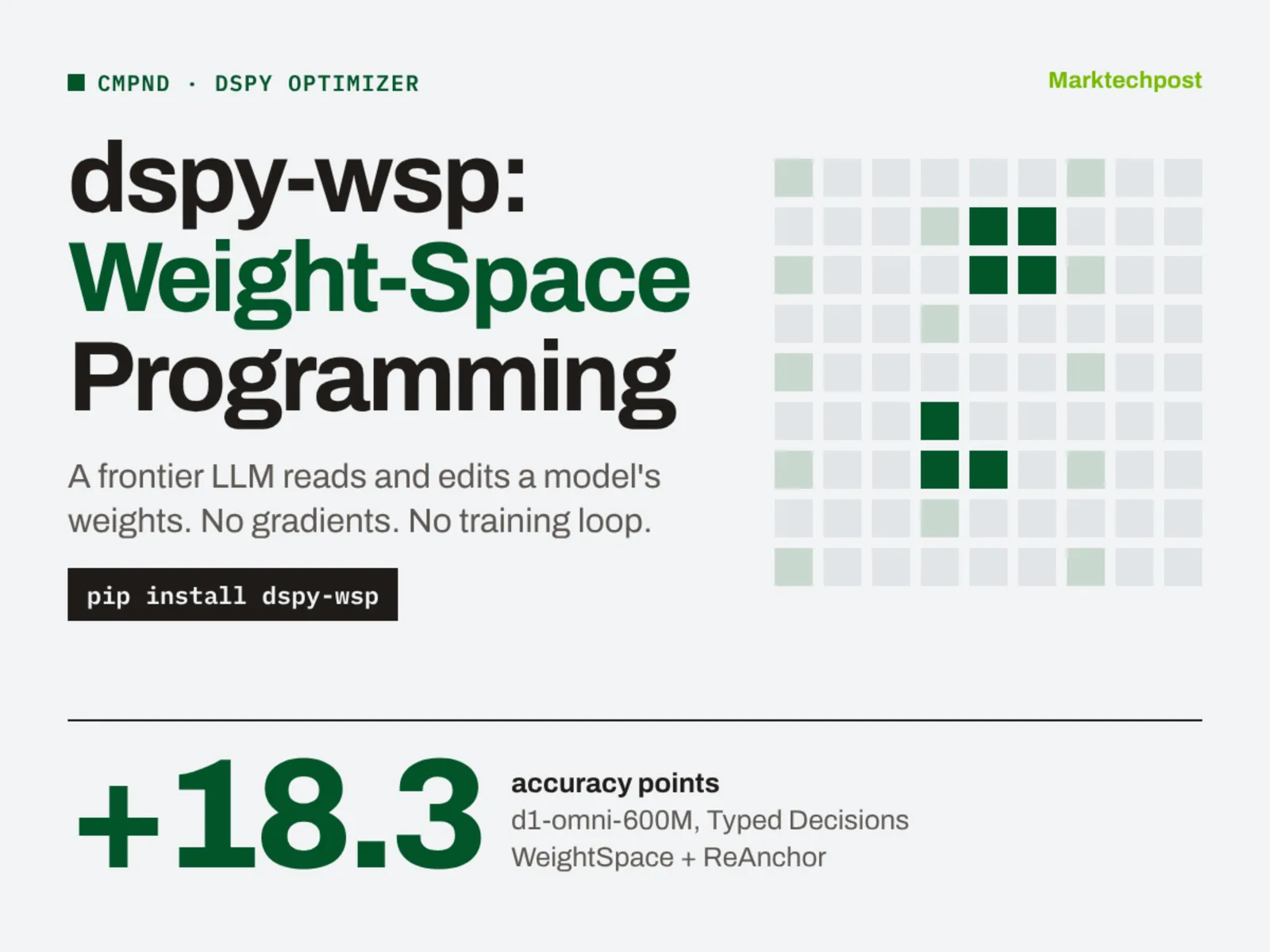
Cmpnd has released dspy-wsp, a prototype optimizer that brings weight-space programming to DSPy. A frontier model reads a smaller model weights and edits them directly, with no gradients, training loop or fine-tuning dataset. In Cmpnd tests, about $5 to $10 of GPT-6-Astra calls improved every decision model tried, which matters for teams seeking cheaper local models without full retraining.
How WeightSpace edits model weights
The package provides WeightSpace, an optimizer that plugs into any DSPy program and metric. It loads a student model from 0.6B to 9B parameters into a local Python process, while a writer model, recommended as gpt-6-astra at maximum reasoning effort, works in a sandbox. On macOS it uses sandbox-exec, on Linux bubblewrap. Each turn includes an explanation and one code block that either reads or edits weights or runs the DSPy program on practice examples. Tests used max_passes=25, with trainset for practice, a 0.25 holdout for scoring, and a hidden valset for final comparison.
The idea comes from MIT research called Sparks of Weight-Space Programming. That work showed Astra naming Breakout, Pong, Pac-Man and Freeway from four PPO policy weights alone, fixing a Kinetix car-on-ramp policy that failed 256 episodes to succeed in 1,024 episodes by editing 3.5% of weights, and lifting Qwen3.5-0.8B on MATH-500 from 7.9% to 48.1% after changing 131,072 weights. Unlike prompt optimization such as MIPROv2 and GEPA, which edits text, or BootstrapFinetune, which uses gradient descent and training data, weight-space programming changes weights by reasoning and checks results with forward passes.
Benchmark gains, costs and limits for users
On Typed Decisions, a benchmark with 400 cases and 2,000 decisions, WeightSpace alone added 1.9 to 16.1 points, with paired standard error of 0.7 to 1.4 points. The d1-omni-600M model rose from 50.9% to 69.1% when combined with ReAnchor, a separate threshold refit tool. The company chief executive said the patch ships as manifest. json and edit. npz with sha256 hashes, rebuildable from the public base model. Runs used one Mac, took 78 to 167 minutes, needed about 6 GB for 2B models and 4 GB or more for d1-omni-600M, and run locally via MLX on Apple silicon or PyTorch on Linux.
The results do not prove a general method for improving models. The 9B Clef-Flash gained only 1.9 points from WeightSpace alone and 6.5 points with ReAnchor. With simulate_head=False, which enforces the original paper stricter rule, d1-omni-600M gained only 2.8 points. Using gpt-6.1-sol as writer gave 5.8 points on d1-omni-600M and minus 0.6 on d1-2B, well below Astra. The release is MIT licensed via pip install dspy-wsp and needs DSPy 3.5, but remains experimental and slow.
// Read next
AI labs near cryptography breakthrough as expert panel prepares statement
A 21-expert cryptography panel lists a forthcoming statement as researchers point to an AI breakthrough in theoretical …
Musk: Google Wants to Rent More Computing Capacity From SpaceX
Elon Musk says Google is interested in renting additional computing power from SpaceX, a signal of how tight AI infrast…
RTX 5090 Cable Melt Triggers Air Quality Alarm in PC Owner Room
A Reddit user says a melting 12+4-pin cable on a Gigabyte RTX 5090 filled the room with particles and damaged the GPU p…
YouTuber builds working USB graphics card for 20 cents
Bitluni turned a 13-cent CH570 microcontroller into a monochrome USB graphics card using PWM video tricks and SRAM cach…