Bitcoin Miners Cut Hashrate 50% as AI Revenue Hits $478M in Q3
Three large miners doubled AI and HPC revenue to $478 million while halving bitcoin hashrate, leaving rivals like Bitdeer to claim more rewards.
AIXVZ
AI agents that sell for you. AIXVZ builds sales agents and automates routine business processes — from first contact to deal.
Learn more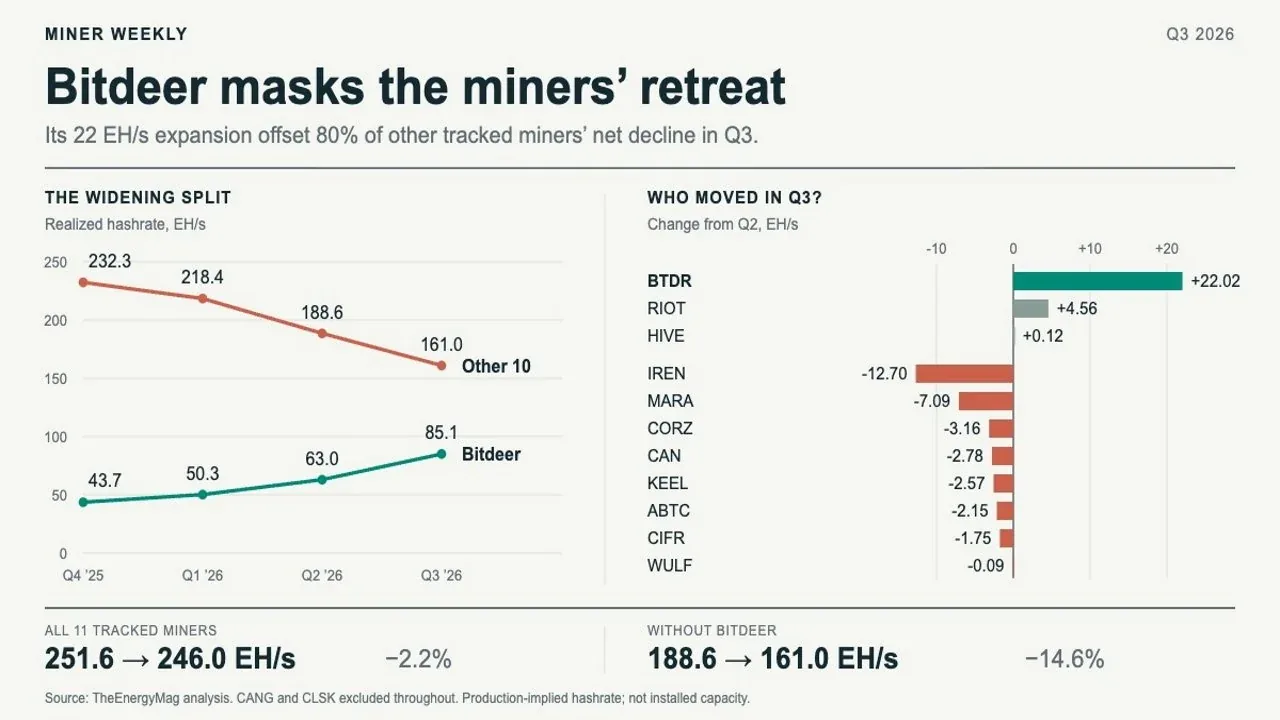
IREN, Core Scientific and TeraWulf together generated about $478 million in AI-cloud and HPC colocation revenue in the third quarter, double the $239 million in the second quarter. Over the same period their combined realized bitcoin hashrate fell about 49%, from 32.8 EH/s to 16.8 EH/s, based on disclosed bitcoin production. The shift shows replacement revenue from computing contracts is now arriving as mining capacity is removed.
How IREN, Core Scientific and TeraWulf changed
IREN recorded the sharpest simultaneous change. Its realized hashrate fell from about 21.6 EH/s to 8.9 EH/s, while AI-cloud revenue rose from $70.5 million to $200 million. Installed mining capacity contracted from 23.2 EH/s to 7.9 EH/s, confirming that equipment removal accompanied the production decline. Core Scientific estimated realized hashrate declined from 7.0 EH/s to 3.8 EH/s, while colocation revenue increased almost 58% to $215.4 million, accounting for about 92% of total quarterly revenue. The company ended September billing customers for 485 MW, up from 395 MW three months earlier, and expects to exit the mining business by the year end.
TeraWulf illustrates the lag between removing miners and collecting replacement revenue. Its realized hashrate was relatively stable in the third quarter following earlier reductions, edging down from about 4.2 EH/s to 4.1 EH/s. HPC revenue nevertheless nearly doubled to $63 million, representing about 83% of total revenue. The rewards those miners are leaving behind remain available to competitors, and Bitdeer is taking a growing share. Its bitcoin production increased from 2,694 BTC in the second quarter to 3,855 BTC in the third quarter, equal to about 9.2% of the quarter total network mining rewards, while its realized hashrate rose from about 63 EH/s to 85 EH/s.
What the AI shift means for mining rewards
For holders of bitcoin exposure and mining stocks, the split matters because the same finite stream of network rewards is now shared differently. Bitdeer produced 1,355 BTC in September alone, accounting for more than 9.7% of network rewards, approaching one bitcoin in every ten distributed to miners. October production has yet to be reported, and a further increase could take Bitdeer above 10%. Across 11 companies that disclosed third-quarter earnings, realized hashrate was about 246 EH/s in the third quarter, down only about 2% sequentially. Excluding Bitdeer, the remaining companies contracted almost 15%, from about 189 EH/s to 161 EH/s. Bitdeer is also building an AI business, with AI-cloud revenue up to $20.4 million from $14 million in the second quarter.
The third quarter strengthens evidence that AI can replace a meaningful share of operating revenue, but it does not prove attractive returns. Whether conversions succeed will depend on capital required, financing costs, cash collections and durability of customer demand. The hardware overhang is also unresolved. IREN and Keel together carried about $80.5 million of mining equipment held for sale, while Core Scientific reported another $29.7 million of sale inventory. Those figures are accounting values, not purchase costs or sale proceeds.
// Read next
FT: Russian VC revealed as multibillion-dollar Tether co-owner
Vitaly Bezrodnykh, founder of Fulgur Ventures, holds a previously undisclosed multibillion-dollar stake in Tether, per …
Binance wins conditional approval for Bhutan regional hub
Binance received in-principle approval from Bhutan’s Gelephu Central Bank to build an Asia hub, weeks after a $6.3 bill…
Bitcoin and gold are 2026's worst-performing major assets
Bitcoin is down 32% in 2026 and gold 16%, placing both at the bottom of the year's major-asset rankings — a pairing mar…
Kalshi fights states over prediction market taxes and gambling rules
New York, New Jersey and Kentucky are testing whether federal oversight shields Kalshi from state gambling laws as Bern…