Bitcoin ETFs fall to $1.56 billion in net outflows for 2026
U. S. spot bitcoin ETFs have lost $1.56 billion so far in 2026 after rapid redemptions in late October and early November pushed flows negative.
AIXVZ
AI agents that sell for you. AIXVZ builds sales agents and automates routine business processes — from first contact to deal.
Learn more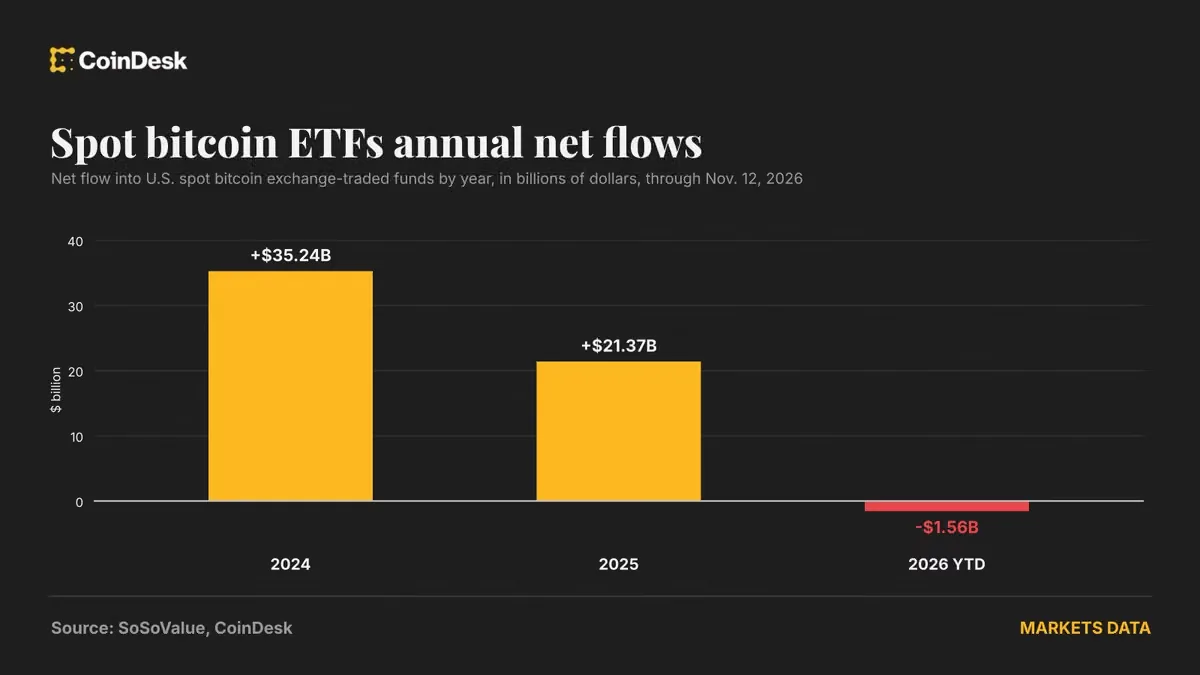
U. S.-listed spot bitcoin ETFs now show $1.56 billion in net outflows for 2026, after a rapid reversal that erased a positive balance in less than two weeks. The funds recorded more than $500 million in net outflows this week alone, while bitcoin fell below $70,000 on Friday to its lowest level since August. For holders, the shift matters because these funds are widely viewed as a proxy for institutional demand.
How $1 billion in inflows turned negative
The reversal was concentrated around the end of October, according to SoSoValue data analyzed by CoinDesk. The funds were up about $1.01 billion for the year on Oct. 29, then posted $643.3 million in net outflows on Oct. 30 alone, leaving the year-to-date balance at about $368 million. Subsequent weekly exits pushed the total into negative territory. The funds lost $643.6 million this week through Thursday, after losing $1.28 billion the week before and $202.6 million the week before that.
This is the 12th week this year with net outflows of more than $500 million. There were 15 such weeks in all of 2025 and four in 2024, meaning four more heavy outflow weeks in the final six weeks of the year would make 2026 a record by that measure. The contrast with prior years is sharp. The funds took in net $21.37 billion in 2025 and $35.24 billion in 2024. The recent redemptions coincided with weaker spot prices, with bitcoin trading below $70,000 early Friday.
What ETF redemptions mean for holders
For a normal holder, ETF flows do not change how Bitcoin works, but they help explain price weakness and liquidity conditions. When ETF investors redeem at this pace, fund providers sell underlying bitcoin exposure, which can add selling pressure alongside regular spot trading. That mechanism is one reason the current market decline has been linked to the outflow figures rather than to a single company event. It also affects sentiment among larger allocators who track ETF demand as a signal of institutional interest.
What the figures do not prove is why each investor sold or whether outflows will continue. The data show aggregate creations and redemptions, not motives, future returns, or the behavior of investors outside ETFs. People without ETF or direct bitcoin exposure are not directly affected, while existing holders face continued volatility if large weekly redemptions persist through year end.
// Read next
FT: Russian VC revealed as multibillion-dollar Tether co-owner
Vitaly Bezrodnykh, founder of Fulgur Ventures, holds a previously undisclosed multibillion-dollar stake in Tether, per …
Binance wins conditional approval for Bhutan regional hub
Binance received in-principle approval from Bhutan’s Gelephu Central Bank to build an Asia hub, weeks after a $6.3 bill…
Bitcoin and gold are 2026's worst-performing major assets
Bitcoin is down 32% in 2026 and gold 16%, placing both at the bottom of the year's major-asset rankings — a pairing mar…
Kalshi fights states over prediction market taxes and gambling rules
New York, New Jersey and Kentucky are testing whether federal oversight shields Kalshi from state gambling laws as Bern…