Baseten Bison-1 Tops Decision Model Ranking With Score of 76
Baseten released two open-weight decision models on Gemma 4 with 128k context, with bison-1 ranking first on the Artificial Analysis index.
AIXVZ
AI agents that sell for you. AIXVZ builds sales agents and automates routine business processes — from first contact to deal.
Learn more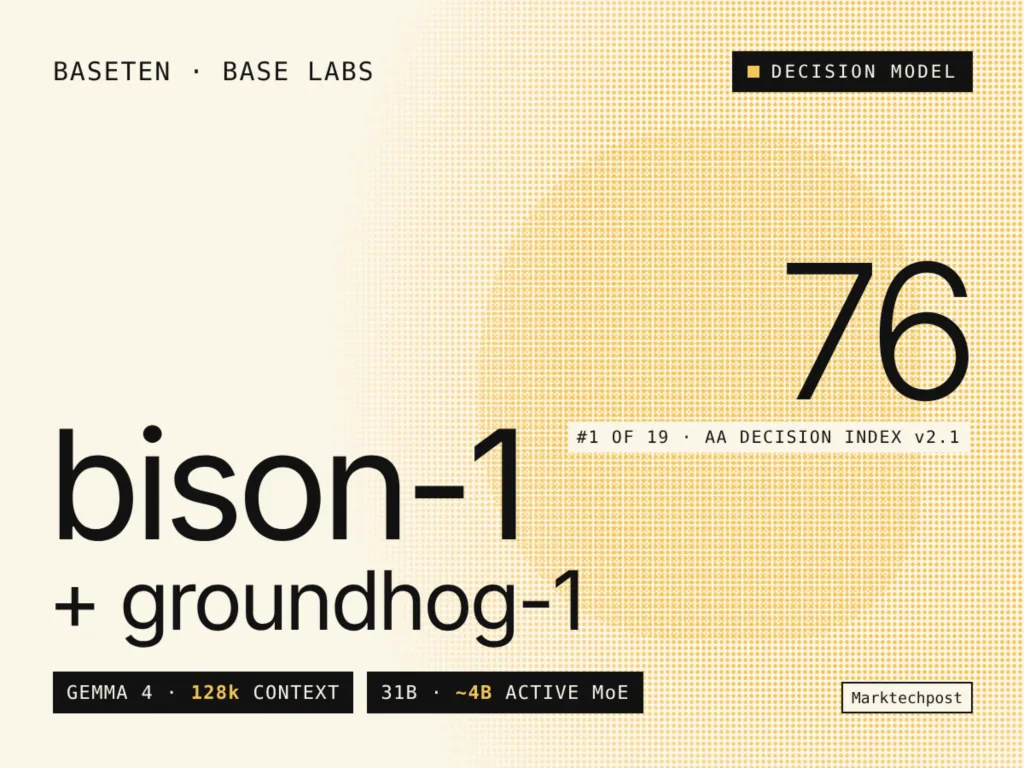
Baseten has released bison-1 and groundhog-1, two open-weight decision models built on Google Gemma 4 that return calibrated probabilities instead of text. Bison-1 scores 76 on the Artificial Analysis Decision Index v2.1, ranking first among 19 models, one point above Liquid AI d1.2-ultra. For teams running routing, triage and guardrail pipelines, the shift matters because decisions arrive as probabilities in one pass.
Bison-1 and groundhog-1 specs and benchmark scores
Bison-1 is a 31B dense model that post-trains Gemma 4 31B, while groundhog-1 fine-tunes Gemma 4 26B-A4B, a mixture-of-experts model with about 4B active parameters per token. Both accept 128k tokens, or 131,072 tokens, up from 16k on earlier Baseten decision models, and accept images. A request carries one state plus any number of questions of type yes/no, choice or score, and the model answers every question in a single prefill pass with no output tokens generated.
Bison-1 ranks first on four of six index components: When2Call at 98, EvalSafe-O*NET-AA at 93, AA-Symmetry v1.1 at 89 and HLE-MultiChoice v1.1 at 51. It scores 73 on AA-Paperclip, which carries 30% weight in the index, and 60 on AA-Omniscience-Decision v1.1, where it ranks 11th. Baseten reports a Brier score of 0.14 for bison-1 against 0.15 for d1.2-ultra, with lower scores indicating better calibration. On long context, LongMemEval M at 128k is 84.8 for bison-1 and 77.4 for groundhog-1, with LongMemEval S at 87.1 and 79.3.
What 128k decision models mean for work pipelines
For product and operations teams, the practical change is larger inputs in one call: full policies, ticket histories and prior messages can sit inside the 128k state without splitting requests. Both models are live on Baseten Model APIs under the same API as older decision models, so switching means changing one model name. Pricing is $0.10 per 1M input tokens for bison-1 and $0.035 for groundhog-1, with no output tokens produced. Open BF16 weights are available on Hugging Face.
The results do not prove superiority across all work. Groundhog-1 has no official index score yet, and Baseten expects it to match mammoth-1 at 71. All benchmark and calibration numbers cited are self-reported by Baseten, and knowledge-heavy decisions remain a weak area for bison-1. Requests longer than the trained limit are refused rather than truncated, so existing pipelines will need a length check.
// Read next
AI labs near cryptography breakthrough as expert panel prepares statement
A 21-expert cryptography panel lists a forthcoming statement as researchers point to an AI breakthrough in theoretical …
Musk: Google Wants to Rent More Computing Capacity From SpaceX
Elon Musk says Google is interested in renting additional computing power from SpaceX, a signal of how tight AI infrast…
RTX 5090 Cable Melt Triggers Air Quality Alarm in PC Owner Room
A Reddit user says a melting 12+4-pin cable on a Gigabyte RTX 5090 filled the room with particles and damaged the GPU p…
YouTuber builds working USB graphics card for 20 cents
Bitluni turned a 13-cent CH570 microcontroller into a monochrome USB graphics card using PWM video tricks and SRAM cach…