Ant Group open-sources 560B medical AI model LingSante
Ant Group released LingSante-3.1-flash under MIT license with 560B parameters, 1M-token context and top open-model scores on medical benchmarks.
AIXVZ
AI agents that sell for you. AIXVZ builds sales agents and automates routine business processes — from first contact to deal.
Learn more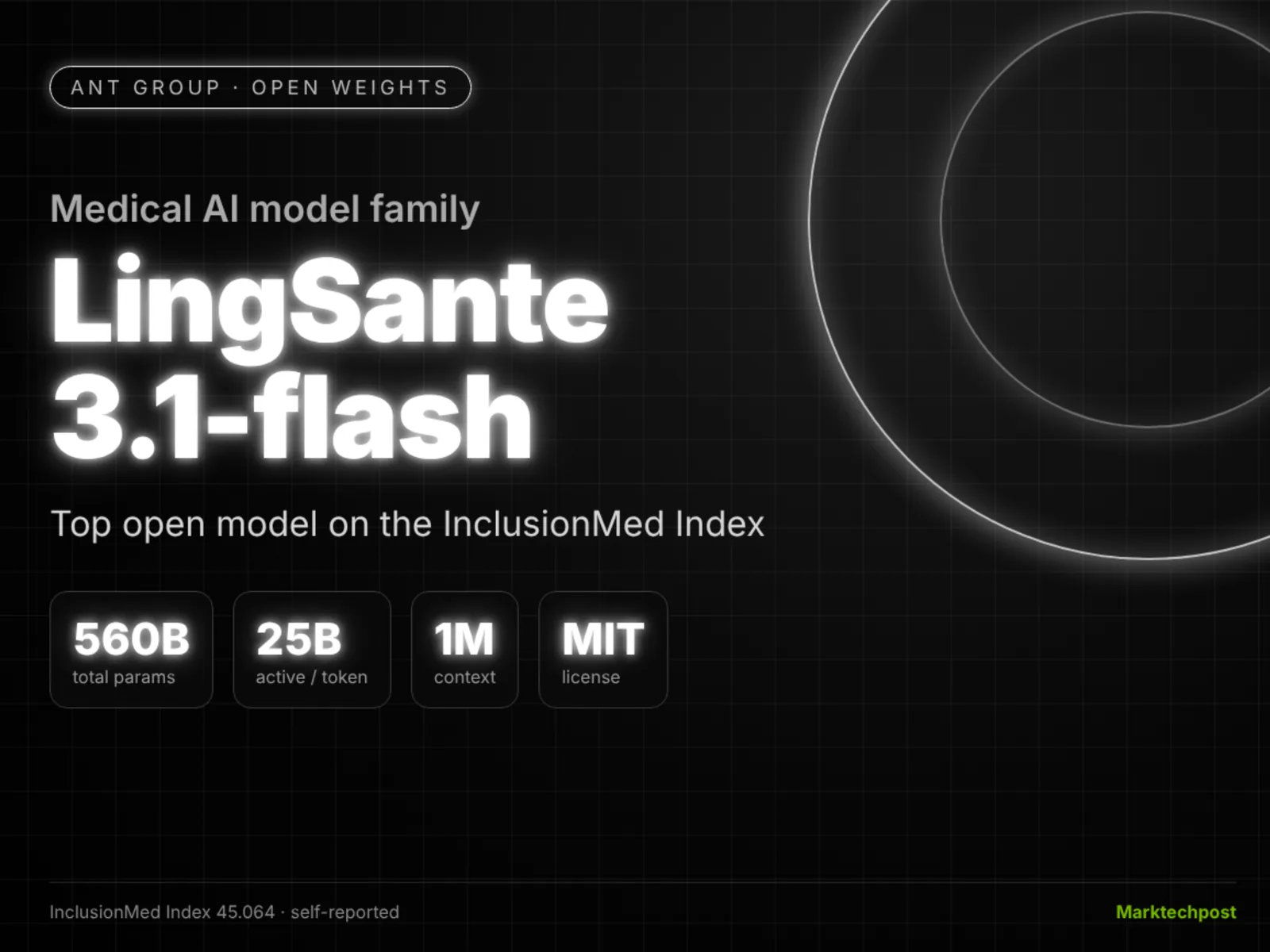
Ant Group has open-sourced LingSante-3.1-flash, a medical reasoning model with 560 billion total parameters and about 25 billion active per token. The weights are available under the MIT license with a 1-million-token context window. It matters because hospitals and developers can now self-host a medical model that tops open-model rankings on clinical benchmarks.
What Ant released and how it is built
LingSante-3.1-flash is built on the Ling-3.1-flash base model and targets complex case analysis, medical search and tool-using agents. Ant Group describes it as a hybrid-linear mixture-of-experts design with 63 KDA linear-attention layers and 9 gated MLA layers, 512 routed experts plus one shared expert, with 8 routed experts active per token. It has a hidden size of 4096, 64 attention heads and a vocabulary of 157,184. A second open model, LingSante-3.1-air-VL, has 124 billion total parameters, 5.5 billion active and 256K context. Three other family members remain closed: LingSante-Pulse for risk prediction across more than 150 conditions, LingSante-MedGuard for safety screening, and LingSante-Live for video consultation.
Training mixed medical and general data through pretraining, mid-training and supervised fine-tuning, followed by reinforcement learning for medical reasoning, tool use and search. Ant Group reports agent training on real MCP services, mock tools and world models, plus contribution-aware joint reinforcement learning that cut search steps by over 20% compared with accuracy-only multi-agent training. Physicians annotated reward data with a reported 99.62% agreement rate. The models power the Afu health app, which Ant says serves 150 million users and handles nearly 20 million health consultations daily. Deployment is via Hugging Face and ModelScope, with an MXFP4 quantized checkpoint and hosted access through Computrix.
Scores, hardware needs and practical limits
On Ant Group's model-card comparison of nine models, LingSante-3.1-flash scored 65.72 on HealthBench Professional, ahead of GPT-6 Astra at 64.18 and Claude Opus 5.5 at 61.19. It also led on EHR-Complex with 74.40, BrowseComp with context at 94.10, and HLE text-only with tools at 72.22 single-agent and 74.87 multi-agent. On the InclusionMed Index it scored 45.064, ranking fifth of 23 configurations behind four closed models and first among open models. For clinics and health startups, that combination of MIT licensing and medical-agent performance lowers the barrier to building triage, records review and research-search tools without sending data to an external API.
The model does not lead everywhere and remains demanding to run. It scored 94.50 on MedQA-USMLE versus 97.33 for GPT-6 Astra and Gemini 4 Argon, and 56.09 on InclusionMed-DxFiles versus 73.40 for Gemini 4 Argon. Ant Group describes it as weaker on general coding and command-line agent tasks. Self-hosting requires multi-GPU servers, with a reference SGLang setup on 8x H200 or 4x GB300, plus vLLM support with expert parallelism and prefix caching. It is a text-only reasoning model, not a certified medical device, and benchmark scores do not prove safe clinical use.
// Read next
AI labs near cryptography breakthrough as expert panel prepares statement
A 21-expert cryptography panel lists a forthcoming statement as researchers point to an AI breakthrough in theoretical …
Musk: Google Wants to Rent More Computing Capacity From SpaceX
Elon Musk says Google is interested in renting additional computing power from SpaceX, a signal of how tight AI infrast…
RTX 5090 Cable Melt Triggers Air Quality Alarm in PC Owner Room
A Reddit user says a melting 12+4-pin cable on a Gigabyte RTX 5090 filled the room with particles and damaged the GPU p…
YouTuber builds working USB graphics card for 20 cents
Bitluni turned a 13-cent CH570 microcontroller into a monochrome USB graphics card using PWM video tricks and SRAM cach…