AMD pushes Radeon RX 9060 XT to record 4.837 GHz on liquid nitrogen
AMD overclocked a mid-range Radeon RX 9060 XT to 4,837 MHz under liquid nitrogen, setting a GPU frequency record while retail prices remain high.
AIXVZ
AI agents that sell for you. AIXVZ builds sales agents and automates routine business processes — from first contact to deal.
Learn more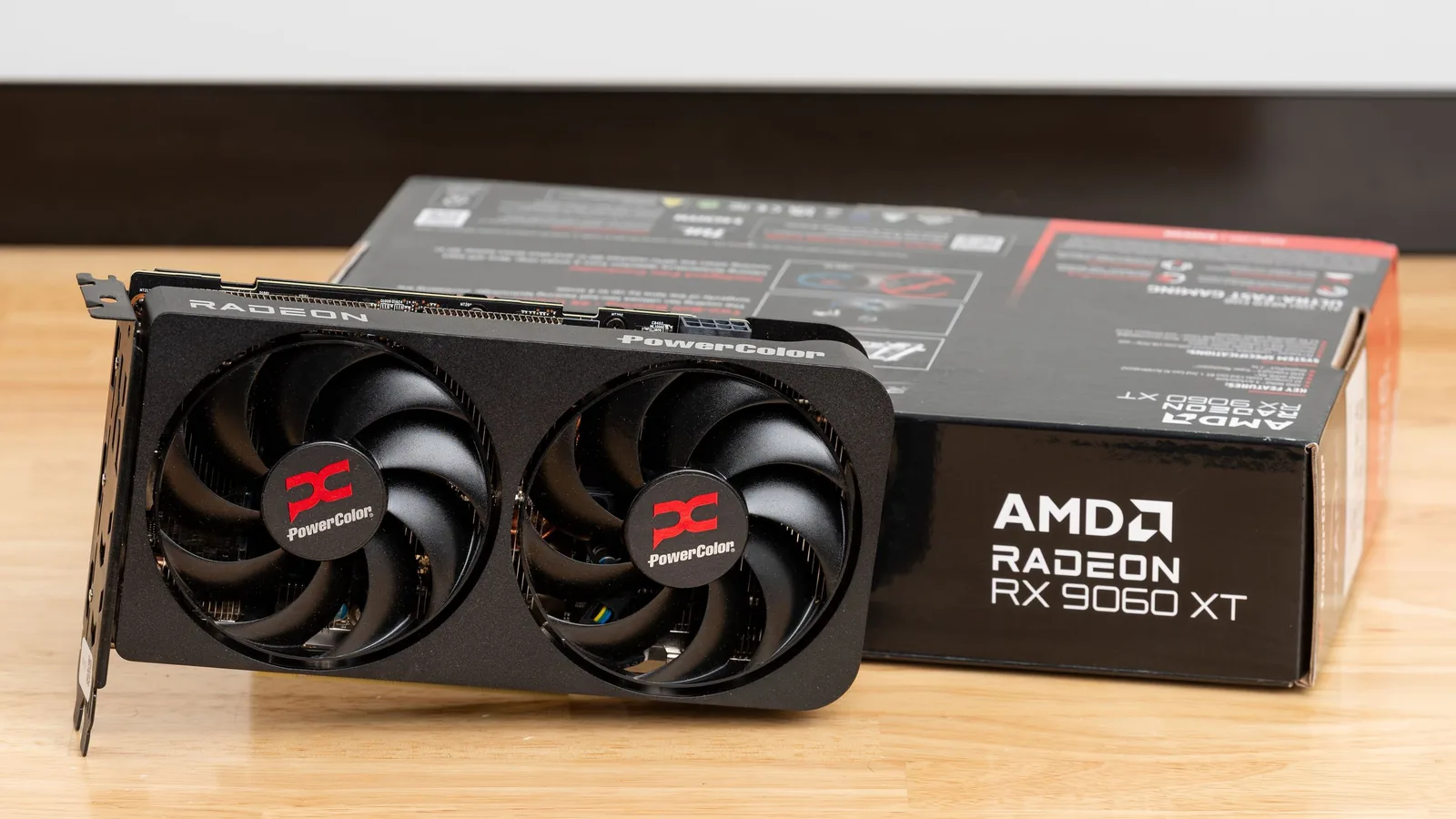
AMD pushed a Radeon RX 9060 XT to 4,837 MHz, setting a new world record for GPU frequency. Veteran overclocker Bill Alverson and AMD vice president Jack Huynh ran the chip about 54.5% above its stock 3,130 MHz boost clock. The result shows how far the mid-range RDNA 4 design can stretch when heat is removed from the equation.
Mid-range Navi 44 chip cooled to minus 49C
The record run took place on November 15 as part of a celebration for a new Micro Center store opening in Austin, Texas, according to the OC World Record Museum database maintained by SkatterBencher. The card used was not AMD flagship RX 9070 XT, but the mid-range RX 9060 XT based on the smaller Navi 44 GPU. That chip has 2,048 shading units across 32 compute units, a 160W TDP, 16GB of GDDR6 memory on a 128-bit bus, and a stock boost clock of up to 3,130 MHz. Cooling was provided by liquid nitrogen, which is standard practice in extreme overclocking. A GPU-Z screenshot confirmed the 4,837 MHz frequency at minus 49 degrees Celsius, with power draw at 62W and voltage at 1.434V. Liquid nitrogen and liquid helium lower temperatures far below what air or conventional liquid cooling can reach, removing thermal limits and allowing higher voltage and clocks for short benchmark runs.
Extreme frequency records are demonstrations of silicon limits rather than usable performance, and they require careful hardware preparation, custom containers for the coolant, and constant monitoring. The coolant evaporates quickly, so such runs last only a short time. This is not the first extreme result for RDNA 4. The RX 9060 XT had previously reached 4,769 MHz in February 2026, followed by a reported 4,789 MHz attempt in June. The November result is 48 MHz higher than the prior mark and moves AMD latest graphics architecture closer to the 5 GHz level. Tom Hardware noted that the demonstration does not indicate what a stock, air-cooled RX 9060 XT can sustain in a normal PC.
Record speed will not lower gaming PC costs
For buyers, the practical issue is price rather than frequency headroom. The 16GB version of the RX 9060 XT launched with a $349 recommended price, but Tom Hardware reports that cards are now selling for more than $700 in late 2026. At that level, the company chief executive would likely acknowledge, the card that was positioned as a budget-friendly enthusiast option offers weak value for gamers building or upgrading a PC. A laboratory record under liquid nitrogen does not change frame rates at home, power use, noise, or reliability. It also does not improve availability. Workers who depend on a PC for editing, 3D work, or AI-assisted tools should therefore treat the 4.837 GHz figure as a signal about chip quality and manufacturing margin, not as extra performance they can unlock safely with standard cooling.
The story does not prove that RDNA 4 cards overclock well on air or that buyers will see higher stock speeds. It does not apply to the flagship RX 9070 XT, which was not used for this record. It also does not explain why street prices have risen to more than double the launch price, or when they might normalize. Gamers with conventional cooling remain bound by temperature, power, warranty, and stability limits, and are unaffected by a brief run at minus 49 degrees.
// Read next
AI labs near cryptography breakthrough as expert panel prepares statement
A 21-expert cryptography panel lists a forthcoming statement as researchers point to an AI breakthrough in theoretical …
Musk: Google Wants to Rent More Computing Capacity From SpaceX
Elon Musk says Google is interested in renting additional computing power from SpaceX, a signal of how tight AI infrast…
RTX 5090 Cable Melt Triggers Air Quality Alarm in PC Owner Room
A Reddit user says a melting 12+4-pin cable on a Gigabyte RTX 5090 filled the room with particles and damaged the GPU p…
YouTuber builds working USB graphics card for 20 cents
Bitluni turned a 13-cent CH570 microcontroller into a monochrome USB graphics card using PWM video tricks and SRAM cach…