The Fed's quiet warning: the next crash could be worse than usual
Buried in the minutes of the Fed's October meeting is a sentence that should make investors pause. Markets are expensive, borrowed up and connected in ways that make a stumble travel further than it should.
AIXVZ
AI agents that sell for you. AIXVZ builds sales agents and automates routine business processes — from first contact to deal.
Learn more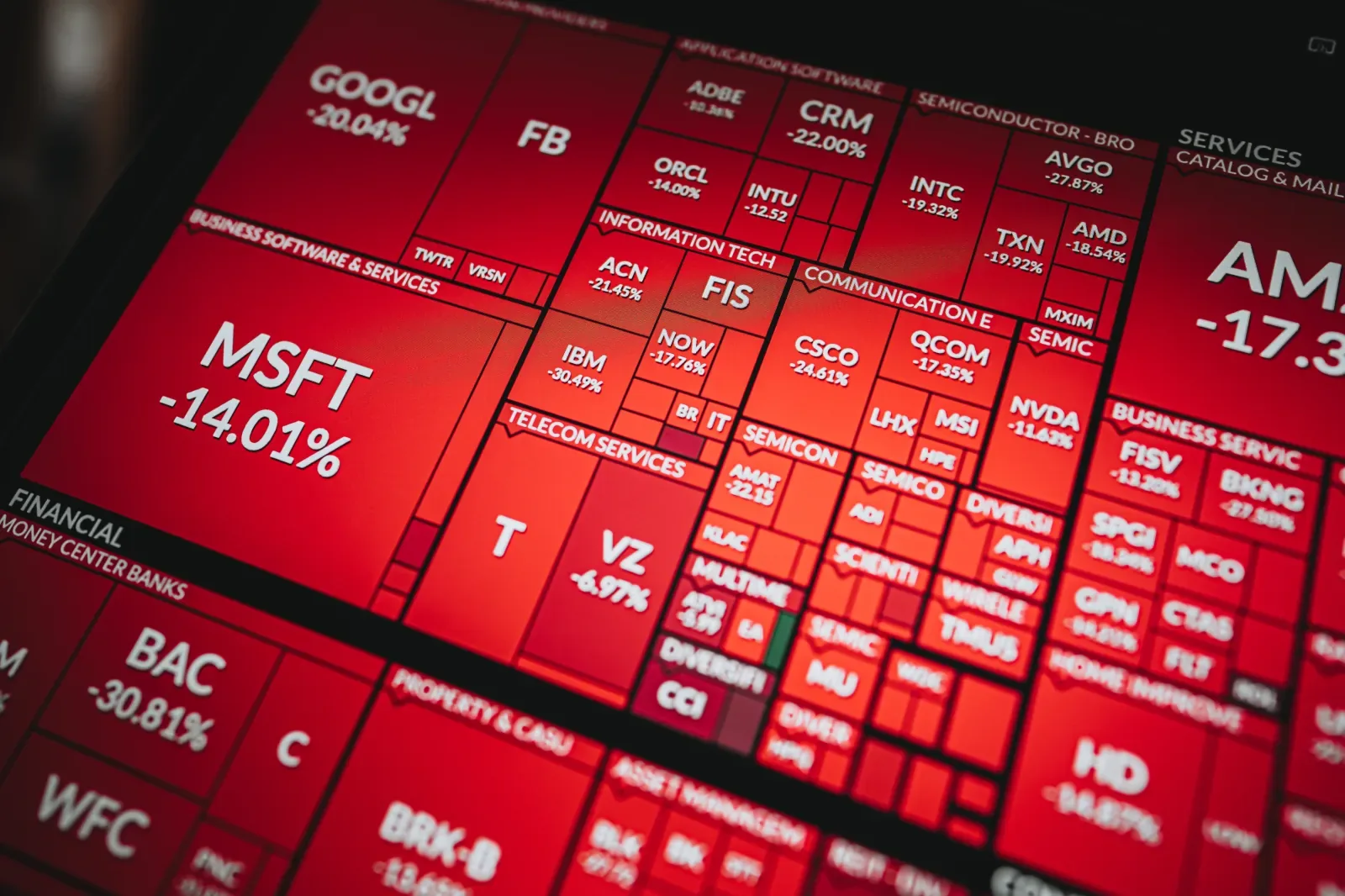
Buried deep in the Federal Reserve's meeting minutes this week, past pages of careful bureaucratic language, is a sentence that reads like a warning shot. If the market cracks, the damage could be worse than it should be.
The Fed never says "a crash is coming". It never does. But the minutes of the 27–28 October meeting, published on 18 November, describe a market that is expensive, heavily borrowed, and wired together in ways that make any stumble travel further than it normally would. And unlike most central-bank documents, this one arrived just as the selling had already started.
What the Fed actually said
Start with valuations. The S&P 500 hit a record of 7,818 on 6 October. On the Fed's preferred long-run measure, the market is priced higher than at almost any point in history — only the dot-com peak and the 2021 frenzy were more extreme. Stocks are not merely optimistic; they are priced for a very specific future in which artificial intelligence delivers enormous profits on schedule.
Now the debt behind that future. Companies have issued more than $680 billion of bonds this year to fund advanced computing — more than five times the $130 billion raised in all of 2023. The Fed notes that much of this borrowing happened through "complex and opaque financing structures", a polite phrase for arrangements where nobody outside the deal can quite see who is holding the risk. Outstanding public debt tied to advanced computing has passed $1.1 trillion and now accounts for roughly a third of all investment-grade corporate issuance. A single industry has become the largest borrower in the corporate bond market.
Then the amplifiers. Hedge fund assets have grown from $4 trillion in 2012 to about $13 trillion, and their leverage is at the highest level since the Fed began tracking it in 2013 — concentrated in a handful of very large funds. Funds that borrow to amplify returns must also sell to survive. When they get margin calls at the same moment, they do not sell selectively; they sell whatever buyers will take.
And the quiet corner where the pressure is already visible: private credit. The share of distressed private loans has been climbing, and the Fed singles out software companies as the group where it shows up most clearly. These are loans made outside public markets, to firms whose revenues depend on the same AI spending everyone is counting on.
Add the backdrop. The Fed raised rates in September — its first increase since 2023 — and inflation is running at 3.6%, nearly double the 2% target. The 10-year Treasury yield sits above 5%, its highest level since 2007. Higher yields are gravity for expensive stocks, and gravity has been switched back on. In Europe, the gap between French and German borrowing costs has widened to levels last seen in 2011, during the euro crisis.
None of this is theoretical any more. Nvidia has lost more than a third of its value since early October. The S&P 500 has fallen for five straight sessions and sits about 8% below its record. The Nasdaq slipped into correction territory. The most crowded trade in the world is being unwound in public.
The household side of the story rhymes. Mortgage rates near their highest levels in two decades have pushed home sales down again and squeezed anyone who needs credit to move. The Fed noted that residential mortgage activity declined further and that higher borrowing costs weighed on housing, commercial real estate and small business lending. None of that is a crisis on its own. It is the same mechanism running quietly in the background: when money costs 5%, everything bought with borrowed money becomes more expensive to hold.
And this is what makes the current setup different from a simple stock market story. Equities, corporate bonds, private credit, bank balance sheets and government debt are not separate rooms — they are one building. A fund that loses money on AI stocks sells Treasuries to raise cash, which pushes yields up, which squeezes every other borrower, which turns up as losses at a bank that had lent into a private credit fund. The Fed's phrase for it is "channels of amplification". Trouble does not need to start everywhere at once. It only needs one door to open.
Then there is the trigger everyone is watching. The Fed held rates at 3.75–4% in October, but two officials voted for an immediate increase, and the minutes show two policymakers arguing that a move of more than a quarter point could be warranted in December if inflation data stay ugly. One governor has said publicly that a half-point hike is probably needed. Markets are pricing a quarter-point rise with near-certainty. Every one of those basis points lands directly on the value of a stock priced for perfection twenty years out.
And the pressure is not only American. French borrowing costs have climbed to their highest since 2002, with the gap over Germany widening to levels not seen since the euro crisis of 2011 — a reminder that when money gets expensive, the weakest balance sheets in the room are found first. Meanwhile the dollar has been strengthening as US yields outrun everyone else's, which tightens conditions for every borrower who owes dollars abroad. None of these channels is dramatic alone. Together they are why the Fed talks about amplification rather than accidents.
But here is the part nobody quotes
The same document says the opposite thing too, and this is where the story turns.
In the Fed's own assessment, the financial system "remained resilient", the banking sector is "well capitalized and able to withstand losses" even under severe scenarios, and "strong bank and household balance sheets provided an important buffer against more severe outcomes". Those are the Fed's words, sitting a few paragraphs below the alarming ones. The warning is not that the house is on fire. It is that the fire escapes are narrower than they look.
The scariest line in the minutes — that forced selling could become severe enough to "impair market functioning" — comes from a deliberately extreme stress test, the kind of scenario planners use to find the edges of the map. It is not a forecast. It is a tail.
Then look at the price rather than the noise. On forward earnings the S&P 500 trades at about 18 times profits — near its long-run average, not a bubble multiple. It looks expensive on past earnings precisely because recent AI profits were extraordinary. Whether that continues is the real question, and it stays open.
The economy underneath is not cracking either. Output grew at a 3.4% annual pace last quarter, employers added 165,000 jobs in October against forecasts of 65,000, and unemployment sits near what economists call normal. The volatility index — the market's own fear gauge — is near 18, about where it was a year ago. Investors are nervous, not panicking.
There is even a piece of logic hiding in plain sight: the Fed is raising rates because the economy is strong, not because it is collapsing. A central bank that feared an imminent crash would be cutting, not hiking. What we are watching is a market being repriced for a world where money costs 5% again — an unpleasant adjustment, but a normal one.
So what should you actually watch
Not the daily index moves. Watch credit. If private credit defaults stay contained and AI borrowers keep servicing their debt, the leverage never has to be tested. That is the hinge this whole story turns on — and it does not snap overnight.
Corrections are how markets digest good news that got priced too fast. Since 2000 the S&P 500 has averaged a peak-to-trough drop of about 15% in a year, yet finished higher 70% of the time. The current drawdown is roughly half that average.
The Fed's verdict, stripped of jargon, is this: vulnerabilities can make a shock worse, but they do not create the shock. Expensive stocks and borrowed money are amplifiers, and amplifiers are quiet until something makes a sound. Underneath them sit banks with real capital, households in better shape than in 2008, and an economy still adding jobs.
The uncomfortable part is that nobody can tell you when the sound comes. The comforting part is that there is far more cushion under this market than the scary headlines suggest — and cushion is exactly what turns a frightening week into a footnote.
// Read next
Growth Stocks Turn Cheaper Than Value for First Time Since 2008
The S&P 500 Growth index fell 15% from the October peak and its forward P/E dropped below value, a split last seen in t…
Tech sell-off drags down three consumer stocks with raised outlooks
With the S&P 500 down nearly 12% from its peak, Amer Sports, Tapestry and Birkenstock trade at 13 to 22 times forward e…
Monster and AutoZone Offer Shelter as Nasdaq Swings on Nvidia
With the Nasdaq whipsawed by Nvidia leadership turmoil, Monster Beverage and AutoZone stand out for low volatility and …
Canada bank earnings preview puts 2027 outlooks in focus
Canada's Big Six banks report fourth-quarter results this week, with analysts watching capital markets softness, margin…