DeepMind says Apollo humanoids hit 96% success rate at Mercedes plants
Google DeepMind reported Apollo 2 robots sorted Mercedes parts with 96% success in Hungary and Germany, but disclosed no data on speed, uptime or human help.
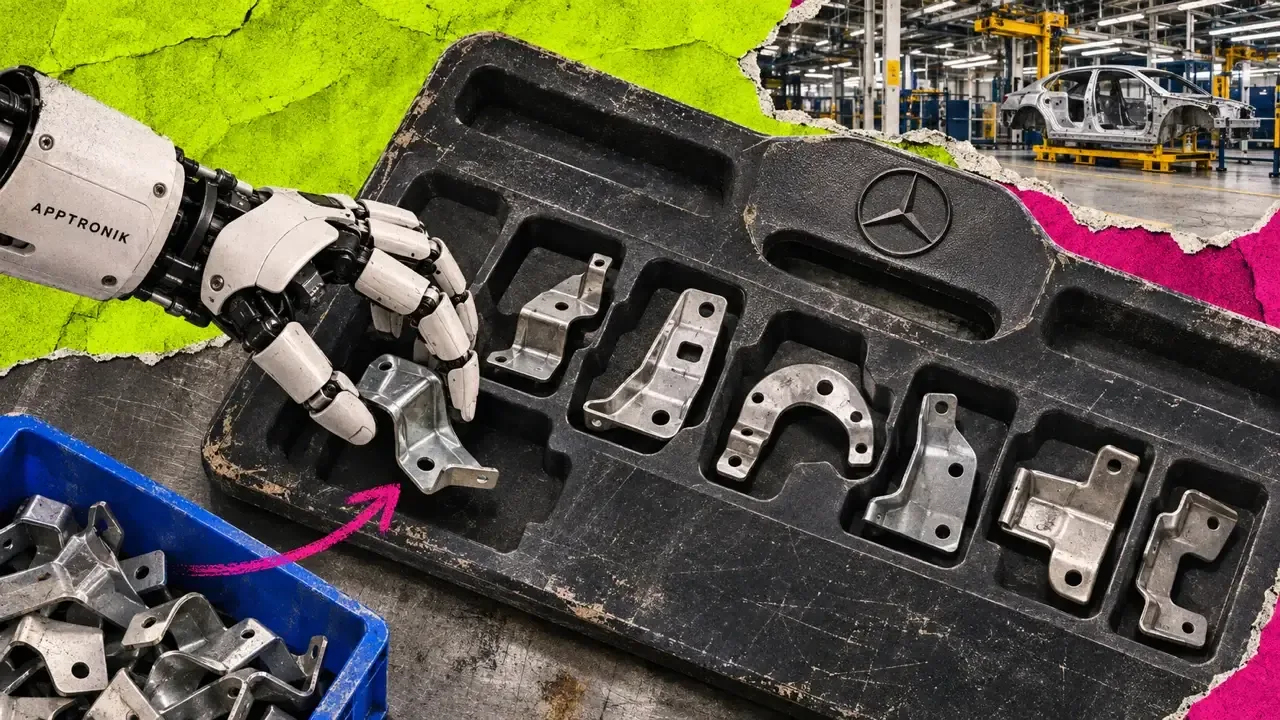
Google DeepMind says Apptronik Apollo 2 humanoids reached a 96% success rate sorting automotive parts on active Mercedes-Benz production lines. The pilot was disclosed on Nov. 10 and covered sites in Kecskemet, Hungary, and Sindelfingen, Germany. The robots handled preparation work that feeds vehicle assembly, a test of AI on repetitive physical tasks rather than a laboratory demonstration. The result matters because it moves humanoid claims into a working factory setting, though key measures of shift-long usefulness remain undisclosed.
Apollo 2 kitting test at two Mercedes sites
DeepMind described the work as automotive kitting, which involves taking parts from bulk bins and organizing them in the order needed for each vehicle. The published example involved picking up metal brackets and placing them into sequencing containers. The trays are meant to match the parts needed for each vehicle, so the robot had to organize components as well as move them. Two models divided the work, with Gemini Robotics ER tracking the workflow while Gemini Robotics 2.5 controlled the hands and arms. Apptronik chief executive Jeff Cardenas said the models improved after a few weeks of post-training and transferred to Mercedes production with little performance drop-off.
The result builds on an earlier relationship between the companies. In March 2024, Apptronik announced an agreement to explore uses for its original Apollo, including delivering assembly kits, inspecting components and transporting containers of kitted parts. The company argued that humanoids could handle repetitive, physically demanding work in spaces designed for people, potentially avoiding a full factory redesign. DeepMind framed the latest pilot as a specific test for its Gemini Robotics 2.5 model, arranging the components needed by the people building cars. The disclosure identifies the task and locations but provides no trial count to support the 96% figure.
What the 96% figure does not yet explain
For factory operations, the headline rate leaves the practical calculation incomplete. DeepMind calls the kitting autonomous but does not define whether success means an individual pick, a completed tray or another unit. It also did not publish how often humans intervened, how quickly the robots worked, or what uptime and operating costs were. Without reset frequency, cycle times and intervention rates, it is difficult to judge how much work the robots finish in a shift and how often a person must step in to keep production moving. The pilot therefore shows that AI-guided hands can perform defined preparation steps, not that the system is ready for unsupervised production.
DeepMind did not publish intervention rates, cycle times, uptime or operating costs, and did not define the unit behind the 96% success claim. The story does not show that humanoids can sustain full-shift output or operate without supervision. It applies to automotive kitting of the type tested, not to assembly work in general, and it does not address employment, safety certification or cost compared with existing automation. Until trial counts and shift-level performance are disclosed, the result is best read as a bounded proof of concept at two plants.
// Read next
OpenAI says Control Room can stop research AI output in 35 seconds
OpenAI says its Control Room system blocks further model output within 35 seconds of a stop order, enforced at the infe…
Tether says tiny 800M-parameter BotPsy agent beats larger phone-task models
Tether unveiled QVAC BotPsy, an 800-million-parameter agent for on-device tasks that topped larger models in company te…
Databricks turns Genie into an always-on agent for CEOs and managers
Databricks updated its Genie agent to run multistep business tasks unsupervised, with CEO Ali Ghodsi using it to surfac…